


Achieve Unmatched Product Quality with 100L Glass Reactors
Jun 06, 2026
Leave a message

Components of Glass Reactors and Their Role
4.Seals and Additional Accessories
Experts' Advice on Optimizing and Achieving the Desired Product Quality
1.Selection of the Most Suitable Reactor
2.Optimization of Temperature Control
4.Application Match Material Compatibility
Reliable and Long-term Benefits with Achieve Chem
Introduction
Reactors are used for stirring and mixing, separation, synthesis, distillation, and concentration under controlled conditions. They allow you precise control over temperature and vacuum level to maintain and achieve ideal conditions for controlling the reaction rate. Available in both transparent and stainless steel models, reactors serve a wide range of industries and applications.
Glass reactorsare transparent, corrosion-resistant, and affordable equipment, extensively used for lab, pilot, and commercial-scale production.
The aim of this blog is to provide manufacturers with crucial insights into how glass reactors work and how to boost production quality and throughput.
Components of Glass Reactors and Their Role
Glass reactors can vary based on the construction material or type, such as single-layer glass or jacketed reactors . However, the working principle and the core components remain the same. More details on the components are listed below:
1. Reaction Vessel
Borosilicate glass, which provides chemical resistance and transparency, allows direct observation of crystallization, emulsion, foaming, or phase change. It is also very versatile for synthesis and distillation processes, with temperature-handling capabilities ranging from −80 °C to +200 °C (depending on design).
2. Stirring System
It consists of a motor, a shaft, and an impeller for uniform mixing of reactants. Adjustable stirring speeds range from 0-600 rpm to 1300 rpm, compatible with both gentle agitation and vigorous mixing.
3. Outer Protection Layer
Usually made of 304 stainless steel or coated steel, it provides structural stability and safety. A high-quality frame prevents vibration, ensuring long-term durability, especially at larger volumes (30-100L).
Note : You can also opt for an explosion-proof design for handling explosive substances.
4. Seals and Additional Accessories
PTFE or mechanical seals prevent leaks and maintain vacuum integrity during reactions. Accessories include funnels, condensers, and temperature probes, enabling regular inspection of seals, which is critical to preventing contamination or vaccine loss.
5. Central Control System
Modern control panels include a digital display for monitoring parameters like temperature, torque, and rpm. Additionally, safety features such as overload protection and emergency shut-off are added to ensure reliable operation.
Note: Precise control systems are essential for risk-free production upscaling and reproducing lab results at a commercial scale.
|
|
|
|
|

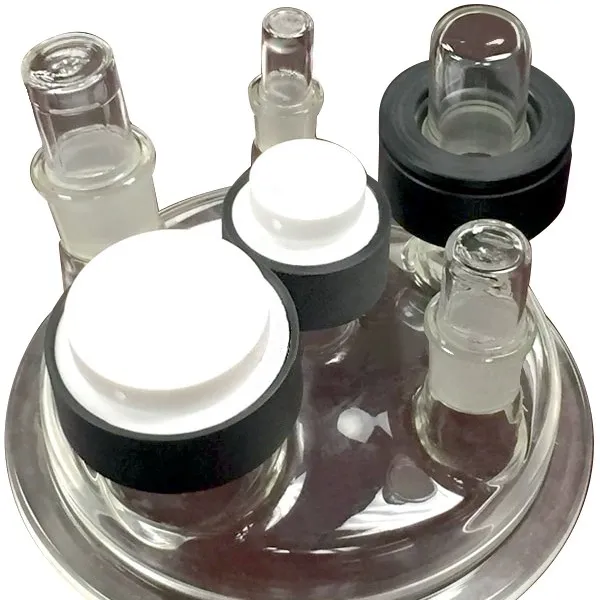


Achieve Chem offers customized reactor components. Talk to our engineers to leverage the customization capabilities.
Experts' Advice on Optimizing and Achieving the Desired Product Quality
Achieving the best results with a chemical synthesis reactor requires complete control over multiple production parameters and professional insights. These steps are specific to 100L glass reactors, which are primarily used for large-scale industrial production.
1. Selection of the Most Suitable Reactor
Base your selection on the production scale, final quality, mixing requirements, reactant types, and temperature/pressure values. Choosing the right equipment assures higher efficiency and lower production cost.
Note: For productions that exceed standard requirements, opt for customized equipment to prevent bottlenecks and lower efficiency.
2. Optimization of Temperature Control
Use jacketed reactors for precise temperature control, which is crucial for heat-sensitive reactants and reactions where temperature is a major contributor to the reaction rate.
3. Mixture Stirring System
The right stirring power and speed can prevent stalling and ensure effective mixing. Therefore, ensure that the stirring system is suitable for the viscosity of the materials being mixed.
4. Application Match Material Compatibility
Choosing the materials, whether glass or stainless steel, should be based on compatibility with the chemicals you'll be using. Borosilicate glass is a popular choice due to its resistance to acids, alkalis, and most organic solvents.
5. Effective Safety Features
Safety features in devices are extremely vital, from safety valves to robust sealing to prevent vacuum leaks. Additionally, monitoring devices and sealing compounds are needed to ensure safe operations under various conditions.
6. On-time Regular Maintenance
Regular and proper maintenance always aids the durability and long-lasting performance of any equipment. Similarly, keeping the reactor clean and well-maintained to prevent contamination and ensure optimal performance is essential.
Need production-specific optimization guidance? Send your production details and get the right guidance from our experts!
Reliable and Long-term Benefits with Achieve Chem
Achieve Chem's ISO-certified manufacturing facilities, backed by reliable, advanced R&D, ensure efficient, high-quality equipment production. Our robust infrastructure, skilled teams, and cutting-edge reactor technology also play a crucial role in helping you achieve optimal performance and faster production cycles.
Why Partner with Achieve Chem:
- Trusted provider with nearly two decades of industry experience (since 2008)
- Proven track record of serving Fortune 500 companies
- Offers both customized solutions and products from an extensive catalog
- Provides end-to-end support, including specifications and consultations
- Ensures seamless delivery for a smooth and reliable procurement process.


FAQs
Ques 1. What customization options are available for the glass reactor with Achieve Chem?
Ans: We provide multiple customization options for our customers. This includes:
- Design support by professionals
- Direct supply of sensor R&D organic intermediate, shortening your time and cost
- High-quality chemical and analysis reagents support
- Advanced technology for purification
- Assistance in Chemical Engineering, such as AutoCAD, Aspen Plus, etc.
Ques 2. What Assurance does Achieve Chem provide?
Ans: We have worked with Fortune 500 companies and hold quality standards certifications, including GMP, CE, and ISO registration. Additionally, Achieve Chem has held a trademark since 2008, adding another layer of assurance and quality control. Lastly, we also offer 1-year free replacement parts with purchase. Contact our support team to get complete details.
Ques 3. Can I use a chemical glass reactor for high-temperature reactions?
Ans: Yes. High borosilicate glass typically tolerates a wide temperature range (for example, −80 °C to around +200 °C) depending on design. The only requirement is to avoid sudden thermal shock and follow the manufacturer's specified temperature and pressure limits of the equipment.
Ques 4. What are some of the advantages of using glass reactors?
Ans: The major advantages include frequency-controlled motor, stable operation, high vacuum, constant-speed stirring, precise temperature control, and efficient distillation. You can use glass reactors effectively for process optimization, as these advantages support their performance.
Ques 5. What options are available for reactors at Achieve Chem?
Ans: Achieve Chem offers a wide range of reactors tailored to production or application needs. Here are a few:
- Single-layer glass reactor
- Jacketed glass reactor
- High-pressure reactor
- Stainless steel reactor
- Hydrothermal Synthesis reactor
- High-temperature reactor
These are a few options from catalogs. However, we are all open to a customizable product manufacturer that fits our application needs. Contact us today and get started on your projects together.