


100-Liter Glass Reactor
Sep 14, 2024
Leave a message
Introduction

In the realm of chemical engineering and pharmaceutical research, reactors play a pivotal role in facilitating various reactions and processes. Among the various types of reactors available, the 100-liter glass reactor stands out as a versatile and reliable tool for conducting experiments and scaling up production processes.
We will talk about the 100-liter glass reactor, exploring its construction, working principles, advantages, applications, and the considerations involved in selecting and operating one.
Understanding the 100-Liter Glass Reactor

A 100-liter glass reactor is a specialized piece of equipment designed for conducting chemical reactions and processes on a relatively large scale. As the name suggests, it has a capacity of 100 liters, making it suitable for a wide range of applications from research and development to pilot-scale production. The primary material of construction is glass, which offers several advantages over other materials such as metal or plastic.
Glass reactors are renowned for their transparency, allowing researchers to observe the reaction mixture directly without the need for sampling or additional instrumentation. This feature is particularly useful during process development, where understanding the behavior of the reaction mixture is crucial. Furthermore, glass is chemically inert, meaning it does not react with most chemicals, ensuring the purity and integrity of the reaction products.
Construction and Design
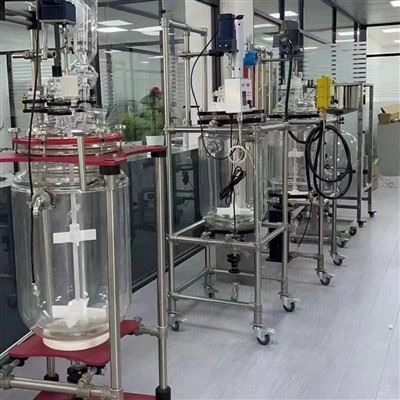
The 100-liter glass reactor typically consists of several key components, each designed to contribute to its overall functionality and efficiency. The main body of the reactor is made from high-quality borosilicate glass, which is known for its exceptional thermal shock resistance and durability. This ensures that the reactor can withstand temperature fluctuations without cracking or breaking.
The reactor is equipped with a jacket surrounding the main body, allowing for the circulation of heating or cooling fluids to maintain the desired reaction temperature. This feature is essential for controlling the rate of the reaction and ensuring reproducibility. The jacket is typically made from stainless steel or other corrosion-resistant materials to withstand the harsh chemicals and temperatures involved.
A stirrer system is integrated into the reactor, typically consisting of a motor-driven impeller that rotates inside the reaction mixture. The stirrer ensures that the mixture is thoroughly mixed, promoting uniform heating and reaction rates. The speed of the stirrer can be adjusted to optimize the mixing efficiency and reaction conditions.
Additionally, the reactor is equipped with various ports and fittings for connecting sensors, sampling ports, and other accessories. These include temperature sensors for monitoring and controlling the reaction temperature, pressure gauges for monitoring the internal pressure, and sampling ports for collecting samples for analysis.
Working Principles
The working principle of the 100-liter glass reactor is relatively straightforward. The reaction mixture is loaded into the reactor through a suitable inlet, and the desired reactants and catalysts are added as necessary. The reactor is then sealed, and the stirrer is activated to mix the mixture.
The heating or cooling jacket is then activated to bring the mixture to the desired reaction temperature. Depending on the reaction conditions, the temperature may need to be maintained within a narrow range to ensure optimal reaction rates and product yields.
As the reaction proceeds, the researcher can observe the mixture through the transparent glass walls and monitor various parameters such as temperature, pressure, and pH using the installed sensors. Samples can be collected periodically for analysis to track the progress of the reaction and identify any issues or deviations from the expected behavior.
Advantages of the 100-Liter Glass Reactor

The 100-liter glass reactor offers several advantages over other types of reactors, making it a popular choice for various applications. Some of the key advantages include:
● Transparency: The use of glass as the primary material of construction allows for direct observation of the reaction mixture, eliminating the need for sampling or additional instrumentation. This feature is invaluable during process development, where understanding the behavior of the reaction mixture is crucial.
● Chemical Inertness: Glass is chemically inert, meaning it does not react with most chemicals. This ensures the purity and integrity of the reaction products, making the 100-liter glass reactor ideal for sensitive reactions and processes.
● Versatility: The reactor can be used for a wide range of reactions and processes, from simple mixing and heating to complex catalytic reactions. Its modular design allows for easy customization and adaptation to specific requirements.
● Scalability: The 100-liter capacity makes the reactor suitable for pilot-scale production, bridging the gap between laboratory-scale research and full-scale industrial production.
● Easy Maintenance: Glass reactors are relatively easy to clean and maintain, ensuring that the reactor remains in optimal condition for future use.
Applications
The 100-liter glass reactor finds applications in various industries and research fields, including but not limited to:
● Pharmaceutical Research: The reactor is widely used in pharmaceutical research for the synthesis of active pharmaceutical ingredients (APIs) and intermediates. Its transparency and chemical inertness make it ideal for conducting sensitive reactions and ensuring the purity of the final products.
● Fine Chemicals: The reactor is also used in the production of fine chemicals, including dyes, pigments, and specialty chemicals. Its versatility allows for the synthesis of a wide range of compounds with varying properties and applications.
● Material Science: Researchers in material science use the reactor for the synthesis of new materials, including polymers, composites, and nanomaterials. The ability to control reaction conditions precisely is crucial for the development of high-performance materials with tailored properties.
● Food and Beverage: The reactor can be used for the processing and formulation of food and beverage products, including flavorings, colorants, and preservatives. Its transparency allows for the direct observation of the reaction mixture, ensuring that the final products meet quality standards.
● Academic Research: Universities and research institutions often use the 100-liter glass reactor for teaching and research purposes. Its user-friendly design and versatility make it an excellent tool for introducing students to the principles of chemical engineering and reaction kinetics.
Conclusion
The 100-liter glass reactor is a versatile and reliable tool for conducting chemical reactions and processes on a relatively large scale. Its transparency, chemical inertness, and scalability make it an excellent choice for various applications, including pharmaceutical research, fine chemicals, material science, and food and beverage processing.
When selecting and operating a 100-liter glass reactor, it is essential to consider the specific reaction conditions, safety features, ease of use and maintenance, customization options, and vendor reputation to ensure optimal performance and safety. With its many advantages and applications, the 100-liter glass reactor is an invaluable asset for researchers and engineers in various industries and research fields.
