1.Laboratory Freeze Dryer:
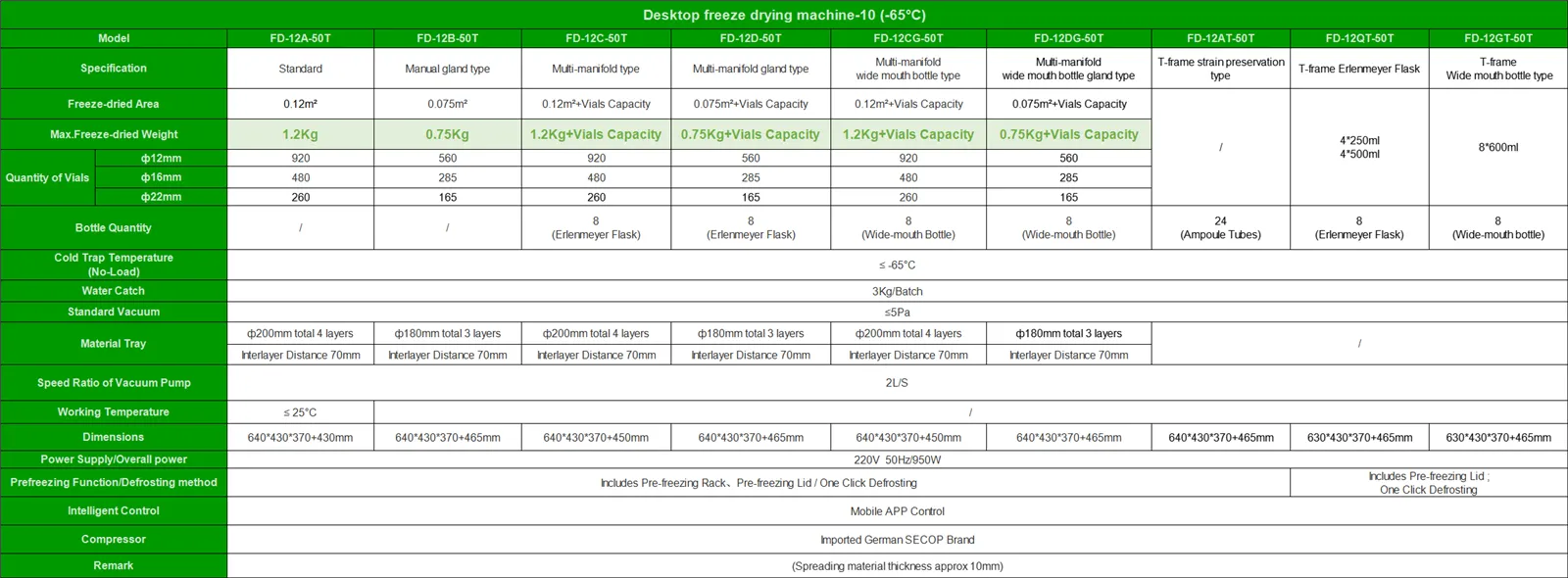
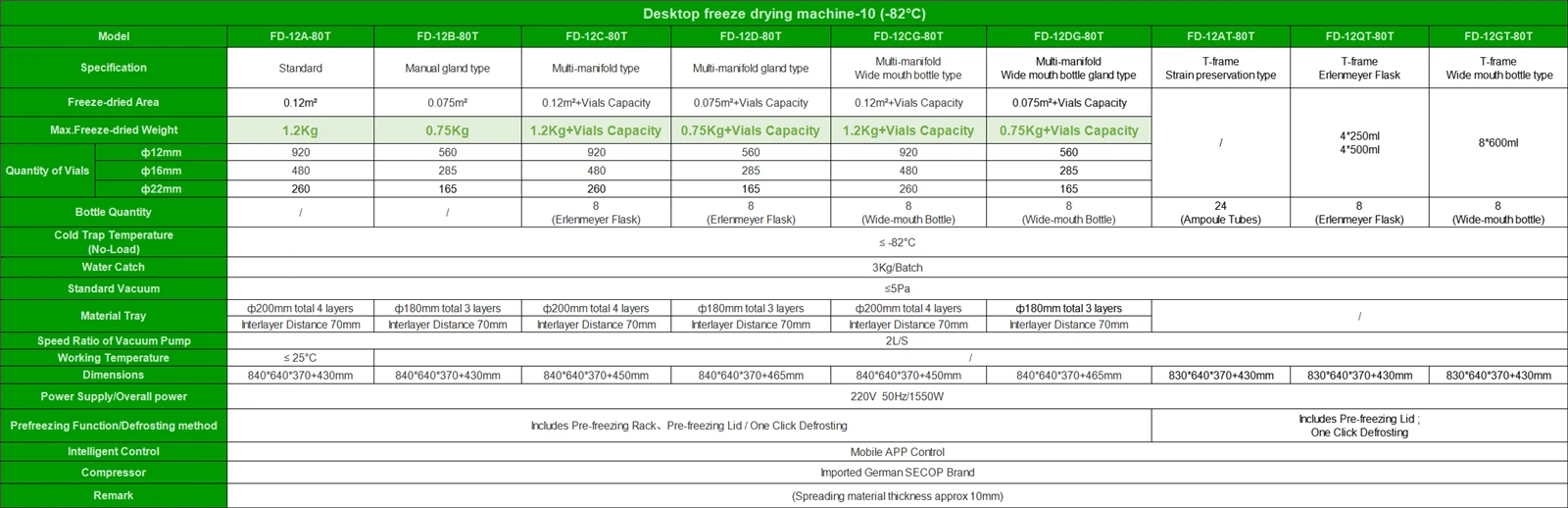
(a)10 series
Lab Scales Desktop(Freeze-dried material 1.5-2KG)
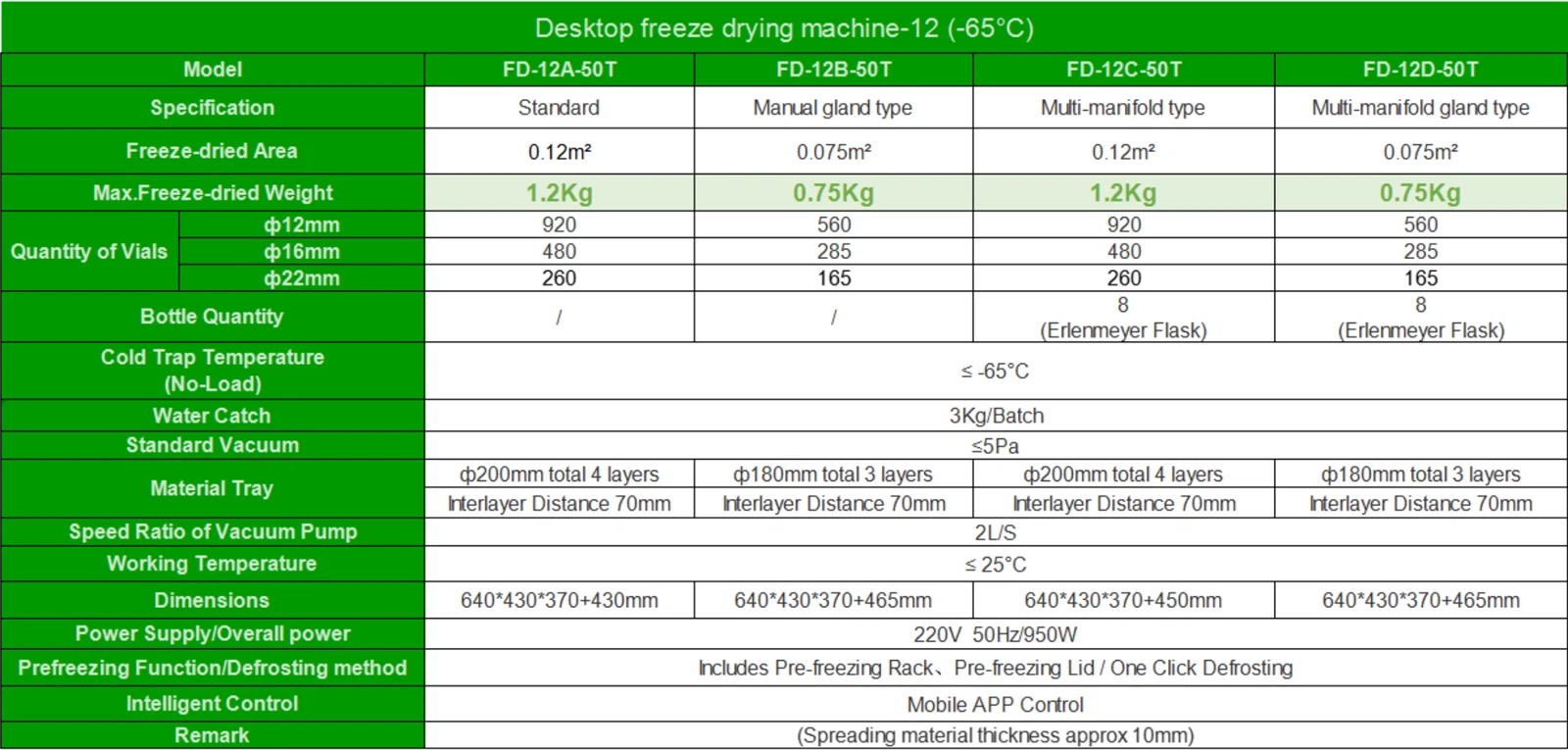
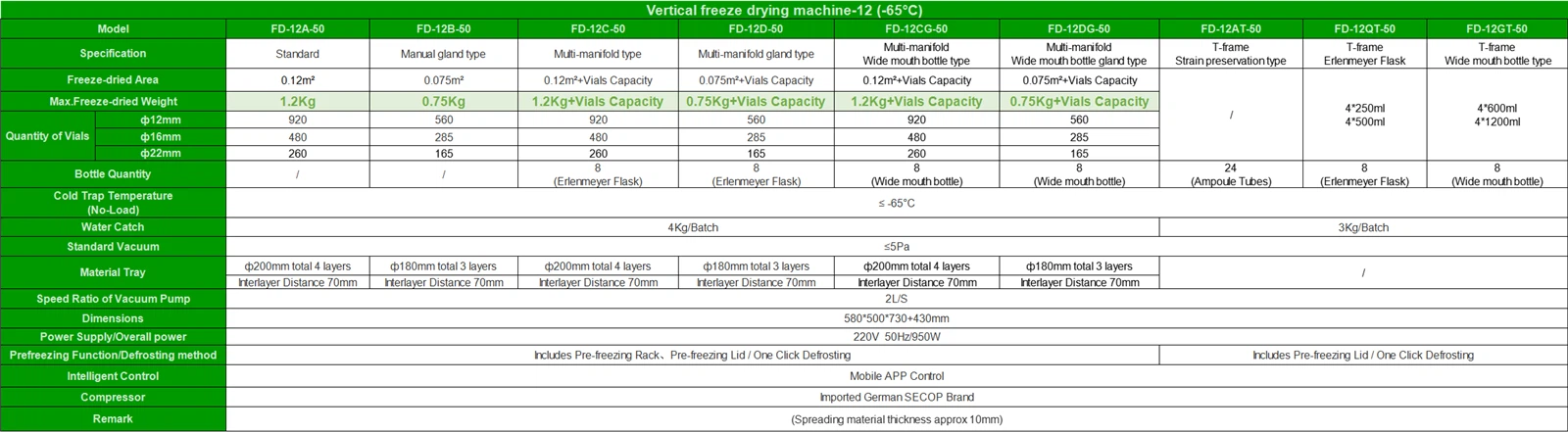
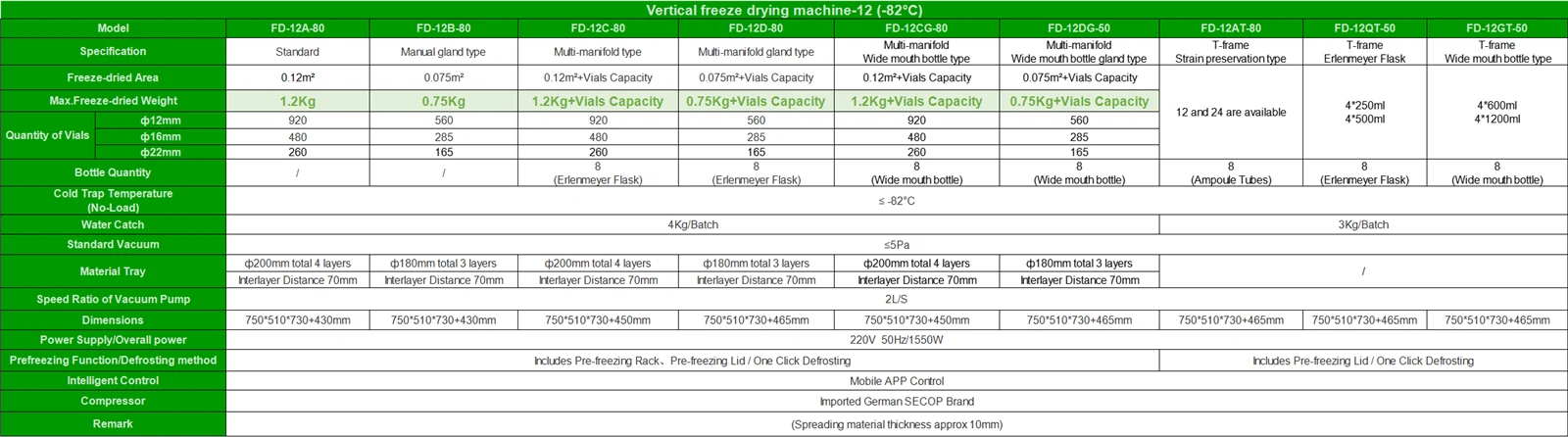
(b)12 series
Lab Scales Vertical(Freeze-dried material 2KG)
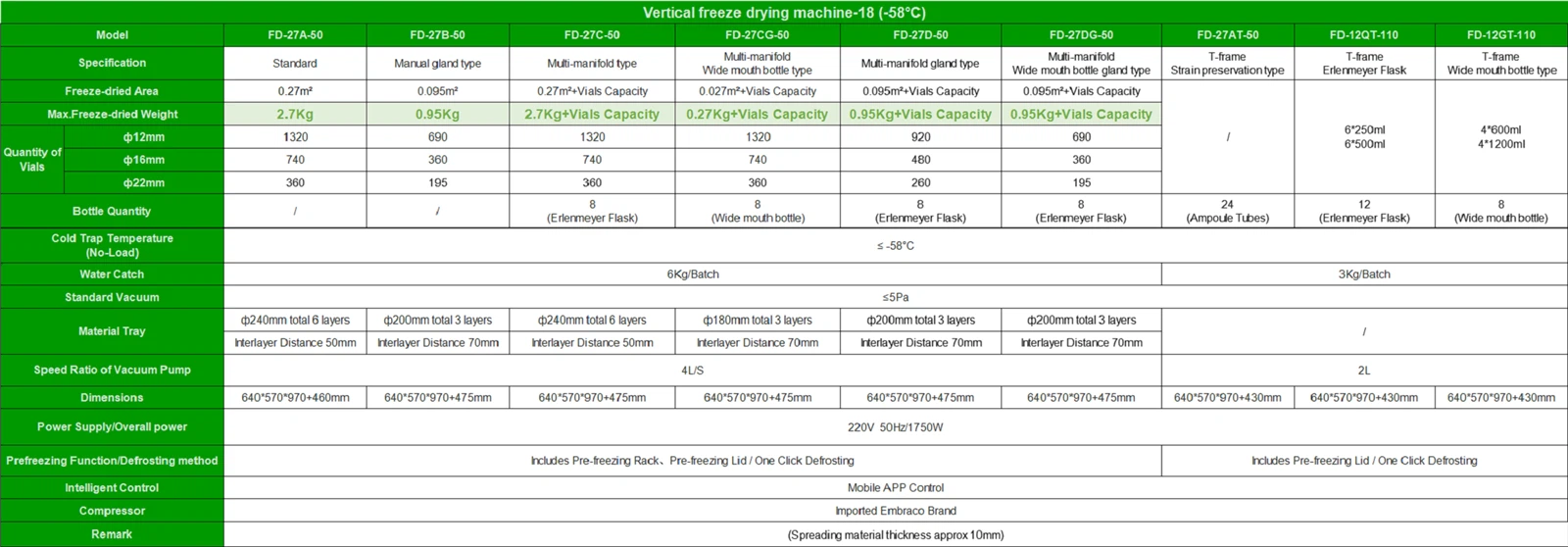
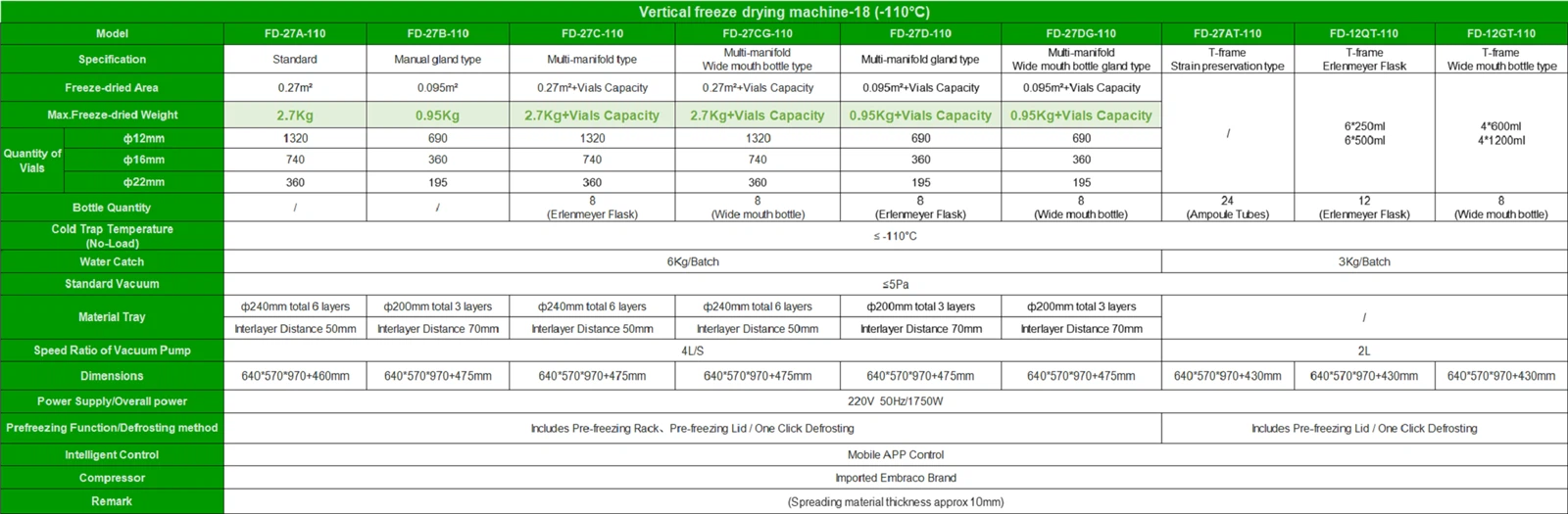
(c)18 series
Scientific Research Scales(Freeze-dried material 3KG)
2.Pilot Freeze Dryer:
0.2m²/0.3m²/0.5m²/1m²/2m²/---Pilot Scales(Freeze-dried material 3KG-20KG)
3.Industrial Freeze Dryer:
5㎡/10㎡/20㎡/30㎡/50㎡/100㎡/200㎡/300㎡(Freeze-dried Weight 5T~60T)
4.Customization: set up the specifications you need
(a)Freeze-dried Area
(b)Freeze-dried Weight
(c)Freeze-dried Material
(d)Interlayer Quantity/Size
(e)Cold Trap Temperature
The Freeze Dry Machine Small achieves rapid, efficient, and high-quality drying of materials through steps such as low-temperature freezing, vacuum sublimation, and condensation discharge. Advanced freeze-drying technology is adopted, which can effectively remove moisture from materials in a short period of time, greatly reducing drying time. Meanwhile, due to its efficient heat conduction and vacuum system, it can reduce energy consumption and achieve energy-saving effects. Its portability design allows this device to be used in various scenarios, especially in situations that require rapid drying and limited space, such as field investigations, emergency rescue, etc. In terms of exterior design, it has multiple characteristics such as compact appearance, lightweight materials, user-friendly operation interface, stable structure, and environmentally friendly materials. These characteristics make the device not only have efficient and convenient drying functions, but also have excellent performance such as aesthetics, lightness, and ease of use, providing users with more convenient and efficient drying solutions.
We provide Freeze Dry Machine Small, please refer to the following website for detailed specifications and product information.
Freeze Dry Machine Smalloperate using the principles of low-temperature evaporation and sublimation.
Throughout the entire drying process, the portable freezedrying machine also provides appropriate heat through a heating system to accelerate the sublimation process of ice crystals. This heating can be intermittent or continuous, depending on the properties of the material and drying requirements.
The product the moisture in the material to be processed into ice crystals through its freezing system. This step utilizes the principle of low-temperature freezing, allowing the moisture in the material to form solid ice at low temperatures.
Enter the drying stage. In a vacuum environment, a portable freezedrying machine gradually reduces the pressure inside the chamber through its vacuum system. As the pressure decreases, ice crystals begin to sublime directly into water vapor without passing through the liquid state. This process is called sublimation and is the core of freezedrying technology.
The basic principle of laboratory freeze-drying machine
Laboratory freeze-drying machine, the full name of vacuum freeze-drying machine, its basic principle is based on the change of three states of water. Water exists in nature in three forms: solid, liquid and gas, and under certain temperature and pressure conditions, these three forms can be converted into each other and coexist. Freeze-drying machine is the use of this principle, in the state of high vacuum, through sublimation, so that the water in the pre-frozen material does not go through the liquid stage, directly sublimed from solid to gas, so as to achieve the purpose of drying.
Specifically, the lyophilization process includes three stages: freezing, sublimation and analytical drying. In the freezing stage, the sample is exposed to low temperatures so that the water inside it gradually solidifies into ice crystals. This step is usually performed in the temperature range of -40 ° C to -60 ° C to ensure that all the moisture in the sample can be converted to solid ice. Subsequently, in the sublimation stage, the sample is transferred to a vacuum drying chamber, where the ice crystals directly change from solid to gas (i.e., sublimation) without going through the liquid phase. This process needs to be carried out at a low pressure (usually less than 100Pa) and at an appropriate temperature (close to the sublimation point of ice, about -25 ° C to 0 ° C) to promote the rapid sublimation of water molecules. Finally, in the analytical drying stage, the temperature is further increased and the pressure is reduced to promote the further sublimation and removal of residual moisture in the sample to obtain a completely dried sample.
Product Features
As an efficient and convenient drying equipment, freeze Dry Machine Small have significant external design features, which are not only reflected in their compact appearance and lightweight materials, but also in their humanized operating interface, stable structure, and environmentally friendly materials.
◆ Environmentally friendly material selection:In terms of material selection, portable freezedrying machines also fully consider environmental factors. The equipment adopts environmentally friendly materials, such as recyclable metal materials, non-toxic and harmless plastics, to reduce environmental pollution during use. At the same time, the equipment also adopts low energy consumption refrigeration technology and energy-saving control system, reducing the energy consumption and carbon emissions of the equipment, in line with the development concept of modern green environmental protection.
◆ Diverse interface design:Portable freezedrying machines also have diverse interface designs to meet the needs of different users. Devices are usually equipped with multiple standard interfaces, such as USB interface, power interface, data interface, etc., to facilitate users to connect and transfer data with other devices. This diverse interface design enables devices to have stronger scalability and compatibility, and can meet the usage needs of different users in different scenarios.
◆ Compact exterior design
The portable freezedrying machine adopts a compact exterior design, making the overall size small and easy to carry and transport. This design not only reduces the footprint of the equipment, but also allows for more equipment to be accommodated within a limited space, improving space utilization. At the same time, the compact exterior design also conforms to modern aesthetic concepts, making the appearance of the equipment more beautiful and generous.
◆ Lightweight material applications
In order to reduce the weight of the equipment, portable freeze-drying machines use lightweight materials in material selection. These materials have the characteristics of light weight, high strength, and corrosion resistance, which can reduce the overall weight of the equipment while ensuring the structural strength and stability of the equipment. The application of lightweight materials not only facilitates the carrying and movement of equipment, but also reduces transportation costs and improves the portability of equipment.
◆ Humanized operation interface
The operation interface design of the portable freeze-drying machine fully considers the user's usage habits and needs, and adopts an intuitive and concise design approach. The layout of buttons and indicator lights on the operation interface is reasonable, easy to recognize and operate. At the same time, the device is also equipped with an intelligent control system, which can achieve one click operation, simplify the operation process, and reduce the difficulty of operation. This humanized design allows users to easily master the usage of the device even without professional skills.
◆ Stable structural design
Although portable freezedrying machines pursue lightweight and compactness, their structural design is still very stable. The equipment adopts high-quality materials and advanced manufacturing processes to ensure tight and firm connections between various components. At the same time, the equipment is also equipped with safety measures such as shock resistance and anti slip, which can maintain stable operation in harsh environments. This stable structural design not only ensures the safety performance of the equipment, but also improves its service life.
Technical features:
There are significant differences between portable freezedrying machines and other drying machines in multiple aspects. Here are some of the main differences between them:
Operation and portability:
Freeze Dry Machine Small: compact and lightweight in design, easy to carry and move. It usually has a simple operating interface and one click operation functions, making it easy for users to master and use. This portability makes it suitable for scenarios that require rapid deployment and movement, such as field investigations and emergency rescue. Other dryers: usually have a large volume and are not easy to move. The operation may be relatively complex and require certain professional skills and experience. They are more suitable for large-scale or continuous drying operations in fixed workplaces.
Drying effect and material protection:
Portable freeze-drying machine: capable of retaining the original color, aroma, taste, and nutritional components of materials to the greatest extent possible, especially for heat sensitive materials and bioactive substances. The freezedrying process is carried out at low temperatures, avoiding the damage of high temperatures to the materials. Other dryers: The drying effect may vary depending on the type of material and drying conditions. High temperature drying may cause damage or denaturation of certain components in the material, especially for heat sensitive materials.
Energy consumption and environmental protection:
Portable freeze-drying machine:Although its energy consumption varies by model and scale, overall, it adopts advanced refrigeration technology and energy efficiency optimization measures, resulting in relatively low energy consumption. Meanwhile, due to the absence of exhaust gas and wastewater during the drying process, it meets environmental protection requirements. Other dryers: Energy consumption varies depending on type and scale. Some traditional dryers may have high energy consumption and may produce waste gas and wastewater during the drying process, which can have a certain impact on the environment.
Hot Tags: freeze dry machine small, China freeze dry machine small manufacturers, suppliers, factory