



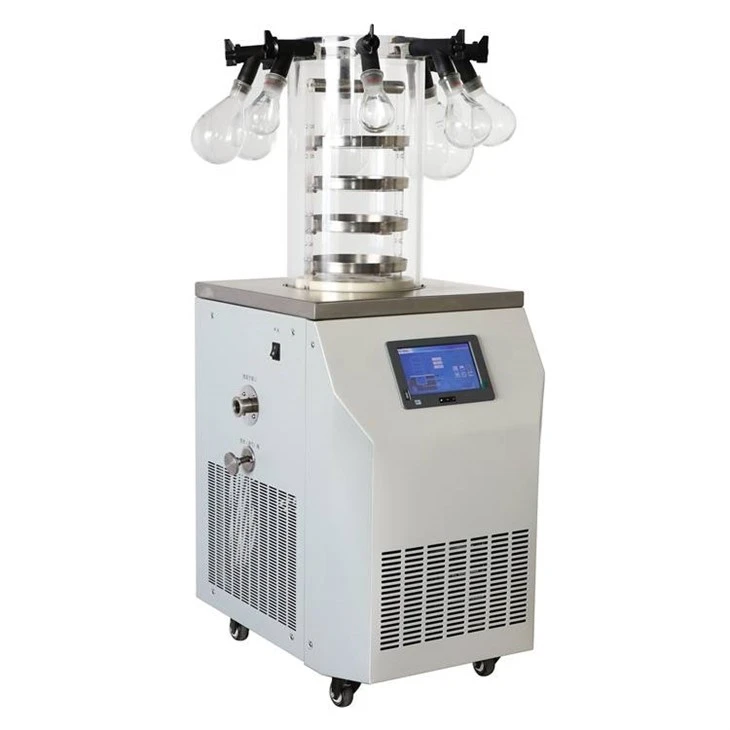


Portable Freeze Dryer
(a)10 series
Lab Scales Desktop(Freeze-dried material 1.5-2KG)
(b)12 series
Lab Scales Vertical(Freeze-dried material 2KG)
(c)18 series
Scientific Research Scales(Freeze-dried material 3KG)
2.Pilot Freeze Dryer:
0.2m²/0.3m²/0.5m²/1m²/2m²/---Pilot Scales(Freeze-dried material 3KG-20KG)
3.Industrial Freeze Dryer:
5㎡/10㎡/20㎡/30㎡/50㎡/100㎡/200㎡/300㎡(Freeze-dried Weight 5T~60T)
4.Customization: set up the specifications you need
(a)Freeze-dried Area
(b)Freeze-dried Weight
(c)Freeze-dried Material
(d)Interlayer Quantity/Size
(e)Cold Trap Temperature
Description
Technical Parameters
Portable Freeze Dryer is a device used to lyophilize (i.e.,freeze-dry) food,medicines,and other objects.It utilizes the principles of freezing and sublimation to remove water from objects for long-term preservation and retention of original properties.Freeze-drying technology can be traced back to the beginning of the 20th century,when it was mainly used for drug manufacturing and preservation.With the development of science and technology,freeze drying technology has been further improved and applied,and gradually expanded to food processing,cosmetics,plant seed preservation and other fields.Freeze dryers are currently categorized according to industry into equipment such as biopharmaceutical freeze dryers,food freeze dryers and new material freeze dryers.


Freeze dryer usually consists of refrigeration system,vacuum system,circulation system,material bin,condenser and control system.The refrigeration system is used to freeze the material at low temperature and control the temperature,the vacuum system makes the freeze-drying chamber form a vacuum environment through the vacuum pump group,the circulating system is a circulating supply system for the heat exchange of the material in the chamber,the condenser traps the water vapor,and the control system is used to set the pre-frozen temperature,the vacuum,the running time and other freeze-drying process data as well as to monitor and regulate the whole freeze-drying process.
Product Parameter
10 Series Laboratory Freeze Dryer


12 Series Laboratory Freeze Dryer


18 Series Laboratory Freeze Dryer


Product Benefits
|
|
|


-
Easy operation: portable freeze dryer adopts intelligent control system,simple and intuitive design,the operation interface is usually clear,the user can easily set drying parameters without professional training, to achieve one-button operation,greatly simplifying the operation process.
-
Portability: Portable lyophilizer is compact in design and light in weight,easy to carry and move.This makes it especially suitable for outdoor adventure,traveling or temporary laboratory use.
-
Wide range of application: the Portable Lyophilizer is suitable for drying a variety of materials,such as pharmaceuticals,food,chemical raw materials,etc.,which can meet the needs of different users.
-
Good effect: It adopts vacuum drying technology,which can effectively retain the nutrients and active ingredients of the materials,while avoiding oxidation and deterioration of the materials to ensure the drying effect.
-
Energy saving and high efficiency: Portable Lyophilizer usually adopts advanced freeze drying technology,which can complete the drying process in a shorter time,while keeping low energy consumption.This helps to save energy and reduce costs.
-
Convenient maintenance: portable freeze dryer has simple structure,easy to maintain,users can carry out routine maintenance and repair by themselves to extend the service life of the equipment.
Products FAQS
Unstable supply voltage
◆ Problem:The lyophilizer may not work properly or operate erratically.
◆ Reason:The power supply voltage deviates from the normal working range of the freeze dryer.
◆ Solution:Check the power supply voltage,if the voltage is unqualified, replace the qualified power supply;if the voltage is not stable,you can use AVR (220V) or add a voltage regulator to the original working power supply.
Poor cooling effect
◆ Problem:The freeze dryer cools slowly or fails to reach the preset temperature.
◆ Reason:It may be caused by high ambient temperature,too much condenser dust or condensing fan not working properly.
◆ Solution:Make sure the environment temperature is suitable,clean the dust on the condenser regularly,check and repair the condensing fan.
Insufficient vacuum
◆ Problem:The lyophilizer cannot reach the required vacuum degree.
◆ Reason:It may be the failure of vacuum pump,leakage of vacuum pipe or aging of seals.
◆ Solution:Check and repair the vacuum pump,check whether the vacuum pipeline and seals are intact,and replace them if necessary.
Material drying is not uniform
◆ Problem: The degree of drying of the material after freeze-drying is not uniform.
◆ Reason: Uneven material placement, uneven tray or uneven temperature distribution inside the freeze dryer.
◆ Solution: Ensure that the material is placed evenly,use a flat pallet, and check the temperature distribution inside the freeze dryer and adjust if necessary.
The operation interface is abnormal
◆ Problem: The operation interface displays errors or fails to respond.
◆ Cause: The operation interface may be damaged,power line problem or control system failure.
◆ Solution: Check whether the power line is connected normally and try to restart the lyophilizer;if the problem persists, it may be necessary to contact a professional for repair or replacement of the operation interface.
Excessive noise
◆ Problem: The noise exceeds the normal range when the freeze dryer is running.
◆ Reason: It may be that the fan, compressor or pump and other parts are not working properly or are not installed stably.
◆ Solution: Check and repair the relevant parts to ensure they are installed securely and work properly.
Maintenance of products
● Maintenance of refrigeration system
Daily routine inspection
The inspection contents are mainly:
Whether all the valves that should be opened are open.
compressor pressure is within the normal range.
whether the pressure and temperature of cooling water is normal.
Whether the oil return and oil level of the compressor are normal.
Whether the sound of compressor operation is normal.
Whether the refrigeration pipeline produces abnormal vibration.
compressor and expansion valve frost conditions.
Inspection of abnormalities found in the situation,should find out why,timely treatment,to eliminate potential accidents.
when not used for a long time should be refrigerant income condenser to prevent refrigerant leakage,in the production process should be often leak detection of the refrigeration system to ensure that leaks are found in a timely manner,such as refrigerant is insufficient,it should be charged in a timely manner,so as not to affect the normal operation of the equipment.
● Maintenance of vacuum system
The maintenance of the vacuum system is a crucial step in ensuring the smooth progress of the freeze-drying process and extending the service life of the equipment.The vacuum system is mainly composed of a vacuum pump and its supporting equipment,and its performance directly affects the freeze-drying efficiency and product quality.
The Importance of Vacuum System Maintenance
During the freeze-drying process,the main function of the vacuum system is to reduce the pressure inside the drying chamber,allowing water molecules to sublime directly from solid (ice) to gaseous state,thereby avoiding adverse phenomena such as deformation,collapse,or color change of the material during the drying process.Therefore,maintaining the good operating condition of the vacuum system is crucial for obtaining high-quality freeze-dried products.
Maintenance steps and precautions
(1) Regularly replace the vacuum pump oil
Purpose:
Vacuum pump oil is an important medium for the normal operation of vacuum pumps,which plays a role in lubrication,sealing,and cooling. As the usage time increases, the pump oil will gradually oxidize, deteriorate, and even mix impurities,thereby affecting the performance of the vacuum pump. Therefore, regular replacement of vacuum pump oil is a necessary measure to maintain the performance of the vacuum system.
Cycle:
The replacement cycle should be determined based on the frequency of use and working environment of the vacuum pump,and it is generally recommended to replace it every six months to one year.
Attention:
When replacing the pump oil,ensure that the inside of the pump body is clean to avoid contamination of the new oil;At the same time,the pump oil model that meets the equipment requirements should be selected to ensure the performance and service life of the pump.
(2) Check the oil level
Purpose:
To ensure that the oil level of the vacuum pump is normal before starting,in order to avoid poor lubrication and seal failure caused by low oil level.
Method:
Observe the oil level through the sight glass,usually at around 1/2 of the sight glass position.If the oil level is too low, the pump oil should be replenished in a timely manner; If the oil level is too high, excess pump oil should be drained to maintain the appropriate oil level.
Attention:
When checking the oil level,ensure that the equipment is in a shutdown state to avoid safety accidents caused by misoperation.
(3) Preparation before vacuuming
Purpose:
To ensure the dryness of the rear box and prevent water vapor from entering the pump body,which may affect the pumping efficiency and lifespan of the vacuum pump.
Step:
Before starting the vacuum pump for vacuuming,check whether the materials in the drying chamber have completely frozen and ensure that the rear box door is well sealed. Meanwhile,the rear box can be pre treated with preheating or dehumidification equipment to further reduce the water vapor content.
Attention:
During the vacuum pumping process, close attention should be paid to the changes in vacuum degree,and any abnormal situations should be detected and dealt with in a timely manner. In addition, the vacuum system should be regularly cleaned and maintained to remove dirt and impurities attached to the pump body and pipelines.
Performance parameter
|
◆ Condensation temperature: 1) The condensing temperature is the temperature of the cold trap in the freeze dryer to capture the water vapor that sublimes out of the item. 2) In general,the lower the condensing temperature,the stronger the water capturing capacity of the equipment. 3) For example,some models of portable freeze-dryers can reach a condensation temperature of -70 ° C or even lower.
◆ Temperature control range: 1) Temperature control range refers to the operating temperature range that the device can control. 2) The temperature control range of some devices may vary from -30 ° C to +60 ° C,depending on the model and use. |
|
|
|
◆ Ultimate vacuum degree: 1) The ultimate vacuum degree is the lowest gas pressure that the equipment can achieve in the no-load state. 2) The higher the vacuum,the lower the gas pressure inside the equipment,which is conducive to the sublimation and removal of water. 3) Common limiting vacuum degrees may reach 3Pa or less,while some high-end devices may reach 1Pa or less.
◆ Freeze-dried area: 1) The freeze-dried area is the effective area in the equipment used to place items for drying. 2) A larger area usually means a larger number or volume of items that can be handled. 3) Common freeze-dried areas may range from 0.18㎡ to 0.4㎡. |
|
◆ Water capture capacity: 1) Water capture capacity refers to the amount of water vapor that a device can capture in a 24-hour period. 2) The stronger the water capture capacity,the more items the device can handle per unit time or the higher the water content in the item. 3) Common water capture capacities may range from 5kg/24h to 6kg/24h.
◆ Power requirements: 1) Power requirements include parameters such as voltage,frequency,and power. 2) Different models of portable freeze dryers may have different power requirements.Therefore,before using the portable freeze dryers,check whether the power parameters of the device are consistent with the local power supply. |
|
|
|
◆ Host size and weight: 1) The size and weight of the host determine the portability and ease of use of the device. 2) Some devices may be designed for compact size and light weight to be easy to carry and move;Other devices may be larger and heavier,but offer more power and higher performance.
◆ Other parameters: Also included are sample tray size,number of material trays,material tray spacing,cold trap depth,cold trap diameter,pumping rate and other parameters,which may also vary depending on the device model and use. |


Technical challenges and solutions
Although portable vacuum freeze dryers show great potential, their development still faces some technical challenges:

Energy supply issues
In outdoor environments, a stable power supply is a challenge. To solve this problem, more efficient battery systems can be developed, such as the use of high-capacity lithium batteries or solar charging technology to extend the use of equipment in outdoor environments. At the same time, designing a low-power operating mode is also key.

Miniaturization and efficiency of vacuum systems
Portable devices require that vacuum systems be miniaturized and remain efficient. Therefore, it is necessary to develop high-precision temperature sensors and intelligent temperature control algorithms to achieve accurate control and rapid response to the internal temperature of the equipment.

Noise and vibration control
When used outdoors, the noise and vibration of the equipment may have an impact on the surrounding environment. Therefore, it is necessary to consider noise and vibration control measures in the design process, such as the use of low noise motor, optimization of equipment structure.
Hot Tags: portable freeze dryer, China portable freeze dryer manufacturers, suppliers, factory
Previous
Dry Freezer MachineNext
Lab LyophilizerSend Inquiry


