



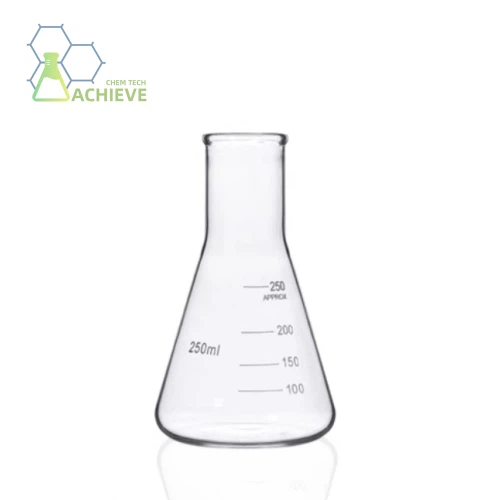

Small Erlenmeyer Flask
1) Narrow-mouth Bottle: 50ml~10000ml;
2) Big B Bottle: 50ml~3000ml;
3) Horn Mouth: 50ml~5000ml;
4) Wide-mouth Bottle: 50ml/100ml/250ml/500ml/1000ml;
5) Conical Flask With Cover: 50ml~1000ml;
6) Screw Conical Flask:
a. Black Lid (General Sets): 50ml~1000ml
b. Orange Lid (Thickening Type): 250ml~5000ml;
2. Single and Multi-mouth Round Bottom Flask:
1) Single Mouth Round Bottom Flask: 50ml~10000ml;
2) Inclined Three-mouth Flask: 100ml~10000ml;
3) Inclined Four-mouth Flask: 250ml~20000ml;
4) Straight Three-mouth Flask: 100ml~10000ml;
5) Straight Four-mouth Flask: 250ml~10000ml.
***Price List for whole above, inquire us to get
Description
Technical Parameters
The Small Erlenmeyer Flask, a staple in chemical laboratories worldwide, is a versatile and indispensable piece of glassware. Known for its distinctive shape and robust construction, this flask offers a multitude of advantages that make it a favorite among scientists and researchers.
Crafted from high-quality borosilicate glass, which exhibits exceptional durability and chemical resistance. Its ability to withstand a wide range of temperatures, from the intense heat of a bunsen burner to the extreme cold of an ice bath, ensures it remains intact and functional under various experimental conditions. This thermal stability is particularly crucial for reactions that require precise temperature control.
The flask's design is a masterpiece of functionality. The wide base provides a stable foundation, minimizing the risk of accidental tip-overs, especially when handling volatile or hazardous chemicals. The narrow neck facilitates easy pouring and minimizes evaporation, preserving the integrity of experimental samples. The ground glass joint at the neck ensures a secure and leak-proof connection to other laboratory equipment, such as reflux condensers or stopcocks, enhancing its versatility in various experimental setups.
Moreover, the smooth surface of the glass allows for thorough cleaning and sterilization, safeguarding against cross-contamination between experiments. This chemical inertness also preserves the purity of samples, ensuring accurate analytical results.
Parameter list


Overview of overall structure
The product is mainly composed of three basic parts: a conical bottom, a long neck, and a wide mouth. This design gives conical bottles unique advantages and application value in chemical experiments.
Conical bottom
Shape and Function
The conical bottom is one of the most prominent features of the Flask. Its bottom is wider and gradually narrows upwards to the long neck. This design not only increases the stability of the flask, preventing it from tipping over during stirring or heating, but also allows the flask to hold more liquid and facilitates the addition and dissolution of solid reagents.
Material
The conical bottom is usually made of high-quality glass to withstand corrosion from various chemical reagents and high temperature heating. The selection of glass material ensures the durability and reliability of the conical bottle.
Long neck
Shape and Function
The long neck is a bridge connecting the conical bottom and wide mouth, with a moderate length that facilitates experimental operations and reduces liquid evaporation. The design of the long neck allows steam and bubbles to rise and escape smoothly during heating or stirring, avoiding the risk of liquid splashing out. Meanwhile, the long neck also facilitates the insertion of experimental tools such as stirring rods, thermometers, or burettes, making experimental operations more flexible and precise.
Material and Craftsmanship
The long neck part is also made of glass material and undergoes fine processing technology to ensure a smooth and flawless surface, reducing resistance during the experimental process.
Wide mouth
Shape and Function
The wide mouth is the opening part of the bottle, with a relatively large diameter, which is convenient for feeding, mixing, and cleaning. The wide mouth design allows experimenters to easily add solid reagents, pour liquids, or perform other operations, improving experimental efficiency. Meanwhile, the wide mouth also facilitates the use of cleaning tools such as brushes or sponges for cleaning and disinfection, ensuring the hygiene and safety of the conical bottle.
Edge treatment
In order to enhance the durability and safety of the wide mouth, it is usually smoothed or protected by a protective cover on its edges. This can prevent the hands of the experimenter from being damaged or scratched due to collision or friction during the experiment.
Special Structure & Function
Scale marking
Some conical bottles will be marked with scale lines on their surface for laboratory personnel to accurately measure the volume of the liquid. These scale lines are usually precisely calibrated to ensure the accuracy of measurement results.
Sealing cap
To prevent liquid evaporation or contamination, some conical bottles are equipped with sealing caps. Sealing covers are usually made of glass or plastic and designed with structures such as threads or buckles to ensure sealing effectiveness.
Heating sleeve
In experiments that require heating, a heating sleeve can be used to wrap the conical bottle for heating. Heating sleeves are usually made of high-temperature resistant materials and designed with temperature control devices to ensure uniformity and stability of heating temperature.
Uses in the Laboratory
Small erlenmeyer flask, As a fundamental and multifunctional glassware in chemical laboratories, it plays an indispensable role in a wide range of applications, from simple solution preparation to complex chemical reactions. We will elaborate on the basic usage steps of Flask in chemical experiments, covering preparation, operation, recording, and subsequent processing.
Preparation stage
- Capacity selection:
Choose the appropriate capacity according to the experimental requirements. Generally speaking, the capacity of small conical bottles ranges from tens of milliliters to hundreds of milliliters, ensuring that the selected conical bottle can hold all the liquid required for the experiment while leaving enough space to avoid overflow.
- Material inspection:
Check whether the conical bottle is intact, without cracks or scratches. Glass conical bottles should have high transparency for easy observation of experimental phenomena.
- Cleanliness:
Ensure that the conical bottle is thoroughly cleaned and free of residue before use. This can be achieved through steps such as washing with detergent, rinsing with distilled water, and drying.
- Weighing solid reagents:
Use a balance to accurately weigh the required solid reagents and prepare liquid reagents. For reagents that are easily hygroscopic or volatile, appropriate protective measures should be taken.
- Safe storage:
Properly store the weighed reagents in designated locations, away from sources of fire and heat, to avoid cross contamination.
- Mixing rod:
Choose a suitable mixing rod according to the experimental needs, such as a glass rod or a magnetic stirrer.
- Temperature gauge:
For experiments that require temperature control, the temperature gauge should be prepared and calibrated for accuracy.
- Heating equipment:
Such as electric heating sleeves, oil bath pots, or water bath pots, choose the appropriate heating method according to experimental requirements.
- Other tools:
Such as droppers, pipettes, funnels, etc., prepare corresponding auxiliary tools according to experimental needs.
Operation phase
- Feeding sequence:
Determine the feeding sequence according to the experimental steps and reagent properties. Generally speaking, solid reagents should be added first, followed by liquid reagents. For experiments that involve intense reactions or release a large amount of heat, the reagents should be slowly added and the experimental phenomena should be observed carefully.
- Mixing evenly:
Use a stirring rod or magnetic stirrer to mix the reagents evenly. When stirring, avoid splashing the liquid or touching the bottom and wall of the conical bottle with the stirring rod.
- Heating operation:
Place the conical flask on the heating device and adjust the heating temperature and time as needed. For experiments that require precise temperature control, a thermometer should be used to monitor and adjust the heating equipment. During the heating process, attention should be paid to observing experimental phenomena to avoid liquid boiling, overflow or danger.
- Cooling operation:
After heating is completed, choose the appropriate cooling method according to the experimental requirements. Such as natural cooling, water bath cooling, or ice bath cooling. During the cooling process, attention should be paid to maintaining the stability of the conical flask to avoid tipping or damage.
- Titration operation:
For experiments that require titration, a dropper or pipette should be used to slowly drip the titrant into a conical flask, while stirring the solution with a stirring rod. During the titration process, attention should be paid to controlling the titration speed and observing the color change of the indicator to determine the titration endpoint.
- Reaction observation:
During titration or reaction processes, experimental phenomena such as color changes, precipitation generation, gas release, etc. should be closely observed, and relevant data and phenomena should be recorded.
Record & observe
- Volume recording:
When using conical bottles with scale markings, the volume changes before and after feeding should be accurately recorded.
- Temperature recording:
For experiments that require temperature control, temperature data should be regularly recorded to evaluate the heating effect.
- Phenomenon recording:
Detailed recording of various phenomena during the experimental process, such as color changes, gas generation, precipitation formation, etc.
- Color change:
Observing the color change of a solution is one of the important criteria for determining the degree of reaction. Standard color cards or spectrophotometers should be used for accurate measurement and recording.
- Gas generation:
Pay attention to observing whether there is gas generation and the nature and quantity of the gas. Appropriate protective measures should be taken for toxic or flammable gases.
- Precipitation formation:
Observe the characteristics of precipitation formation rate, morphology, and color to infer the reaction mechanism and product properties.
Subsequent processing
- Preliminary cleaning:
Pour the waste liquid from the small erlenmeyer flask into the waste liquid tank, and then rinse the inside and outside of the conical flask with distilled water to remove most of the residue.
- Deep cleaning:
For residues that are difficult to clean or residues of special reagents, appropriate detergents or solvents can be used for deep cleaning. When cleaning, attention should be paid to avoiding damage to the surface and markings of the conical bottle.
- Drying treatment:
Invert the cleaned conical flask on a drying rack and let it dry naturally or use a hair dryer or other tools to blow dry it. After drying, it should be stored in a dry and ventilated place to avoid moisture and pollution.
- Waste liquid treatment:
Collect and store the waste liquid generated during the experimental process according to relevant regulations. Special treatment measures should be taken for toxic and harmful waste liquids to ensure that they do not pose a threat to the environment and human health.
- Solid waste disposal:
Classify and dispose of solid waste generated during the experimental process, such as filter paper, cotton, etc., according to relevant regulations. Recyclable solid waste such as metal catalysts should be recycled and reused.
- Organize the experimental bench:
Clean up the used instruments and tools and place them in the designated location for future use. At the same time, clean up the debris and garbage on the experimental platform to maintain its cleanliness and hygiene.
- Check instrument status:
Check if all instruments are intact and in good condition. Damaged or malfunctioning instruments should be promptly repaired or replaced to ensure the safety and accuracy of the experiment.
The flask's design embodies a perfect blend of form and function. Its wide base ensures stability, preventing accidental tip-overs, especially crucial when handling volatile or hazardous chemicals. The narrow neck facilitates easy pouring and minimizes evaporation, while the ground glass joint provides a secure seal for connections to other equipment, such as reflux condensers or stopcocks.
Glass, being inherently corrosion-resistant, allows the small erlenmeyer flask to withstand exposure to a wide range of acidic, basic, and organic solvents without degradation. This chemical inertness preserves the purity and integrity of experimental samples, ensuring accurate analytical results. Furthermore, glass's smooth surface facilitates thorough cleaning and sterilization, safeguarding against cross-contamination between experiments.
Its ability to withstand temperature extremes adds another layer of versatility. Whether subjected to the direct heat of a bunsen burner for gentle warming or placed in an ice bath for cooling, the flask remains intact, maintaining its structural integrity. This thermal stability is crucial for reactions requiring precise temperature control.
Hot Tags: small erlenmeyer flask, China small erlenmeyer flask manufacturers, suppliers, factory, Hydrothermal Reactor, Rotovap Machine, Glass Reactor Laboratory, Double Glass Reactor, Double Jacketed Reactor, SS316 Reactor
Previous
200 Ml Erlenmeyer FlaskSend Inquiry


