


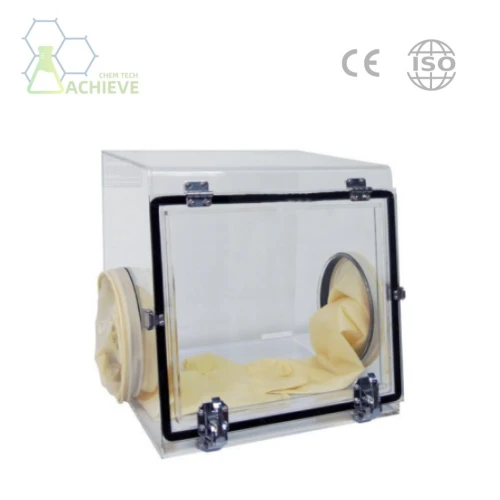


glove box isolator
1)Acrylic Type A glove box: No sample transfer window, must be take it out from the door.
2)Acrylic Type B glove box:There is a sample transfer window, which can protect the gas environment inside the box from being damaged by the outside world.
3)Acrylic Type B glove box:The air in the box can be extracted through the vacuum pump, and then through the high purity dry inert gas into the box, and reach the lower water oxygen content in the box
2.Customization:
1)Single, double, multiple people and other different station boxes.
2)Different shapes, different structures, different applications, different thickness customization options.
3)Doors of different sizes can be opened on any side of the box to facilitate the entry and exit of equipment and accessories.
4)For other optional configurations, contact sales personnel.
***Price List for whole above, inquire us to get
Description
Technical Parameters
A glove box isolator, also commonly referred to as a glove box, is a specialized device primarily used in a variety of scientific, industrial, and hazardous materials handling applications. It is essentially a rigid, airtight container that provides a controlled environment. It is designed to allow the operator to manipulate objects and substances inside the container without direct exposure to the external environment. This is achieved through special sealed ports equipped with gloves, allowing the operator to work in an isolated space while maintaining the integrity of the controlled atmosphere.
The device comprises a confined space of rigid and/or flexible barrier materials that repeatedly sterilize internal air and exposed surfaces to remove biological loads through an integrated vaporized hydrogen peroxide (VHP) sterilization system. After sterilization, air is exchanged through a high efficiency filter (HEPA) and the cabin pressure is kept constant to block outside contamination. Operators operate in a confined space with gloves to avoid direct contact with samples and ensure a sterile environment.
Specifications


The impact of the controlled environment
The impact of the controlled environment is mainly seen in the following areas, closely related to the oxygen control, humidity control and aseptic environment:
Material stability:
at specific oxygen levels, sensitive materials can be protected from oxidative influences, keeping their chemical and physical properties stable.
Biological process regulation:
In biological experiments and cell cultures, cell growth and metabolic processes can be optimized by precisely controlling the oxygen concentration, mimicking the in vivo environment or specific physiological conditions.
Safety:
In applications involving flammable and explosive substances, the risk of fire and explosion can be reduced by lowering the oxygen concentration.
Material Protection:
Appropriate humidity levels can prevent materials from deforming, cracking or failing due to moisture absorption or drying.
Electronic component performance:
During the manufacturing and storage of electronic devices, humidity control prevents electrostatic discharge and corrosion, ensuring component reliability and performance.
Biological laboratory conditions:
In biological and medical research, humidity control is critical to maintaining the activity of cells, tissues and microorganisms.
Preventing contamination:
sterile environments prevent contamination of samples, products and experimental procedures by eliminating or minimizing the presence of microorganisms.
Biosafety:
In research involving pathogens or potentially harmful microorganisms, sterile environments protect operators from the risk of infection.
Product Quality:
In industries such as pharmaceutical, biotechnology, and food processing, aseptic environments are a key factor in ensuring product safety and compliance with regulatory requirements
Application In the food processing industry
Glove box technology can provide a relatively sterile environment, which is essential for aseptic packaging and processing in food processing. Food processing and packaging in aseptic glove boxes can significantly reduce microbial contamination, thereby improving product safety and hygiene. This is particularly important for the production of food with a long shelf life or products that require strict control of microbial contamination.
Some ingredients are extremely sensitive to air, moisture or microorganisms, such as certain fruits, vegetables, meat and dairy products. Handling these ingredients in the glove box can protect them from external environmental contamination and oxidation, thus maintaining the freshness and nutritional value of the ingredients. In addition, glove boxes can be used to accurately measure and mix various additives or flavorings, ensuring that products are formulated and taste as desired.
During food processing, some operations may involve harmful or irritating substances. Glove box can provide a relatively closed operating environment to protect operators from these substances. At the same time, the glove box can also reduce the direct contact between the operator and the food, reducing the risk of cross-contamination.
The glove box provides a stable and pure operating environment, enabling operators to complete their tasks more efficiently. Food processing and packaging in the glove box can reduce interruptions and errors in the production process, improve productivity. In addition, the design of the glove box usually has a large operating space, so that the operator can be more flexible to carry out a variety of operations.
In the food research and development and testing phase, the glove box also plays an important role. R & D personnel can carry out a variety of experiments and tests in the glove box to assess the safety and taste of new products. At the same time, the glove box can also be used to simulate different environmental conditions (such as high temperature, high humidity or specific gas environment), aging test and performance evaluation of materials.
The Technology Required For The Vibration Isolation System
1. Active vibration isolation technology
glove box isolator
Active vibration isolation technology is the active control of vibration through an external exciter to reduce or eliminate the impact of vibration on the system. This technology usually requires the use of sensors to monitor the vibration situation and drive the exciter to generate a reaction force to counteract the external vibration after calculation by the controller.
Magnetic levitation active vibration isolation technology:
Principle: Utilizing the principle of magnetic levitation, vibration is actively controlled through devices such as Lorentz force exciters.
Applications: Vibration isolation devices such as STABLE, MIM series, g-LIMIT and MVIS use this technology.
Contact active vibration isolation:
Principle: Active control of vibration through contact exciters connected to the vibration system.
Application: such as ARIS and other cabinet-level active vibration isolation system using this technology.
2. passive vibration isolation technology
Passive vibration isolation technology is through the vibration transmission path set up vibration isolation components (such as springs, dampers, etc.) to reduce the vibration transmission. This technique usually does not require external energy, but the vibration isolation effect may be affected by the system parameters and excitation frequency.
glove box isolator:
Passive vibration isolation technology is through the vibration transmission path set up vibration isolation components (such as springs, dampers, etc.) to reduce the vibration transmission. This technique usually does not require external energy, but the vibration isolation effect may be affected by the system parameters and excitation frequency.
Rubber vibration isolators:
Principle: Utilizing the elastic and damping properties of rubber to isolate vibration.
Application: Widely used for vibration isolation of various mechanical equipment.
Metal Spring Vibration Isolator:
Principle: Utilize the elasticity of metal springs to isolate vibration.
Application: suitable for the vibration isolation performance requirements of higher occasions.
3. Composite vibration isolation technology
Composite vibration isolation technology is the active vibration isolation and passive vibration isolation technology, in order to make full use of the advantages of the two technologies, improve the vibration isolation effect.
4. Active-passive composite vibration isolation system:
- Principle: On the basis of passive vibration isolation element, increase active exciter, realize active control of vibration through controller.
- Application: Suitable for occasions with extremely high requirements for vibration isolation performance, such as space microgravity scientific experiments.
5. Other related technologies
Sensor technology:
Used to monitor the vibration situation, providing accurate vibration information for the controller.
Including accelerometers, displacement sensors and so on.
Controller technology:
Used to calculate and drive the exciter to generate reaction force to counteract external vibration.
Needs to be characterized by high accuracy, high reliability and real-time.
System integration technology:
Integrate the vibration isolator with other equipment to realize a multi-functional experimental platform.
Need to consider the compatibility between equipment, interface matching and other issues.
which technology is best in a vibration isolation system for glove box vibration isolators
When evaluating which technology is best in a vibration isolation system for glove box vibration isolators, several factors need to be considered, including vibration isolation, stability, cost, applicability, and ease of maintenance.

Active Vibration Isolation Technology
Advantage:
Capable of real-time monitoring and active control of vibration to achieve high-precision vibration isolation effect.
Applicable to occasions with extremely high requirements for the vibration environment, such as space science experiments.
Disadvantages:
Higher cost, requires additional energy input.
Complex technology, requiring professional maintenance and operation.
passive vibration isolation technology
Advantage:
Simple structure, lower cost.
Does not require external energy input, stable operation.
Disadvantage:
Vibration isolation effect may be affected by system parameters and excitation frequency.
In high-frequency vibration or complex vibration environment, the effect may not be as good as active vibration isolation technology.


composite vibration isolation technology
Advantage:
Combines the advantages of active vibration isolation and passive vibration isolation to achieve more efficient vibration isolation.
Applicable to the vibration isolation performance has very high requirements for the occasion.
Disadvantage:
Higher cost and complex technology.
Requires professional maintenance and operation.
Suggestions for technology selection
Choose according to the demand:
If there is a very high demand for vibration isolation effect and cost is not a problem, you can choose active vibration isolation technology or composite vibration isolation technology.
If the vibration isolation effect has certain requirements, but the cost is limited, you can choose passive vibration isolation technology.
Consider the ease of maintenance:
Active vibration isolation technology and composite vibration isolation technology require professional maintenance and operation, so you need to consider the convenience of maintenance and personnel training costs.
Passive vibration isolation technology is relatively simple, and the maintenance convenience is higher.

Technological development
Technological evolution stage

Complete basic functions (origin to the end of the 20th century)
Tightness and gas purification: Early glove boxes achieved environmental isolation through a sealed structure and inert gas filling, but the gas purification capacity was limited.
Application field expansion: From nuclear physics research, special material preparation to pharmaceutical, electronics and other fields, to promote the initial upgrade of sealing technology and purification system.

Automation and Intelligence (early 21st century to present)
Control system upgrade: Integrated PLC, touch screen and other automation technology to achieve accurate control of gas composition, pressure and temperature.
New purification technology: catalytic purification, membrane separation purification and other technologies can reduce the oxygen content of water to an extremely low level to meet the needs of high-precision experiments.

Deepening of industry application (2010s to present)
Emerging fields: Widely used in new energy (such as lithium-ion battery material preparation), biomedicine (such as sterile sample preservation) and other fields.
Technology integration and innovation: Combining electronic technology and automation technology, to promote the development of intelligent and multi-functional glove boxes.
Current technical characteristics
High precision environmental control
Equipped with advanced sensors, real-time monitoring of temperature, humidity, gas composition, pressure and other parameters.
Artificial intelligence and machine learning algorithms are used for data analysis to achieve automatic regulation of the purification system.
Intelligent and remote monitoring
Through the Internet of Things technology, operators can use mobile phones, computers and other terminals to remotely monitor the operating status of the glove box.
Reduce downtime by automatically alerting and providing diagnostic recommendations when the system is abnormal.
New materials and energy saving design
New adsorption materials (such as molecular sieve, MOFs) were used to improve the removal efficiency of water oxygen.
Optimize airflow design and operation patterns to reduce energy consumption and waste generation.
Future development trend
Deepening of intelligence and automation
Integrate more advanced sensors and control systems to achieve real-time monitoring and remote control of the experimental process.
Combine virtual reality (VR) and augmented reality (AR) technologies to provide intuitive operating experience.
Multi-functional and customized
For different areas of demand, integrated heating, cooling, mixing and other functions.
Customized solutions such as high temperature annealing, gas cycle testing, etc.
Miniaturization and portability
Develop smaller and lighter equipment for small laboratories, research institutions and field testing scenarios.
Improve the flexibility and applicability of equipment.
Environmental protection and sustainable development
Use recyclable, degradable materials to reduce environmental impact.
Optimize the purification process, reduce the amount of waste generated, improve the recycling rate.
The direction of technological breakthrough
Composite purification process
Combined with adsorption, catalysis, membrane separation and other technologies to achieve a deeper purification effect.
For example, most of the impurity gas is removed by membrane separation, and then the trace impurity is treated by adsorption or catalytic technology.
An integrated system
Seamless docking with material transfer system, reaction equipment, analysis and testing instruments, forming an integrated experiment or production system.
High efficiency gas cycle and energy saving technology
Use frequency conversion fan, energy saving adsorbent regeneration technology to reduce operating costs.
Integration and modularity
Seamless docking with material transmission system, reaction equipment, analysis and testing instruments, to achieve the whole process closed, clean environment.
Provide standardized modules and customized options to meet the diverse needs of different users.
Industry application prospects
New energy industry
In the research and development of lithium-ion batteries, solid-state batteries, etc., to prevent the reaction of active substances with air, improve battery performance.
Biomedicine
To provide a sterile, low-oxygen environment for cell culture, tissue engineering, biopharmaceutical, to ensure the accuracy of experiments.
Semiconductor manufacturing
Provide a water-free and oxygen-free environment to prevent photolithography, etching and other processes from being interfered by air components to ensure high-precision processing.
Summary
Glove box isolator technology is developing in the direction of intelligent, efficient and green. In the future, it will further enhance environmental control capabilities through material innovation, process optimization and functional integration to meet the higher demand for high cleanliness and low biological load environments in scientific research and industrial production.
Hot Tags: glove box isolator, China glove box isolator manufacturers, suppliers, factory, High Pressure Reactor, Hydrothermal Synthesis Reactor, Double Glass Reactor, Short Path Distillation, Lab Rotary Evaporator, PPL Lined Hydrothermal Autoclave
Previous
Box For GlovesNext
Inert Gas Glove BoxSend Inquiry


