



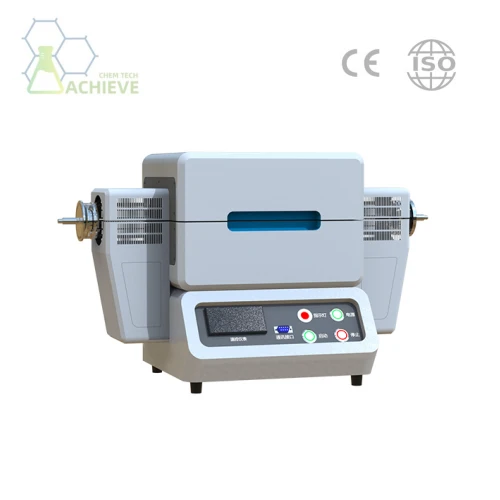


Hot Tube Furnace
2.Lab Box Furnace Equipment:1L-36L
3.Working Temperature can reach 1200℃-1700℃
***Price List for whole above, inquire us to get
Description
Technical Parameters
Hot tube furnace, also known as heat pipe furnace, is an efficient heating device widely used in various industrial fields. It utilizes the principle of heat pipes to transfer heat from the heat source to the object that needs to be heated through the heat conduction of the heat pipe and the circulation of steam, thereby achieving the purpose of heating. Heat pipe furnaces are highly favored due to their simple structure, easy operation, high heating efficiency, low heat loss, and good temperature uniformity.In the closed system, the inside of the heat pipe is pumped into a vacuum and a certain amount of liquid (medium) is injected. When one end of the heat pipe (evaporation section) is heated, the liquid medium will absorb heat and evaporate into steam, and the steam flows to the other end (condensation section) under the action of the pressure difference in the tube, and there the heat is released and condensed into a liquid. The condensed liquid then relies on gravity or capillary force to return to the evaporation section and restart the evaporation heat absorption process. In this way, heat is continuously transferred through the continuous phase transition of the medium in the tube.


Principle of heat pipe
The core component of a heat pipe furnace is the heat pipe, which is an efficient heat transfer element that uses the evaporation and condensation of working fluids (such as water, alcohol, acetone, ammonia, etc.) enclosed inside the pipe to transfer heat. The working principle of a heat pipe can be
summarized as follows:
Evaporation section absorbs heat:
The evaporation section of the heat pipe is placed near the heat source. When the heat source heats the evaporation section, the working fluid evaporates in the evaporation section, forming steam.
Steam flow:
Steam forms a certain pressure inside the pipe, pushing it from the evaporation section to the condensation section.
Condensation section releases heat:
After the steam reaches the condensation section, due to the low temperature of the condensation section, the steam begins to condense and release latent heat.
Working fluid reflux:
The condensed working fluid forms a liquid in the condensation section, and due to the action of gravity or capillary force, the liquid working fluid refluxes to the evaporation section, completing a cycle.
Through this process, the heat pipe can transfer a large amount of heat from the evaporation section to the condensation section, thereby achieving efficient heat transfer.
Parameter


Distinguish
structure
The structure of a hot tube furnace usually consists of a furnace body, heat pipes, heating elements, control systems, etc.
Furnace body:
The furnace body is the outer shell of a heat pipe furnace, usually made of materials that are resistant to high temperatures and corrosion, such as stainless steel, alloy steel, etc. The function of the furnace body is to protect the internal heat pipes and heating elements, while preventing heat loss.
Heat pipe:
The heat pipe is the core component of a heat pipe furnace, as mentioned earlier, it uses the evaporation and condensation of the working fluid to transfer heat. The number and arrangement of heat pipes can be determined based on heating requirements and the size of the furnace body.
Heating element:
The heating element is the heat source of the heat pipe furnace, which can be resistance wire, electric heating tube, gas burner, etc. The power and arrangement of heating elements also need to be determined according to the heating requirements and the size of the furnace body.
Control system:
The control system is used to control the heating temperature, heating time and other parameters of the heat pipe furnace, ensuring that the heat pipe furnace can operate according to the predetermined process requirements. Control systems typically consist of temperature sensors, controllers, actuators, and other components.
Working principle of heat pipe furnace
The working principle of a hot tube furnace is indeed as you described, it is an efficient and precise heat transfer process. Here is a more detailed explanation:
The heating process of a heat pipe furnace begins with the heating element. These components can be resistance wires, electric heating tubes, gas burners, etc., which are selected and configured according to the design and requirements of the heat pipe furnace. When the heat pipe furnace starts working, the heating elements start working, generating heat.
The heat pipe is the core component of the heat pipe furnace, which utilizes the phase transition (evaporation and condensation) of the working fluid to efficiently transfer heat. The interior of a heat pipe is usually filled with liquid working fluids with low boiling points and high latent heat, such as ammonia, water, acetone, etc.
Evaporation section:
The evaporation section of the heat pipe is located near the heating element. When the heat generated by the heating element is transferred to the evaporation section, the working fluid begins to evaporate, forming steam. Steam accumulates in the evaporation section and generates a certain pressure, pushing the steam to flow towards the condensation section.
Steam flow:
Steam forms a high-speed airflow inside the heat pipe and flows along the heat pipe towards the condensation section. During this process, steam carries a large amount of heat.
Condensation section:
When steam reaches the condensation section, due to the lower temperature of the condensation section (usually the temperature of the object that needs to be heated), the steam begins to condense and release latent heat. This latent heat is transferred to the object that needs to be heated, thereby achieving the purpose of heating.
Working fluid reflux:
After condensation, the working fluid forms a liquid in the condensation section. Due to the action of gravity or capillary force (if there is a capillary structure inside the heat pipe), the liquid working fluid refluxes to the evaporation section, preparing for the next round of evaporation and condensation processes.
The control system plays a crucial role in ensuring that the heating temperature of the heat pipe smelter remains within the predetermined range. Control systems typically include temperature sensors, controllers, and actuators.
Temperature sensor:
The temperature sensor monitors the temperature inside the heat pipe smelter in real time and feeds back the temperature information to the controller.
Controller:
The controller calculates the power of the heating element that needs to be adjusted based on the feedback information from the temperature sensor and the preset temperature range.
Executor:
The actuator adjusts the power of the heating element according to the instructions of the controller, thereby controlling the heating temperature of the heat pipe furace.
Due to the temperature difference between the smelter body and the environment, the heat pipe smelter will experience some heat loss during operation. To compensate for this heat loss, the control system will increase the power of the heating element appropriately. This is usually achieved by fine-tuning the power of the heating element through a controller to ensure that the heating efficiency of the heat pipe smelter remains at a high level.
In summary, the working principle of a heat pipe smelter is a complex and delicate heat transfer process, which utilizes the phase change heat transfer characteristics of heat pipes to efficiently transfer the heat generated by heating elements to the objects that need to be heated. Meanwhile, through precise adjustment of the control system, it is possible to ensure that the heating temperature of the heat pipe smelter remains within the predetermined range, thereby achieving efficient, energy-saving, and environmentally friendly heating effects.
Advantages of heat pipe furnace
precautions for product use
High heating efficiency: The heat pipe furace utilizes the heat conduction of the heat pipe and the circulation of steam to transfer heat, with efficient heat transfer performance. Compared with traditional heating methods, heat pipe smelter have higher heating efficiency and can save a lot of energy.
Good temperature uniformity: Due to the uniform temperature distribution of steam flowing inside the heat pipe, the heating temperature uniformity of the heat pipe furnace is good, which can avoid problems of local overheating or uneven temperature.
Small heat loss: The hot tube furnace body of the heat pipe smelter is usually made of high temperature resistant and corrosion-resistant materials, which can effectively prevent heat loss. At the same time, the control system of the heat pipe smelter can adjust the power of the heating element based on the feedback information of the temperature sensor, further reducing heat loss.
Wide applicability: Heat pipe smelter are suitable for various industrial fields that require heating, such as metal heat treatment, glass manufacturing, ceramic sintering, food processing, etc. Meanwhile, the heat pipe smelter can also be customized according to the specific needs of customers to meet different heating requirements.
Application of heat pipe furnace

Metal heat treatment: In the field of metal heat treatment, heat pipe furnaces are commonly used to heat and quench metal workpieces. By controlling the heating temperature and heating time, the microstructure and properties of metals can be changed, achieving the goal of improving hardness, wear resistance, corrosion resistance, and so on.
Other fields: In addition to the above fields, heat pipe furaces can also be applied to other industrial fields that require heating, such as chemical, pharmaceutical, electronics, etc. In these fields, hot tube furnaces can leverage their advantages of high efficiency, energy conservation, and environmental protection, providing strong support for industrial production.
Ceramic sintering: In the field of ceramic sintering, heat pipe furaces are commonly used for sintering and heat treatment of ceramic products. By controlling the heating temperature and heating time, the sintering quality and performance of ceramic products can be ensured.
Food processing: In the field of food processing, heat pipe smelter are commonly used for heating and sterilizing food. Due to the high heating efficiency and good temperature uniformity of the heat pipe smelter, it can ensure the heating and sterilization effects of food.
Glass manufacturing: In the field of glass manufacturing, heat pipe smelter are commonly used for melting and forming glass. Due to the high heating efficiency and good temperature uniformity of the heat pipe furace, it can ensure the melting quality and forming effect of the glass.

Conclusion
Hot tube furnaces are essential tools in a wide array of industries and research fields. Their ability to provide controlled high - temperature environments with precise temperature control and uniform heating makes them invaluable for processes ranging from materials synthesis to chemical reactions. While they have certain limitations, such as high energy consumption and maintenance requirements, ongoing advancements in technology are likely to address these issues. With future trends pointing towards increased energy efficiency, automation, advanced temperature control, and miniaturization, hot tube furnaces will continue to play a vital role in driving innovation and progress in various scientific and industrial domains.
Hot Tags: hot tube furnace, China hot tube furnace manufacturers, suppliers, factory, Chemglass Jacketed Reactor, Hydrothermal Autoclave Reactor, Short Path Distillation System, 5l Short Path Distillation, High Pressure Hydrothermal Autoclave Reactor, Stainless Steel Chemical Reactor
Previous
Thermolyne 21100 Tube FurnaceNext
CVD Tube FurnaceSend Inquiry


