



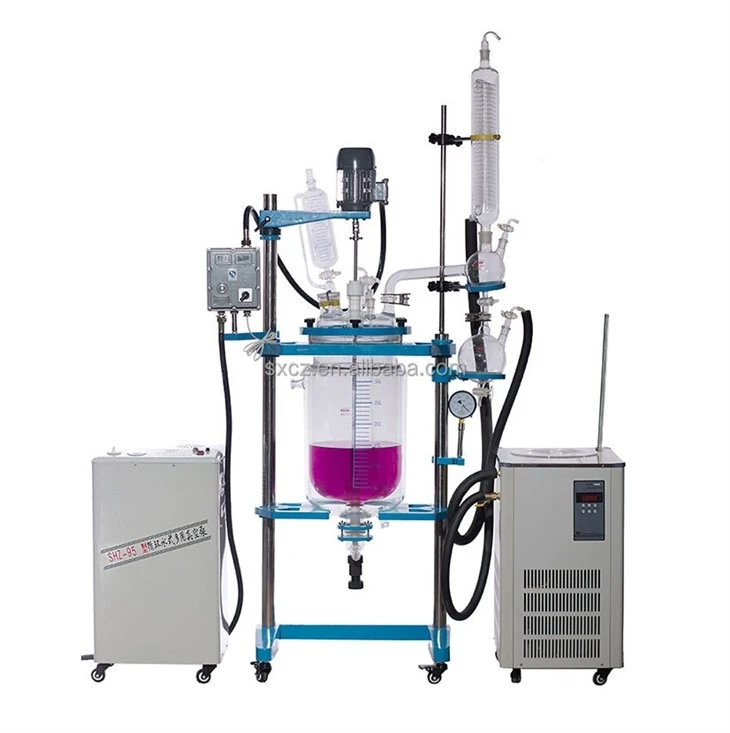


Glass Chemical Reactor
(1)1L/2L/3L/5L---Standard
(2)10L/20L/30L/50L/100L---Standard/EX-proof/Lifting Kettle
(3)150L/200L---Standard/EX-proof
***Price List for whole above, inquire us to get
2. Customization:
(1)Design support
(2)Directly supply the Senior R&D organic intermediate, shorten your R&D time and cost
(3)Share the advanced purifying technology with you
(4)Supply the high quality chemicals and analysis reagent
(5)We want to assist you on Chemical Engineering (Auto CAD, Aspen plus etc.)
3. Assurance:
(1)CE and ISO certification Registered
(2)Trademark: ACHIEVE CHEM(since 2008)
(3)Replacement parts within 1-year for free
Description
Technical Parameters
Glass chemical reactor is a common laboratory or industrial production equipment, which is used for chemical reaction, solution mixing, substance synthesis and other operations. Its main feature is that it is made of acid, alkali and high temperature resistant glass, and it will not cause pollution and corrosion during chemical reaction.
The glass chemical reaction kettle heats the solution or mixture in the reaction container through the heater, the agitator can evenly mix the reactants, and the cooler can cool the solution or mixture in the reaction kettle in time. The equipment is widely used in pharmaceutical, chemical, food, biology and other fields, mainly used for preparing chemicals, synthesizing drugs and researching new materials.
classification
|
|
|


Overview


The temperature sensor is an important component in the glass chemical reactor, which is used to measure the temperature value in the reaction system and transmit the data to the control system through signal output. Common types of temperature sensors include thermocouples, resistance thermometers and infrared thermometers.
Common temperature sensors
● Thermocouple: Thermocouple is a temperature sensor based on thermoelectric effect, which is usually composed of two different metal materials. When two different metals have a temperature difference, a potential difference will occur, and this principle is used to measure the temperature. Thermocouple has the characteristics of fast response and high reliability, and is widely used in glass chemical reactors.
● Resistance thermometer: Resistance thermometer is a kind of temperature sensor based on resistance change, and its principle is to measure temperature according to the law of material resistivity changing with temperature. Resistance thermometer has the advantages of high precision and good stability, but its response speed is relatively slow.
● Infrared thermometer: The infrared thermometer is a non-contact temperature sensor, and its principle is to measure the temperature by using the relationship between the infrared radiation emitted from the surface of the target object and the temperature. Infrared thermometer has the advantages of fast reaction speed and no need to touch the target object, but its accuracy is relatively low.
PT100 temperature sensor is a temperature sensor based on resistance change, and its measuring principle is to realize temperature measurement by using the change of resistance value of platinum resistance with temperature change. PT100 temperature sensor is widely used in glass chemical reaction kettle, which is mainly composed of platinum resistor, thermistor, connecting wire and shell.
The advantages of PT100 temperature sensor are high precision, good stability and fast response, which can meet the requirements of high precision and high stability temperature measurement. At the same time, PT100 temperature sensor also has the characteristics of corrosion resistance, high temperature resistance and anti-interference, and can work normally in harsh environments such as chemical reactors.
The design principle of PT100 temperature sensor includes the selection of suitable platinum resistance material, circuit design, shell material selection and so on. Among them, the purity and manufacturing process of platinum resistance material are the key factors affecting the accuracy and stability of PT100 temperature sensor. In general, the accuracy of PT100 temperature sensor will increase with the purity of Pt resistor, but the corresponding price will be higher.
Tips
● Installation position: The installation position of PT100 temperature sensor should be in contact with reactants to ensure the accuracy of measurement results.
● Connecting circuit: The connecting circuit of PT100 temperature sensor should avoid signal attenuation and interference caused by line impedance and other reasons.
● Temperature range: The measuring range of PT100 temperature sensor should match the actual demand to avoid damage caused by exceeding the range.
Applications
● Pharmaceutical Research and Development: Glass reactors play a pivotal role in the synthesis of active pharmaceutical ingredients (APIs) and intermediates. Their transparency allows for close monitoring of reaction progress, while their chemical inertness ensures the purity of the final product.
● Fine Chemicals and Specialty Chemicals: For the production of high-value, low-volume chemicals, glass reactors offer precise control over reaction conditions, facilitating the synthesis of complex molecules with high yields and purity.
● Catalysis Research: Catalysis, the acceleration of chemical reactions by a catalyst, is a fundamental process in many industrial and laboratory settings. Glass reactors are well-suited for studying catalyst behavior, as they allow for direct observation of catalyst activation, deactivation, and poisoning phenomena.
● Polymer Synthesis: In the field of polymer science, glass reactors are used to synthesize polymers under controlled conditions, enabling researchers to explore the effects of different monomers, catalysts, solvents, and reaction conditions on polymer properties.
● Teaching and Education: Glass reactors are often used in undergraduate and graduate chemistry laboratories as a hands-on tool for teaching synthetic chemistry techniques and principles.
Maintence

● All glass parts should be cleaned before installation.
hould be coated with a small amount of vacuum silicone grease to increase air tightness.
● Before installation, use, maintenance and inspection, please be sure to read all the contents of this manual and use it correctly.
● The power supply voltage must be consistent with the provisions of this instrument.
● No-load should not be high-speed operation.
● The life of the electrical box has a great influence on the ambient temperature and humidity. Please keep the governor and motor dry.
Knowledge
The jacket (also called cooling jacket or heating jacket) in the glass chemical reactor is an important component for controlling the temperature in the reaction vessel.
Jacket is usually composed of two layers of glass tubes, forming a space in which external circulating fluid (such as water or oil) is used for cooling or heating.
Jacket Manufacturing Process
● Selection of glass tube: Choose glass tube with appropriate size and material, usually using heat-resistant borosilicate glass (such as PYREX) or other acid and alkali-resistant glass materials.
● Making the outer glass tube: A section of glass tube with larger diameter is heated and softened, and it is stretched into the required length and shape by using glass tools. This step can be made by hand or use special glass processing equipment according to specific needs.
● Making inner glass tube: Select a glass tube with suitable inner diameter and insert it into the outer glass tube to ensure that there is enough gap between them.
● Sealing and connection: Seal the two ends of the glass tube to ensure that the fluid in the jacket will not leak. Usually, high-temperature glue or glass glue is used for sealing, and the jacket is connected with the external circulating fluid system through rubber or silicone tube.

Common problems and solutions
Shell damage (corrosion, cracks, perforations)
Cause of failure:
Subjected to medium radiation (pitting, intergranular corrosion).
Thermal stress causes cracks or alkalis.
Wear thinning or uniform corrosion.
Treatment method:
Shells lined with corrosion-resistant materials need to be relined or partially repaired.
If the shell thickness is lower than the minimum thickness allowed by the design, the body needs to be replaced.
Over temperature and over pressure
Cause of failure:
Meter failure, loose control.
Misoperation, improper ratio of raw materials, resulting in violent reactions.
Poor heat transfer or stirring performance, resulting in side reactions.
Intake valve failure, intake pressure is too high.
Treatment method:
Check and repair the automatic control system to ensure that the instrument is working properly.
Strictly implement the operating procedures, take emergency pressure relief measures, according to the prescribed quantitative feeding time.
Increase heat transfer area or remove scale to improve heat transfer effect; Repair mixer to improve mixing efficiency.
Close the main steam valve and repair the intake valve.
Seal leak
Packing seal leakage
The cause of failure
The mixing shaft is worn or corroded at the packing place, resulting in excessive gap; Improper oil ring location or oil circuit blockage can not form an oil seal; The gland is not pressed tightly, the packing quality is poor, or the use of too long; Corrosion of stuffing box.
Treatment method
Replace or repair the mixing shaft, and process on the machine tool to ensure the roughness; Adjust the oil ring position, clean the oil circuit; Press the filler or replace the filler; Repair or replace the stuffing box.
Mechanical seal leakage
Fault cause
Dynamic and static ring end face deformation, damage; The end face specific pressure is too large, the friction pair will produce thermal deformation; The sealing ring material selection is wrong, the compression force is not enough, or the V-shaped sealing ring is installed backwards, and the sealing property is lost. The vertical error between axis and end face of static ring is too large; The operating pressure and temperature are unstable, and hard particles enter the friction pair; Insert or glue moving or static ring insert leakage.
Treatment method
Replace the friction pair or re-grind; Adjust the specific pressure to be appropriate, strengthen the cooling system, and take away the heat in time; The material selection and installation of the sealing ring should be reasonable, and there should be enough pressing force; Stop the machine and re-align it to ensure that the non-verticality is less than 0.5mm; Strictly control the process index, particles and crystals can not enter the friction pair; Adjust and overhaul the shaft to reach the standard; Improve the installation process, or the amount of interference should be appropriate, or the adhesive should be easy to use and firm.
There's an abnormal noise in the kettle
Cause of failure:
Stirrer friction tank inside accessories (snake tube, thermometer tube, etc.) or scraping wall.
Agitator bent or bearing damaged.
Treatment method:
Stop and repair to find the right, so that the agitator and accessories have a certain distance.
Stop to check, tighten bolts or replace damaged parts.
Enamel agitator off
Cause of failure:
Fractured by medium corrosion.
The motor rotates in the opposite direction.
Treatment method:
Replace the blender.
Stop to change motor steering.
The flange of enamel kettle is leaking
Cause of failure:
The porcelain face of the flange is damaged.
The selection of washer material is not reasonable, the installation of joints is not correct, empty, wrong shift.
The clip is loose or insufficient.
Treatment method:
Repair, apply anticorrosive paint or resin.
According to the process requirements, select the washer material, the washer interface should be folded, and the position should be uniform.
According to the design requirements, there is a sufficient number of clips, and to tighten.
The porcelain surface has scale explosion and micro-pores
Cause of failure:
Acid impurities enter the jacket or stirring shaft tube, resulting in hydrogen embrittlement.
The porcelain layer is not dense, and there are hidden dangers of micro-pores.
Treatment method:
After neutralization with sodium carbonate, rinse with water or repair, serious corrosion needs to be replaced.
Small number of micropores can be repaired, serious need to update.
The motor current exceeds the rating
Cause of failure:
The bearing is damaged.
Stirrer diameter is too large.
Treatment method:
Replace the bearings.
Adjust mixer diameter appropriately.
Hot Tags: glass chemical reactor, China glass chemical reactor manufacturers, suppliers, factory, Hydrothermal Autoclave Reactor With Teflon Chamber 100ml, 20l Rotovap, Rotovap Machine, Lab Rotary Evaporator, 5l Rotovap, High Pressure Laboratory Reactor
Send Inquiry


