



Centrifuge Machine Speed
Description
Technical Parameters
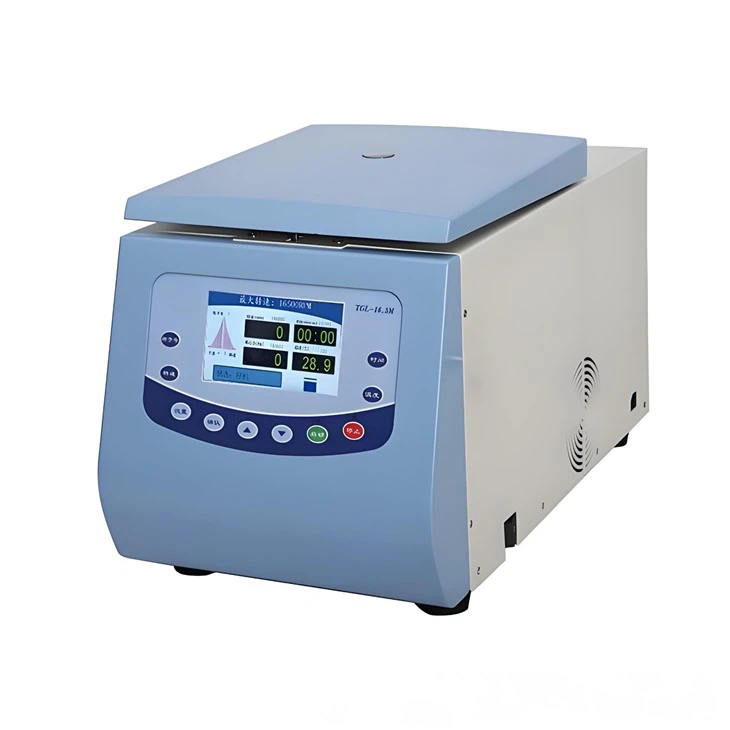
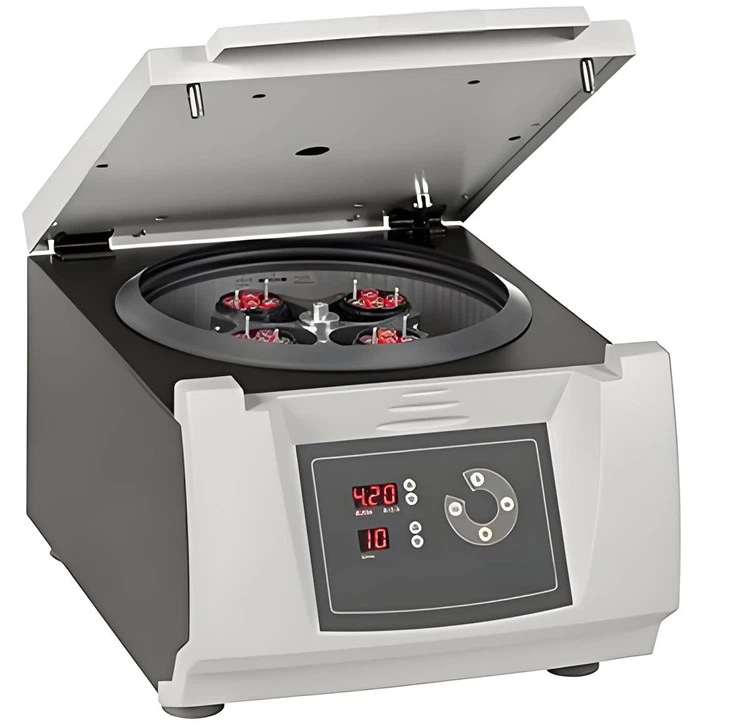
Centrifuge, as an important separation equipment, plays a key role in many fields such as biomedicine, chemical industry and food industry. Centrifuge machine speed, as its core parameter, directly affects the separation effect and equipment performance. The speed refers to the number of revolutions per minute of rotation of the centrifuge rotor, expressed in revolutions per minute (r/min). It is one of the important indicators to measure the performance of the centrifuge, which determines the centrifugal force generated during the centrifugal process.
Relative centrifugal force means that in a centrifugal field, the centrifugal force acting on the particle is equivalent to a multiple of the Earth's gravity, and the unit is the gravitational acceleration "g" (980cm/s²). Its calculation formula is as follows:RCF=1.118×r×(rpm/1000) ².Where, r is the centrifuge rotor radius (unit: centimeter), rpm is the number of revolutions per minute. Relative centrifugal force can more accurately reflect the force of the sample in the centrifugal process, so g is commonly used in high-speed centrifuges.
Technological development
Centrifuge machine speed as its core performance index, its technical development has a profound impact on the separation efficiency and application boundaries in biomedicine, material science, industrial manufacturing and other fields. The following is a systematic description of the technological evolution of centrifuge speed from four dimensions: technological breakthrough, material innovation, intelligent control and green design.
Speed breakthrough: from low speed to ultra-high speed
High speed process
Historical evolution: At the beginning of the 19th century, the centrifuge speed was only a few hundred revolutions per minute; In the middle of the 20th century, the speed of ultra-fast centrifuges exceeded 45,000 rpm. Modern ultra-high speed centrifuges have achieved more than 80,000 rpm and centrifugal force of more than 1,000,000×g.
Application expansion: The high speed enables centrifuges to move from the laboratory to industrial production, such as the efficient separation of viral vectors in biopharmaceuticals (purity >99%), and the precise control of quantum dot particle size distribution in the field of nanomaterials (CV<5%).
Improved performance in extreme conditions
Pneumatic noise control: under ultra-high speed operation, pneumatic noise becomes a technical bottleneck. The new generation of centrifuges has been optimised hydrodynamically to reduce noise to below 55 dB.
Vibration suppression: magnetic suspension bearing and active shock absorption technology are used to reduce the vibration amplitude to the micron level to ensure equipment stability.
Material innovation: the core of supporting the speed limit
Rotor material revolution
Titanium alloy application: aero-grade titanium alloy rotor combined with finite element simulation design, while subjected to extreme centrifugal forces (such as 100,000×g), the noise is controlled below 55 dB.
Carbon fiber composite: The experimental carbon fiber rotor reduces weight by 30% and the limit speed exceeds 150,000 rpm, marking the depth of material science to empower centrifuge performance.
Durability and safety
Extended life: Brushless motor and magnetic bearing technology control the speed fluctuation within 0.1%, and extend the rotor life to more than 20,000 hours.
Safety protection: Automatic rotor identification, unbalance detection and emergency braking function to ensure the safety of overspeed operation.
Intelligent control: precise separation of the "brain"

AI algorithm optimization
Real-time parameter adjustment: AI algorithm is used to analyze sample characteristics and dynamically optimize centrifugal parameters (such as rotational speed, time, temperature) to improve separation efficiency.
Failure prediction: A remote monitoring system based on the Internet of Things can provide early warning of equipment failure and reduce the risk of downtime.
Multimodal integration
Combined technology: Centrifuges are combined with mass spectrometry and flow cytometry to build a whole process platform of "sample processing - analysis", for example, in gene sequencing, the single processing time is reduced to 15 minutes.
Automated operation: From sample loading to result output, the whole process is automated to reduce human error.

Green design: Technology orientation for sustainability
Energy efficiency optimization
Frequency conversion technology: driven by frequency conversion motor, temperature control is accurate and energy saving 30%, such as Xiangyi high-speed desktop refrigerated centrifuge HT230R.
Energy recovery system: Converts rotational kinetic energy into electricity, reducing power consumption by 40%.
Environmental protection material
Biodegradable rotors: Experimental rotors use bio-based materials to reduce environmental impact.
Low noise design: Through acoustic optimization, the equipment operation noise meets the laboratory environmental protection standards.
Future outlook: Technology integration and industrial upgrading
Interdisciplinary
The integration of nanotechnology and centrifugal technology: the development of nanoscale separation equipment to promote the industrialization of nanomaterials.
Combining biotechnology and centrifugation: In the field of cell therapy, efficient separation of cell subpopulations is achieved.
Deepening of industrial application
Personalized medicine: High-speed centrifuges are used in precision medicine for exosome extraction to help detect tumor markers.
New energy materials: Ultra-high speed centrifuges improve the purity and consistency of electrode materials in the preparation of lithium-ion battery materials.
The technological development of centrifuge machine speed reflects the deep integration of material science, mechanical engineering, electronic technology and artificial intelligence. From speed breakthrough to material innovation, from intelligent control to green design, each progress has promoted the expansion of the boundaries of centrifuge exploration in the microscopic world. In the future, with the continuous iteration of technology, centrifuges will play a more critical role in the fields of life science, new energy, environmental protection, and become an important tool for human exploration of the microcosmic world.

Verification and optimization of speed setting
Centrifuge machine speed is the core parameter that affects the separation effect, and its verification and optimization should be combined with calibration method, experimental verification and continuous optimization to ensure that the speed setting is accurate, efficient and meets the experimental requirements. Here are the strategies:
Verification of speed setting
Calibration method
Non-contact laser speed measurement
Use high-precision laser tachometer (such as OptoSpin series) to measure the actual speed, the error must be ≤±1% (high-speed centrifuges) or ≤±2% (low-speed models).
Example: a brand of high-speed centrifuge has a deviation of 3.2% at 18,000 rpm, which is checked as an aging drive circuit capacitor, and the deviation returns to 0.8% after replacement.
Dynamic force sensor comparison
According to the formula RCF=1.118×r×(RPM)²the theoretical centrifugal force is calculated and compared with the measured data of a dynamic force sensor such as HBM T40B.
Example: If the rotor radius is 10 cm and the target centrifugal force is 800g, the speed needs to be set to about 4300 rpm.
Temperature stability verification
For refrigerated centrifuges, the chamber temperature control accuracy is verified in the range of -20℃ to 40℃, and the fluctuation should be <±1℃ (monitored with PT100 platinum resistance probe).
Experimental verification
Gradient test
Different speed gradients (such as 8000 rpm, 10000 rpm, 12000 rpm) were set, and the separation effect was evaluated by microscope observation and electrophoretic analysis.
Example: In the DNA extraction experiment, high purity DNA can be obtained at 12000 rpm, 20 minutes and 4℃.
Repeatability verification
The experiment was repeated three times under the same conditions, and the coefficient of variation (CV) of the separation efficiency was calculated to ensure the stability and reliability of the results.
Optimization of speed setting
Parameter adjustment policies
PID algorithm optimization
Improve speed overrush or fluctuations by adjusting the motor drive signal, such as modifying the P value in the control board EPROM.
Example: The P value of a certain model of centrifuge is adjusted from 0.85 to 0.92, and the speed stability is significantly improved.
Mechanical deviation correction
Replace high-precision bearings (ABEC-7 or above) or re-grind the spindle cone to reduce speed deviations caused by mechanical wear.
Digital twin technology
The numerical model of centrifuge is established by ANSYS simulation, and the measured data such as vibration and temperature rise are input to realize virtual calibration and shorten the field debugging time by 40%.
Intelligent predictive maintenance
AI predictive calibration
Based on machine learning analysis of historical operating data, the bearing life is predicted in advance (89% accuracy), and the calibration reminder is automatically pushed.
Example: Thermo Fisher's CentriSoft system monitors equipment status in real time and optimizes speed Settings.
Quantum sensing technology
The experimental NV color center quantum sensor can achieve nanoscale vibration monitoring, and the calibration accuracy may be improved by two orders of magnitude in the future.
The key point of speed optimization
| optimization direction | Specific measures | expected effect |
| improve the separation efficiency | Select the best speed according to the sample characteristics (e.g. 8000 rpm for protein separation, 70000 rpm for virus particle separation) | shorten the separation time and improve the purity |
| reduce equipment loss | Calibrate speed regularly to avoid rotor breakage or bearing damage caused by overspeed | extend equipment life and reduce maintenance costs |
| ensures experimental stability | Combined with temperature control (such as centrifugation at 4℃ to prevent protein denaturation) and balanced symmetrical placement (error <0.1g) | reduces experimental error and improves repeatability |
| adapt to complex working conditions | The multi-stage counter-current drum design or intelligent control system is adopted to automatically adjust the speed, flow rate, temperature and other parameters | for high viscosity and corrosive materials |
Common problems and solutions
| The problem | causes | solutions |
| large speed deviation | drive circuit capacitor aging, voltage fluctuation | replace the capacitor, optimize the power supply stability |
| poor separation effect | the rotational speed does not match the characteristics of the sample | the rotational speed is recalculated according to the centrifugal force formula, or the gradient centrifugation technique |
| large vibration | rotor unbalance, bearing wear | into the action balance detection, replace the high-precision bearing |
| temperature compensation failure | frost formation and feedback delay of the temperature sensor | a cavity dehumidification module is installed to ensure the normal operation of the sensor |
Implementation process of verification and optimization
Equipment pre-inspection
Clean the rotor cavity and check the rotor for cracks or corrosion (an endoscope is recommended to detect hidden damage).
Parameter calibration
Data were collected respectively at 20%, 50%, 80% and 100% rated speed, each speed lasted 5 minutes, and the speed, vibration spectrum and cavity temperature were recorded.
Data correction
Adjust the motor drive signal by PID algorithm, or replace the high-precision bearing to correct the mechanical deviation.
Validation archive
Perform three full load operation tests, generate ISO/IEC 17025 standard calibration certificates, and establish equipment life cycle files.

Sum up
The verification and optimization of centrifuge machine speed setting should follow the principles of scientific calibration, experimental verification and intelligent optimization. Through high-precision calibration, experimental gradient testing, AI predictive maintenance and other technical means, the precision, automation and intelligence of the speed setting can be achieved, thereby improving the separation efficiency, reducing equipment losses, and ensuring the accuracy and repeatability of the experimental results.
Hot Tags: centrifuge machine speed, China centrifuge machine speed manufacturers, suppliers, factory, Rotary Distillation, 50l Rotary Evaporator, Crystallization Reactor, Single Press Tablet Machine, High Pressure Laboratory Reactor, Hydrothermal Autoclave Reactor
Previous
Chemical Centrifuge MachineSend Inquiry


