



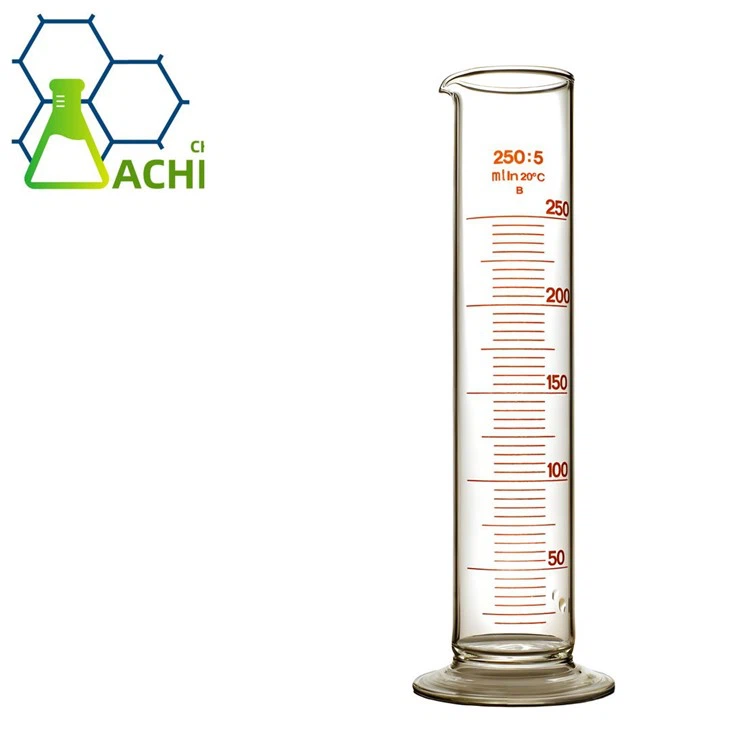


5 Ml Measuring Cylinder
Capacity(ml):5/10/25/50/100/250/500/1000/2000/5000
2.Stoppered measuring cylinder
Capacity(ml):5/10/25/50/100/250/500/1000/2000
***Price List for whole above, inquire us to get
Description
Technical Parameters
A 5 ml measuring cylinder is a precise laboratory instrument designed to measure and dispense small liquid volumes accurately. Typically crafted from durable, transparent materials like borosilicate glass or high-quality plastic, it features a narrow cylindrical shape with a stable base to prevent tipping. The cylinder is calibrated with graduated markings along its side, allowing users to read volumes at eye level for minimal parallax error. Its small capacity (5 ml) makes it ideal for applications requiring high precision, such as chemical titrations, pharmaceutical preparations, or microbiological assays where even slight volume variations could impact results.
Key advantages include its portability, affordability, and suitability for handling reagents, dilutions, or essential oils. The tapered spout enables controlled pouring, reducing spillage. While less durable than volumetric flasks, its simplicity and cost-effectiveness suit educational settings or low-stakes experiments. However, it's less accurate than Class A glassware for analytical work. To maintain accuracy, users should avoid thermal shock, clean it thoroughly after use, and store it upright. Despite its limitations, the measuring cylinder remains a fundamental tool in labs worldwide, balancing practicality with precision for routine liquid measurements.
Specifications
|
|


applications in the Food & Beverage Industry
Formulation of Flavorings, Additives, and Nutritional Supplements
In beverage production-spanning soft drinks, energy drinks, alcoholic mixers, juices, and beyond-achieving consistent taste profiles is critical for brand reputation, consumer loyalty, and regulatory compliance. Flavor extracts, which include natural or synthetic compounds like citrus oils, vanilla concentrates, herbal tinctures, or spice blends, are often added in minute quantities to avoid overwhelming the base beverage. A 5 ml measuring cylinder serves as an essential tool for ensuring precision, accuracy, and repeatability in flavor dosing.
Formulation of Flavor Concentrates
Natural vs. Synthetic Flavors:
- Natural flavors (e.g., orange oil, lemon zest extracts) and synthetic equivalents (e.g., vanillin, ethyl butyrate) are added in micro- to milliliter volumes. A 5 ml cylinder allows beverage technologists to measure small, controlled batches of flavorings for trial blends before scaling up.
- Example: In crafting a cola-flavored energy drink, a 5 ml cylinder might be used to add 0.5–2 ml of cinnamon extract or 1–3 ml of lime oil to balance sweetness and acidity.
Standardization Across Batches:
- Consistency is vital for mass production. A 5 ml cylinder ensures that each production run receives the exact same flavor dosage, preventing batch-to-batch variability.
- Example: In lemon-lime soda production, 1.2 ml of lemon oil and 0.8 ml of lime oil per liter of syrup are measured using a 5 ml cylinder to maintain a uniform citrus profile.
Aromatic and Herbal Infusions
Tea-Based and Botanical Beverages:
- For herbal teas, kombucha, or gin-based mixers, small volumes of essential oils (e.g., juniper, chamomile, hibiscus) or tinctures (e.g., elderflower, lavender) are added. A 5 ml cylinder prevents over-flavoring, which could result in a bitter or medicinal aftertaste.
- Example: In a gin & tonic mixer, 0.5–1 ml of juniper berry extract is measured to mimic the botanical notes of traditional gin without excessive bitterness.
Functional and Adaptogenic Beverages:
- In energy drinks or wellness tonics, herbal extracts (e.g., ginseng, ashwagandha, guarana) are added for perceived health benefits. Precise dosing ensures efficacy without off-flavors.
- Example: A 5 ml cylinder might measure 0.3–0.7 ml of guarana extract (standardized to 22% caffeine) per 100 ml of beverage to enhance stimulation without bitterness.
Alcoholic and Spirit-Based Mixers
Cocktail Bitters and Liqueurs:
- In pre-mixed cocktails or bitters for home bartending, small amounts of high-intensity flavorings (e.g., Angostura bitters, orange bitters) are added. A 5 ml cylinder ensures that 3–5 drops (≈0.15–0.25 ml) are measured accurately, as overuse can dominate the drink's profile.
- Example: In a pre-batched Negroni mixer, 0.5 ml of orange bitters is added to 500 ml of the base to achieve the classic bitter-sweet balance.
Fortified Wines and Spirits:
- In vermouth, sherry, or liqueur production, small volumes of herbal infusions (e.g., wormwood, clove, cinnamon) are measured using 5 ml cylinders to achieve the desired aromatic complexity.
- Example: A 5 ml cylinder might measure 0.8–1.2 ml of wormwood tincture per liter of white wine to produce a dry vermouth with subtle bitterness.
Why Precision Matters in Flavor Dosing
Avoiding Over-Flavoring
Excessive flavoring can lead to unpleasant aftertastes, chemical off-notes, or masking of base beverage flavors. For example, too much vanilla extract in a cream soda can make it taste synthetic.
Preventing Under-Flavoring
Insufficient flavoring results in a bland, indistinct product that fails to meet consumer expectations. For instance, a ginger ale lacking adequate ginger oil will lack its characteristic spiciness.
Cost Efficiency
Flavor extracts are often expensive. Precise measurement using a 5 ml cylinder minimizes waste and ensures optimal use of raw materials.
Regulatory Compliance
In some regions, maximum flavoring limits are enforced (e.g., EU regulations on certain essential oils). Accurate dosing prevents non-compliance and potential recalls.
|
|
|


Microbiological and Analytical Testing
In food safety laboratories, the accurate aliquoting of liquid samples (e.g., milk, juice, meat extracts, ready-to-eat foods, or beverages) is critical for reliable microbial analysis, including total plate counts (TPC), pathogen detection (e.g., Salmonella, E. coli, Listeria), and spoilage organism enumeration. A 5 ml measuring cylinder is indispensable for this purpose due to its precision, ease of use, and compatibility with standard microbiological protocols.
Key Applications in Microbial Testing
A. Sample Preparation for Serial Dilution
Purpose:
- Microbial testing often requires serial dilutions to reduce sample concentration to a countable range (e.g., 30–300 CFU/plate). A 5 ml cylinder ensures consistent dilution factors (e.g., 1:10, 1:100) by accurately transferring volumes to diluents (e.g., sterile saline, peptone water).
Example:
- For a milk sample, a 5 ml cylinder is used to transfer 1 ml of milk into 9 ml of diluent (1:10 dilution). Subsequent 1:10 dilutions (e.g., 1 ml of the 1:10 dilution into 9 ml of fresh diluent) are performed using the same cylinder, ensuring logarithmic accuracy for plating.
B. Enrichment Broth Inoculation
Purpose:
- In pathogen detection (e.g., Salmonella in poultry, Listeria in dairy), samples are often enriched in selective broths (e.g., buffered peptone water, Rappaport-Vassiliadis) to amplify low microbial loads. A 5 ml cylinder ensures precise inoculum volumes, improving detection sensitivity.
Example:
- For ground beef, a 5 ml cylinder is used to add 25 ml of enrichment broth to 25 g of sample (1:1 dilution), followed by incubation to allow pathogen growth.
C. Plating and Spreading Techniques
Purpose:
- After dilution, 0.1–1 ml of the sample is plated onto agar media (e.g., plate count agar, xylose lysine deoxycholate agar). While pipettes are typically used for volumes <1 ml, a 5 ml cylinder may be employed to pre-measure larger volumes before transferring to petri dishes or pour-plating setups.
Example:
- In pour-plating for TPC, a 5 ml cylinder measures 1 ml of a 1:100 dilution, which is then mixed with molten agar and poured into a plate.
D. Quality Control of Culture Media
Purpose:
- Microbiological media (e.g., tryptic soy broth, MacConkey agar) must be prepared with precise volumes of dehydrated powder and water. A 5 ml cylinder is used to measure small volumes of additives (e.g., antibiotics, indicators) to ensure media performance.
Example:
- For selective Listeria enrichment, a 5 ml cylinder measures 0.1 ml of acriflavine supplement per liter of broth to inhibit competing flora.
Why Precision Matters in Microbial Testing
Avoiding False Negatives/Positives:
- Over-dilution (e.g., using a 10 ml cylinder instead of 5 ml for a 1:10 dilution) can lead to underestimation of microbial loads, missing pathogens or spoilage organisms.
- Under-dilution can result in overcrowded plates (too many colonies to count, or "TNTC"), making enumeration impossible.
Regulatory Compliance:
- Methods like ISO 4833 (TPC), FDA BAM (pathogen detection), and AOAC guidelines specify exact volumes for dilutions and inoculations. A 5 ml cylinder ensures adherence to these standards, preventing non-compliance.
Reproducibility:
- Consistent use of a 5 ml cylinder across batches and analysts ensures inter-laboratory reproducibility, a cornerstone of food safety certification (e.g., GFSI, BRCGS).
Practical Example: Testing for E. coli in Raw Spinach
Objective: Detect E. coli O157:H7 in 25 g of spinach using modified tryptone soy broth (mTSB) enrichment.
Steps:
- Weigh Sample: Transfer 25 g of spinach into a sterile stomacher bag.
- Add Diluent: Use a 5 ml cylinder to measure 225 ml of mTSB (1:10 dilution).
- Homogenize: Blend for 2 minutes in a stomacher.
- Serial Dilution:
Transfer 1 ml of the 1:10 dilution into 9 ml of mTSB using a 5 ml cylinder (1:100 dilution).
Repeat for 1:1000 dilution.
- Inoculate Plates:
Use a 1 ml pipette to plate 0.1 ml of the 1:1000 dilution onto MacConkey sorbitol agar (MSA).
- Incubate & Enumerate: Colonies are counted after 24 hours; E. coli O157:H7 appears as colorless colonies on MSA.
Outcome:
- The 5 ml cylinder ensures the 1:10 and 1:100 dilutions are accurate, allowing reliable detection of E. coli at ≤1 CFU/g (if present).
Design Features
A 5 ml measuring cylinder is a precision laboratory tool designed for accurately measuring and dispensing small liquid volumes. Its key design features include a narrow, calibrated cylindrical body with graduated markings, typically at 0.1 ml intervals, ensuring high readability. The transparent material (usually borosilicate glass or durable plastic) allows clear visualization of the meniscus, minimizing parallax errors during measurements. A spouted rim facilitates controlled pouring, reducing spillage, while a hexagonal or flat base enhances stability on flat surfaces. Some models incorporate a molded grip or raised ridges for ergonomic handling.
Advantages of this cylinder include its compact size, which saves bench space and minimizes reagent waste. The fine graduations enable high-precision measurements, critical for analytical chemistry, pharmaceutical formulations, or microscale experiments. Its affordability and reusability make it cost-effective for routine tasks. Additionally, the durable construction resists thermal shock and chemical corrosion, ensuring longevity. The spout design also streamlines transfers between containers, reducing contamination risks. For tasks requiring accuracy within ±0.05–0.1 ml, such as titrations or dilutions, the 5 ml cylinder offers an ideal balance of precision and practicality, making it indispensable in educational and professional labs alike.
Hot Tags: 5 ml measuring cylinder, China 5 ml measuring cylinder manufacturers, suppliers, factory, Hydrothermal Synthesis Autoclave Reactor, Short Path Distillation Equipment, High Pressure Hydrogenation Reactor, Molecular Distillation Equipment, 50l Rotovap, 20l Rotary Evaporator
Previous
Vertical Planetary Ball MillSend Inquiry


