





250ml Separating Funnel
2.Big mouth Funnel:90mm/170mm/210mm/260mm
3.Wide-mouthed funnel: 150mm/200mm/250mm/300mm
***Price List for whole above, inquire us to get
Description
Technical Parameters
250ml Separating Funnel, also known as a searating funnel, is a commonly used laboratory equipment, particularly suitable for phase separation in liquid-liquid extraction processes. As a standard laboratory separatory funnel, it has multiple advantages and a wide range of application fields. Its main function is to help experimenters separate two immiscible liquids, allowing the denser liquid to deposit at the bottom of the funnel through gravity, while the denser liquid is located in the upper layer, making it easy to discharge through a valve.
Parameter


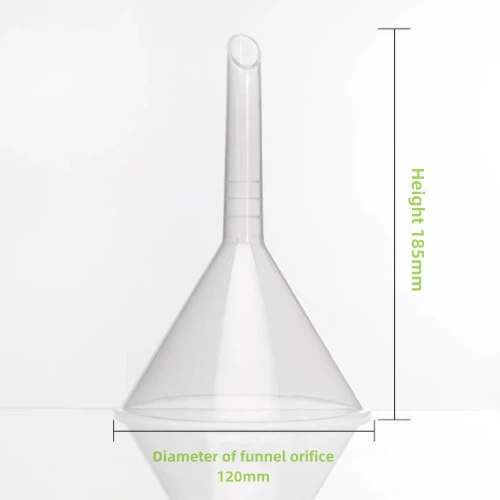
Triangular Funnel

Big mouth Funnel


Wide-mouthed funnel

Material and Construction
(1) Material:
Common materials for 250ml seprating funnls include glass, plastic (such as FEP, Teflon, etc.), and certain special alloys.
Glass material separatory funnels are widely favored due to their high chemical stability and transparency, but care should be taken to prevent damage.
Plastic material (such as FEP, Teflon) separation funnels have better corrosion resistance, especially for chemicals that may corrode glass.
The seprating fnnel made of special alloy material is suitable for high temperature or high pressure environments.
(2) Construction:
A 250ml separating funnel typically consists of a funnel body, a valve (usually made of PTFE or glass material), a plug (used to seal the funnel mouth), and possible fixing devices (such as brackets).
The funnel body is usually designed in a spherical or pear shape to better accommodate liquids and promote phase separation.
The valve is usually located at the bottom of the fnnel and controls the discharge of liquid through rotation or push-pull operation.
The plug is used to maintain its sealing state when the funnel is not in use, preventing liquid leakage.
Function and purpose
(1) Phase separation:
The main function of a 250ml separating funnel is to perform phase separation during liquid-liquid extraction processes. During the extraction process, two immiscible liquids (such as organic solvents and water) will spontaneously separate into two distinct layers. By adjusting the tilt angle of the fnnel and rotating the valve, it is easy to discharge the required layer of liquid.
(2) Chemical synthesis:
In chemical synthesis, a 250ml separatory fnnel is commonly used for adding reactants and collecting products. By controlling the droplet velocity and sequence of reactants, the efficiency of chemical reactions and product purity can be optimized.
(3) Sample processing:
During the sample processing, a separatory funnel can be used to extract and separate target components from the sample. For example, in the field of environmental science, separatory funnels are commonly used to extract organic pollutants from soil or water samples.
(4) Aseptic operation:
The sterile fnnel (sterilized seprating funnel) plays an important role in sample filtration and extraction under sterile conditions. By avoiding microbial contamination of samples during operation, the accuracy and reliability of experimental results can be improved.
Difference
Dropping funnels can be divided into atmospheric pressure dropping fnnels and constant pressure dropping funnels based on whether the pressure of contact between the upper and lower liquid surfaces during dripping is the same. Dropping fnnels can be divided into spherical dropping funnels and cylindrical dropping funnels based on the shape of the container. The atmospheric pressure dropping funnel consists of a frosted glass stopper at the upper end, a container in the middle, and two pipes and a handle at the lower end. The biggest difference between the dropping funnel and the separating funnel is the handle. The handle of the dropping fnnel consists of two parts. The lower handle of the atmospheric pressure spherical dropping funnel consists of a short glass tube and an outer spherical long glass tube.
The main function of the spherical dropping funnel is:
When preparing some gases (especially toxic gases), the droplet velocity of the liquid is controlled to control the reaction rate, especially for some reactions that are more intense, smoke is generated in the container during the reaction, or colored gases are prepared. For example, in the laboratory, chlorine gas (especially potassium permanganate reacts with concentrated hydrochloric acid to produce chlorine gas), nitrogen dioxide, manganese dioxide catalyze the decomposition of hydrogen peroxide to produce oxygen, and in the laboratory to produce acetylene and other gases, it is not convenient to control the reaction rate by observing the speed of liquid droplet addition in the reaction container. The concept of green chemistry is to first prevent and control the reaction, rather than adjusting it after discovering that the reaction is too fast or too slow. The lower end structure of the droplet fnnel determines that liquid can be easily added during gas preparation through its spherical handle at the lower end. Observing the speed at which liquid droplets are added.
For some reversible reactions, the equilibrium is continuously shifted towards the target product by continuously adding liquid while distilling the reaction product. In the experiment, the lower end of the dropping funnel should be extended below the liquid level. In current ground glass instruments, whether it is an atmospheric pressure cylindrical dropper fnnel or a constant pressure cylindrical dropper funnel, the lower end is a double-layer sleeve, and the inner tube is slightly longer than the outer tube, mainly used for the dropwise addition of liquids in organic reactions. The outer tube has a ground mouth, which is used to insert into the reaction vessel to seal its contact area, and also plays a certain role in fixing the dropper funnel. The inner tube is connected to the fnnel container through a piston for the dropwise addition of liquids. This structure ensures that the liquid is added in a droplet form instead of flowing along the reactor wall, which is not only convenient for observing the speed of liquid dripping, but also for the droplet to enter the middle position of the container, which is convenient for stirring and mixing the reactants, improving the reaction rate, and reducing side reactions. If... Using a grinding mouth seprating funnel, as the lower handle of the seprating funnel is a single-layer glass tube, When adding liquid droplets, the liquid will flow along the wall of the reactor into the reaction vessel, which is not conducive to experimental operation and may slow down the reaction rate or reduce the yield.
The dropping funnel and the seprating fnnel have significant differences in structure, and each has its corresponding purpose. The main function of the spherical seprating fnnel is to quickly shake and settle the mixture for separation. For some gas preparation experiments with mild reactions, such as measuring the reaction rate of zinc and dilute sulfuric acid reaction. However, for the preparation of gases such as chlorine gas, hydrogen peroxide catalyzed decomposition to produce oxygen, nitrogen dioxide, and acetylene in the laboratory, as well as for some experiments that require insertion of liquid droplets below the liquid level, it is not advisable to use a spherical seprating fnnel instead of a spherical dropping funnel. It is best to use a spherical dropping funnel
Operation Guide
|
(1) Preparation stage:
Before using the 250ml separating funnel, ensure that it is clean and undamaged. (2) Loading liquid:
Carefully pour two immiscible liquids into the funnel. Pay attention to controlling the pouring speed to avoid uneven mixing or splashing of the liquid. (3) Phase separation:
Wait for the liquid to naturally layer. Usually, liquids with higher density deposit at the bottom of the funnel, while liquids with lower density are located in the upper layer. (4) Discharge liquid:
Tilt the funnel to the desired angle, open the valve, and slowly discharge the required layer of liquid. (5) Cleaning and maintenance:
After use, clean the funnel with a suitable solvent to remove any residue. |
|
Common problems and solutions
(1) Liquid leakage:
Possible reasons: The valve or plug is not tightly closed; The funnel body has cracks or damage.
Solution: Check if the valve and plug are tightly closed; Replace the damaged funnel.
(2) Uneven mixing of liquids:
Possible reason: The pouring speed of the liquid is too fast; The funnel shape is not suitable.
Solution: Control the pouring speed; Choose a more suitable funnel shape.
(3) Difficulty in emissions:
Possible reasons: valve blockage; The inclination angle of the funnel is not sufficient.
Solution: Clean the valve; Adjust the inclination angle of the funnel.
Assembly points
1.
Check if the glass plug and piston core are compatible with the seprating fnnel. If they are not compatible, they often leak or cannot be operated at all. If you want to use an incompatible sparating funnel, you must first test its suitability and leakage after assembly, and only use it after confirmation that it can be used.
2.
Apply a thin layer of lubricating grease, such as Vaseline, on the piston core, insert the piston core into the piston, rotate it several times to evenly distribute the lubricating grease, and then close the piston. Then, put a rubber ring with a suitable diameter on the groove of the piston core (cut a thin ring from a latex tube with a suitable diameter) to prevent the piston core from leaking or falling off during operation, which may cause experimental failure.
3.
When a sparating funnel needs to be dried, special attention should be paid to pulling out the piston core and checking whether the piston is clean and dry. Those that do not meet the requirements should be cleaned and dried before use.
Hot Tags: 250ml separating funnel, China 250ml separating funnel manufacturers, suppliers, factory, Hydrothermal Reactor, High Pressure Autoclave Reactor, Hydrothermal Autoclave Reactor With Teflon Chamber 100ml, Tablet Press Machine, SS Reactor Manufacturer, Stainless Steel Chemical Reactor
Previous
500ml Separatory FunnelSend Inquiry


