



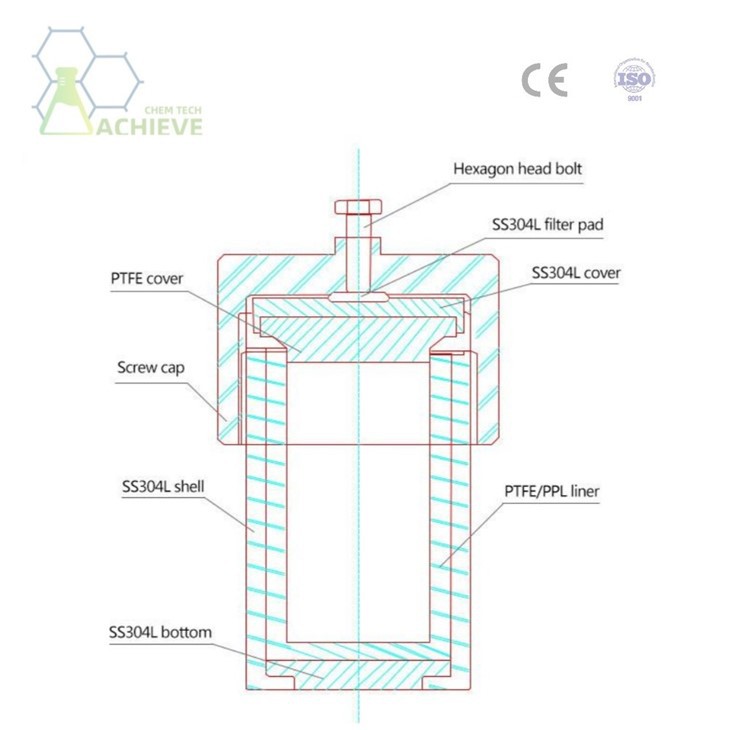
Teflon Coated Autoclave
(1)25ml/50ml/100ml/150ml/200ml/250ml/300ml/400ml/500ml/1000ml---PTFE/≤ 220°C
(2)25ml/50ml/100ml/150ml/200ml/250ml/300ml/400ml/500ml/1000ml---PPL/≤ 280°C
***Price List for whole above, inquire us to get
2. Customization:
(1)Design support
(2)Directly supply the Senior R&D organic intermediate, shorten your R&D time and cost.
(3)Share the advanced purifying technology with you
(4)Supply the high quality chemicals and analysis reagent
(5)We want to assist you on Chemical Engineering (Auto CAD, Aspen plus etc.)
3. Assurance:
(1)CE and ISO certification Registered
(2)Trademark: ACHIEVE CHEM(since 2008)
(3)Replacement parts within 1-year for free
Description
Technical Parameters
Teflon Coated Autoclave is a sophisticated experimental equipment widely used in various chemical reactions and high pressure application scenarios in chemical laboratories. The polytetrafluoroethylene coated high-pressure kettle mainly consists of two components: the kettle body and the kettle cover. The interior of the kettle is equipped with a polytetrafluoroethylene coating, which can resist the erosion of various chemicals and ensure that the chemicals inside the kettle are not contaminated. The kettle cover is equipped with a safety valve and pressure gauge, which can monitor the pressure inside the kettle in real time to ensure the safety of the experiment. In addition, the kettle body is also equipped with a heating sleeve and stirrer, which can facilitate heating and stirring operations. It has a series of excellent properties that make it an ideal material for application in many fields. The most significant ones are its chemical corrosion resistance and low friction coefficient. Due to the stability of the molecular structure of polytetrafluoroethylene, it can maintain stability and is not corroded in most chemical environments. At the same time, due to its extremely low friction coefficient, the friction resistance generated by the equipment during operation is smaller, and the energy consumption is lower.

Product Introduction

Teflon Coated Autoclave is a product that combines the advantages of polytetrafluoroethylene material and autoclave equipment. Polytetrafluoroethylene is a highly corrosion-resistant material with extremely low friction coefficient and high chemical stability. Applying polytetrafluoroethylene material to the inner lining of high-pressure vessels can improve the corrosion resistance and chemical resistance inside the vessel, ensuring that chemical substances are not contaminated during the experimental process. It has various specific applications in cell culture, including environmental control, operational optimization, gas exchange, pollution control, pressure control, drug screening, and scientific research. These uses make polytetrafluoroethylene coated autoclaves an important tool in biomedical experiments and preparation processes, providing reliable solutions for cell culture.
Product Parameter

All kinds of "Hydrothermal Synthesis Reactor", price list, you can choose online HERE
function

Teflon Coated Autoclave have many specific applications in cell culture.
The polytetrafluoroethylene coated high-pressure kettle can provide a constant temperature and non-toxic environment, providing suitable conditions for cell culture. In biomedical experiments and preparation processes, cell culture requires a stable, sterile, and non-toxic environment. The polytetrafluoroethylene coated autoclave can meet these requirements and provide suitable conditions for cell growth and reproduction.
The coating inside the polytetrafluoroethylene coated high-pressure vessel has extremely low friction coefficient and excellent anti adhesion, which can make the mixing and mass transfer during the cell culture process more complete, improving the efficiency and effectiveness of cell culture. At the same time, this material can also prevent cell adhesion and growth, thereby avoiding the generation of cell clusters and optimizing the operation process of cell culture.
The polytetrafluoroethylene coated high-pressure vessel has good gas permeability and can provide a good gas exchange environment for cell culture. Gas exchange is one of the important factors in maintaining cell growth and metabolism during cell culture. The coating inside the high-pressure kettle can fully penetrate the gas, avoiding the problem of poor gas exchange caused by sealing.
The polytetrafluoroethylene coated autoclave has non-toxic and biocompatible properties, which can effectively prevent pollution during cell culture. Pollution is one of the common problems in cell culture, which can lead to cell death, growth stagnation, or mutation. The use of polytetrafluoroethylene coated high-pressure vessels can effectively avoid pollution issues and ensure the safety and effectiveness of cell culture.
The polytetrafluoroethylene coated high-pressure kettle can monitor the pressure inside the kettle in real-time, providing accurate data support for pressure control during the cell culture process. During the process of cell culture, changes in pressure can have an impact on cells. If the pressure is too high, it may lead to cell death, while if the pressure is too low, it may lead to cell growth arrest. The use of high-pressure vessels can accurately control pressure and provide a suitable pressure environment for cell culture.
Polytetrafluoroethylene coated high-pressure vessels can provide a high-temperature, sterile, and non-toxic environment, suitable for drug screening and other research work. During the drug screening process, it is necessary to maintain a stable and sterile environment to avoid interference from external factors. The polytetrafluoroethylene coated autoclave can meet these requirements and provide suitable conditions for drug screening.
Polytetrafluoroethylene coated high-pressure vessels are suitable for biomedical scientific research and can be widely used in research fields such as cell biology, molecular biology, immunology, neuroscience, etc. This high-pressure kettle can provide a high-temperature, sterile, and non-toxic environment, providing reliable experimental conditions for scientific research.
Product Introduction
The material advantages of Teflon Coated Autoclave are as follows:
1. Corrosion resistance and chemical stability:
Polytetrafluoroethylene coating has extremely high corrosion resistance and hardly reacts with any chemical substances, effectively preventing chemical corrosion and material pollution. It has high stability to acids, bases, salts, and most other chemical substances and can be used in harsh chemical environments.
2. High temperature resistance:
PTFE coating can maintain good stability at high temperatures, so PTFE coated high-pressure vessels can be used at higher temperatures. Most organic chemical reactions and biomedical experiments require high temperature conditions, so this high-pressure vessel provides convenience for experiments and research in these fields.
3. Anti adhesion and low friction coefficient:
PTFE coating has extremely low friction coefficient and excellent anti adhesion, which can fully stir and mix the materials in the high-pressure kettle, while preventing material adhesion and blockage of the equipment. This not only improves the efficiency of the experiment, but also helps to reduce energy consumption.
4. Non toxicity and biocompatibility:
PTFE coatings do not release toxic substances and are not toxic to biological tissues, making them safe for use in biomedical experiments. In addition, it can also be used in sterile environments, suitable for biomedical research and preparation processes that require high levels of sterility.
5. Easy to clean and maintain:
The polytetrafluoroethylene coating has a smooth surface and is not prone to adhering substances, making the high-pressure kettle easy to clean and maintain. Simply wipe with a soft cloth to keep the equipment clean, saving a lot of cleaning and maintenance time and costs.
6. Good mechanical properties:
PTFE coating has good mechanical properties and can withstand high pressure and high shear forces. During the operation of the high-pressure kettle, the coating will not crack or fall off, ensuring the safety of the experiment and the long-term stable operation of the equipment.
7. Economy:
Although the cost of PTFE coating is relatively high, it can greatly extend the service life of high-pressure vessels and reduce the frequency and cost of equipment updates. In the long run, using polytetrafluoroethylene coated high-pressure vessels is more cost-effective.
8. Sustainability and environmental protection:
PTFE coated autoclaves are a sustainable and environmentally friendly material solution. It can be recycled and reused, reducing the generation of waste. In addition, due to its low energy consumption and long lifespan, it helps to reduce resource consumption and environmental impact.
Accessory
Polytetrafluoroethylene (PTFE), commonly known as the "plastic king" or Teflon, is a high molecular weight polymer made by polymerizing tetrafluoroethylene as a monomer. Among numerous polymer materials, polytetrafluoroethylene is known for its extremely low coefficient of friction, which not only provides unique advantages for its application in multiple fields, but also makes it an important research object in the field of materials science.
1. Friction coefficient of polytetrafluoroethylene
The coefficient of friction is a physical quantity that describes the ratio between the frictional force that two objects need to overcome when they come into contact and move relative to each other and the positive pressure on the contact surface. It is usually represented by μ, and the smaller its value, the smaller the frictional resistance between the two objects. The friction coefficient of polytetrafluoroethylene is extremely low, generally around 0.04, which is much lower than most other materials, including other polymer materials, metals, and ceramics. This extremely low friction coefficient makes polytetrafluoroethylene highly valuable for applications that require reducing friction and wear.
2. The cause of extremely low friction coefficient
The reason why polytetrafluoroethylene has such a low friction coefficient is mainly attributed to its unique molecular structure and surface properties. The molecular chain of polytetrafluoroethylene is composed of a large number of fluorine atoms and a small amount of carbon atoms. The fluorine atoms form a dense protective layer on the outside of the molecular chain, making the surface of polytetrafluoroethylene extremely smooth and low in surface energy. This low surface energy makes it difficult for polytetrafluoroethylene surfaces to form strong chemical bonds or physical adsorption with other substances, thereby effectively reducing frictional resistance during relative movement.
In addition, the weak interaction force between polytetrafluoroethylene molecular chains makes them prone to slip and rearrangement when subjected to external forces, thereby further reducing frictional resistance. The slip and rearrangement characteristics of this molecular chain also enable polytetrafluoroethylene to self repair when subjected to wear, maintaining a low friction coefficient and a longer service life.
3. Application of extremely low friction coefficient
The extremely low friction coefficient of polytetrafluoroethylene provides broad space for its application in multiple fields. In the mechanical industry, polytetrafluoroethylene is widely used to manufacture various sliding bearings, seals, piston rings, and other components to reduce friction and wear, improve the operational efficiency and reliability of mechanical equipment. In the field of chemical engineering, polytetrafluoroethylene coating is used for anti-corrosion equipment and pipeline lining to prevent corrosion and wear of equipment by chemical media. In the fields of food processing and medicine, polytetrafluoroethylene coatings are used to manufacture non stick pans, baking molds, and medical devices to ensure product hygiene and safety.
Hot Tags: teflon coated autoclave, China teflon coated autoclave manufacturers, suppliers, factory, High Pressure Hydrogenation Reactor, High Pressure Lab Reactor, SS Reactor, 50L Jacketed Reactor, Rotovap Distillation, High Pressure Stainless Steel Reactor
Previous
Teflon Lined Stainless AutoclaveSend Inquiry


