


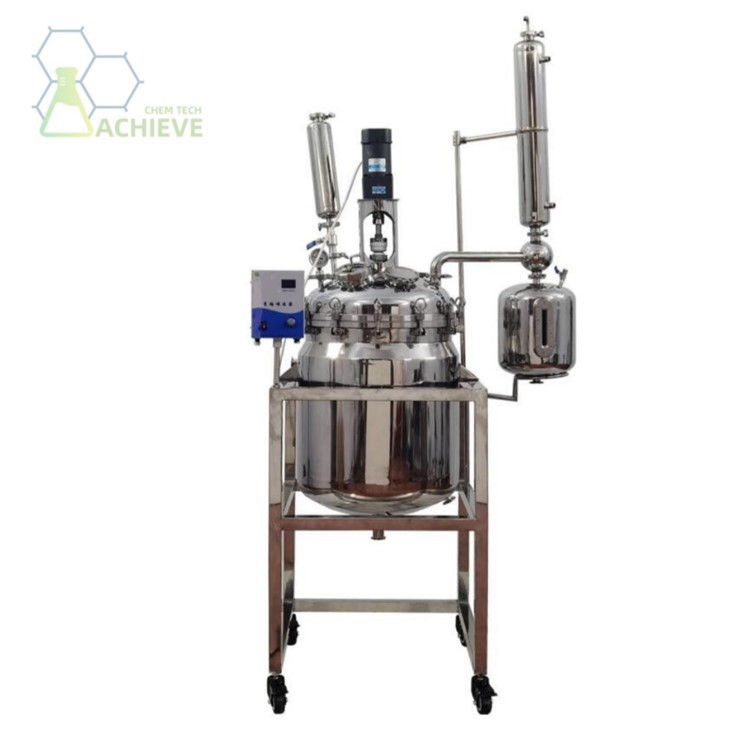


Stainless Steel Jacketed Reactor
(1)2L/3L/5L/10L/20L/30L/50L/100L/150L/200L---Standard
(2)2L/3L/5L/10L/20L/30L/50L/100L/150L/200L---EX-proof
***Price List for whole above, inquire us to get
2. Customization:
(1)Design support
(2)Directly supply the Senior R&D organic intermediate, shorten your R&D time and cost
(3)Share the advanced purifying technology with you
(4)Supply the high quality chemicals and analysis reagent
(5)We want to assist you on Chemical Engineering (Auto CAD, Aspen plus etc.)
3. Assurance:
(1)CE and ISO certification Registered
(2)Trademark: ACHIEVE CHEM(since 2008)
(3)Replacement parts within 1-year for free
Description
Technical Parameters
Stainless steel jacketed reactor is a kind of equipment used for chemical reaction, mixing and heating/cooling.
It consists of an inner container (reaction container) and an outer jacket, and a space is formed between them for the medium to flow. The inner container is usually made of stainless steel, which has good corrosion resistance and tightness. The outer jacket is also made of stainless steel, which can heat or cool the reactants in the jacket by circulating fluid.
When selecting the reactor, it is necessary to consider the material, specifications, heating method, stirring form, pressure and temperature range of the reactor to ensure that the equipment can meet the specific use needs. In addition, many manufacturers also provide customized services, which can be designed and manufactured according to the specific requirements of users.


Product Features


The main reasons for using cylindrical container in stainless steel jacketed reactor are as follows:
◆ Uniform stress distribution: Cylindrical container can evenly disperse stress under the action of internal pressure. Compared with other shapes (such as square or oval), cylindrical containers can bear internal pressure more effectively and have stronger deformation resistance.
◆ Lower surface area to volume ratio: Compared with other containers, cylindrical containers have the smallest surface area to volume ratio. This means that in the case of the same volume, the cylindrical container needs less materials and the manufacturing cost is lower. In addition, the smaller surface area can also reduce the heat exchange with the outside world and improve the thermal insulation performance.
◆ Optimized liquid mixing and heat transfer effect: Cylindrical container is beneficial to liquid mixing and heat transfer effect. Due to the symmetry of the cylindrical container, the rotation of the agitator can better mix the reaction materials evenly. In addition, the cylindrical container is beneficial to the uniform distribution of heat conduction, thus improving the efficiency of the reaction and the quality of the product.
◆ Convenient fluid discharge and cleaning: The bottom of cylindrical container is usually provided with a discharge port to facilitate fluid discharge. At the same time, the cylindrical container has no sharp corners and dead corners, which makes it more convenient to clean and not easy to leave reaction materials and pollutants.
Please feel free to click the laboratory reactors to obtain more details. Following that, you will know how to purchase the item you want from the list.
Maintenance
The selection of cleaning agents for Stainless Steel Jacketed Reactor is crucial for ensuring equipment cleanliness and extending its service life. The following are some types of cleaning agents suitable for stainless steel jacket reaction vessels:
Firstly
For common dirt on the surface of stainless steel, such as grease, rust, scale, etc., stainless steel specific cleaning agents can be selected. This type of cleaning agent usually has excellent emulsifying, dispersing, penetrating, and cleaning properties, which can quickly and effectively remove dirt on the surface of stainless steel while maintaining its luster and integrity. The characteristic of stainless steel cleaning agent is its strong cleaning ability, which can clean various metals and has no corrosion on the surface of stainless steel, does not damage the substrate, and is safe to operate.
Secondly
For special types of dirt, such as acidic or alkaline dirt, corresponding acid-base cleaning agents can be selected. For example, for acidic dirt, weak alkaline cleaning agents can be used for neutralization and cleaning; For alkaline dirt, weak acidic cleaning agents can be used. However, it should be noted that when using acid-base cleaning agents, it should be ensured that the cleaning agent is compatible with the material of the stainless steel jacket reactor to avoid corrosion to the equipment.
In addition
There are some environmentally friendly cleaning agents to choose from. These cleaning agents are typically made from natural or renewable raw materials and are harmless to the environment and human health. During the cleaning process, they can quickly decompose and remove dirt, while reducing environmental pollution. Choosing environmentally friendly cleaning agents can help enterprises achieve green production and meet the requirements of sustainable development.

The cleaning agent for stainless steel jacket reactor can be selected according to different dirt properties and cleaning requirements. The following are some commonly used types of cleaning agents:
Special cleaning agents for reaction vessels:
These cleaning agents are composed of safe organic acids, penetrating agents, corrosion inhibitors, and clay stripping agents. Although they are acidic, they are safe for materials. The descaling and rust removal effects are good, safe to use, and easy to operate. It can effectively improve the efficiency of equipment, significantly reduce power consumption and operating costs.
Pure acid and alkali washing solution:
Depending on the nature of the fouling in the enamel reactor, it can be directly soaked in concentrated sulfuric acid (HCL), concentrated sulfuric acid (H2SO4), and concentrated nitric acid (HNO3). Sodium carbonate washing solution is often soaked in concentrated caustic soda (NaOH), potassium hydroxide (KOH), or sodium carbonate (Na2CO3) solution with a concentration of more than 10%.
Alkaline potassium permanganate washing solution:
Using alkaline potassium permanganate as the washing solution, take 4g of potassium permanganate (KMnO4) and dissolve it in a small amount of water. Then add 100mL of 10% sodium hydroxide (NaOH) and slowly pour it into the dirt area of the enamel reactor for alkaline cleaning.
Organic solvents:
For enamel reaction vessels with fatty dirt, they can be scrubbed or soaked with organic solvents such as gasoline, toluene, xylene, acetone, alcohol, chloroform, ether, etc. However, it should be noted that these organic solvents are flammable and require strict adherence to safety operating procedures when used.
When selecting cleaning agents, the following factors need to be considered:
◆ Dirt properties: Different types of cleaning agents may be required for different types of dirt. For example, acidic cleaning agents may be more effective against alkaline dirt, while alkaline cleaning agents may be more effective against acidic dirt.
◆ Material compatibility: Ensure that the selected cleaning agent does not cause corrosion or damage to the stainless steel jacket reactor. You can check the ingredient description of the cleaning agent to understand its compatibility with stainless steel.
◆ Safety: The use of cleaning agents should comply with relevant safety operating procedures to ensure personnel safety. For example, avoid the risk of fire when using flammable organic solvents.
◆ Environmental friendliness: Choosing environmentally friendly cleaning agents can help reduce pollution to the environment. You can pay attention to whether cleaning agents contain harmful chemical components and try to choose cleaning agents that meet environmental requirements.
Please note that the above suggestions are for reference only. In practical applications, suitable cleaning agents should be selected according to specific situations, and relevant usage instructions and safety operating procedures should be followed. If necessary, you can consult professional cleaning agent suppliers or experts in related fields.
 |
 |
 |
Material selection
For the pharmaceutical profession, when choosing the material of the jacketed reactor, it is necessary to consider multiple factors such as the nature of the reactants, reaction conditions, corrosion resistance, strength, cost, and ease of cleaning and maintenance. Here are some suggested material choices:
Stainless steel material
Stainless steel is one of the most commonly used materials in jacketed reactors, especially in the pharmaceutical industry. Stainless steel has good corrosion resistance, high strength and good heat transfer properties. The following are several common stainless steel materials and their characteristics:
304 stainless steel
It has good corrosion resistance and is suitable for general chemical reactions and pharmaceutical processes. However, for certain highly corrosive materials, higher grades of stainless steel may be required.
316 stainless steel
Compared with 304 stainless steel, 316 stainless steel has better corrosion resistance, especially in the environment containing chloride ions. It is suitable for the treatment of materials containing chloride ions, such as the synthesis process of some drugs.
316L stainless steel
It is a low-carbon version of 316 stainless steel and has similar corrosion resistance to 316, but it is not easy to produce intergranular corrosion when welding. It is suitable for jacketed reactors requiring welding.
Other material consideration
In addition to stainless steel, the following materials can also be considered, but need to be selected according to the specific application scenario and needs:
Glass materials
Glass jacketed reactors are often used for laboratory-scale reactions because of their excellent transparency and ease of observing the reaction process. However, glass may not withstand as much pressure and temperature as stainless steel.
Ceramic materials
Some high-performance ceramic materials (such as silicon nitride ceramics) have high hardness and corrosion resistance, suitable for harsh chemical environments. However, the cost of ceramic materials is usually higher, and processing and maintenance can be more complex.
Titanium material
Titanium is a metal with excellent corrosion resistance, suitable for handling highly corrosive materials. However, the cost of titanium is also relatively high.
Material selection suggestions

Select according to reactant properties
Understand the chemical properties of the reactant, including its corrosion, reaction temperature, pressure, etc., to choose a material that can withstand these conditions.

Consider cost and processability
Stainless steel generally has a lower cost and good processability, suitable for mass production and industrial applications. Other materials such as ceramics and titanium may be more expensive or difficult to process.

Consider cleaning and maintenance
The pharmaceutical industry has strict requirements for the cleaning and maintenance of equipment. Choosing materials that are easy to clean and maintain can extend the service life of your equipment and meet industry requirements.
Operating standards and safety measures
Operating specification
Check the reactor thoroughly before use to ensure that it is in good working condition.
Check that critical components such as agitators, heating systems, cooling systems, pressure gauges, thermometers are in good condition, and that pipes and valves are unimpeded.
According to the nature of the reactants and process requirements, prepare the corresponding protective equipment, such as protective glasses, gloves, protective clothing, etc.
Before adding, turn on the mixer and make sure it is working properly and without noise.
According to the process requirements, the reactants are added to the reactor in a certain order and proportion, and the feeding speed is controlled to avoid the reaction being uneven or out of control due to too fast or too slow.
Precise control of reaction temperature, temperature measurement using accurate thermometers, and regular calibration to ensure measurement accuracy.
Pay close attention to pressure changes during the reaction, use a pressure gauge for pressure measurement, and regularly calibrate to ensure measurement accuracy.
During heating or cooling, the steam valve or cooling water valve should be adjusted slowly to avoid excessive thermal shock or cold shock to the reactor.
During the reaction process, pay close attention to the operating status of the equipment and the reaction process, find problems in time and take measures.
Do not switch on or off the device or adjust parameters such as temperature and pressure to avoid safety accidents.
After the reaction, the product should be properly disposed of in accordance with the process requirements to avoid direct discharge of the product into the environment.
When cleaning the stainless steel jacketed reactor, appropriate cleaning agents and cleaning methods should be selected to avoid corrosion or damage to the equipment.
Security measures
Safety protection
Operators should wear protective equipment, such as protective glasses, gloves, protective clothing, etc., to prevent chemicals from splashing on the skin or eyes.
Set up obvious safety warning signs in the operation area to remind operators to pay attention to safety.
01
Emergency treatment
Develop an emergency plan to clarify the response measures and escape routes in the event of an emergency.
When abnormal conditions are found, such as overtemperature, overpressure, leakage, etc., the operation should be stopped immediately and the relevant personnel should be reported, and emergency measures should be taken to deal with it, such as closing the steam valve and opening the cooling water valve.
02
Chemical Management
Store chemicals in a dry, ventilated, cool place, away from fire and heat sources.
Ensure that chemical packaging is intact to avoid leakage or volatilization.
When using chemicals, you should carefully read the chemical safety instructions to understand the nature, hazards and protective measures of the chemicals.
03
Equipment maintenance and maintenance
Regular maintenance of the stainless steel jacketed reactor, such as cleaning equipment surface dirt, wiping dust, lubricating bearings, etc.
Inspect and replace worn or damaged parts to ensure equipment is in good working order.
04
Training and supervision
Conduct regular safety training and operation skills training for operators to improve their safety awareness and operation skills.
Set up a special safety supervisor to supervise the entire operation process to ensure that the operator complies with the operation specifications and safety measures.
05
Hot Tags: stainless steel jacketed reactor, China stainless steel jacketed reactor manufacturers, suppliers, factory, 50L Jacketed Reactor, Short Path Distillation Kit Turn Key, Chemglass Jacketed Reactor, Stainless Steel Pressure Reactor, Jacketed Glass Reactor Vessel, 20l Rotary Evaporator
Previous
SS316 ReactorSend Inquiry


