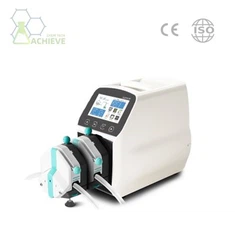
Peristaltic Pump Speed
Flow range:0.0053-6000ml/min
2.Basic peristaltic pump:LabM series
Flow range:0.0053-3100ml/min
3.Industrial peristaltic pump
Speed range:0.1-600rpm
Description
Technical Parameters
Peristaltic pump speed, In Chinese, it is usually translated as "perisaltic pump", but can also be translated as "perisaltic pump", "perisaltic pump" or "perisaltic pump". It is a special fluid transport device that uses a hose as a pump tube to periodically squeeze the hose to push the fluid forward, thereby achieving the transport of liquid. Its working principle is similar to human intestinal peristalsis, hence its name. It plays an important role in multiple fields such as biomedical, chemical experiments, and industrial production. It can precisely control the flow rate and velocity of fluids, meeting various precise transportation needs. Meanwhile, due to its independence from fluid viscosity or gravity, it can effectively operate under various conditions, including transporting high viscosity fluids or handling small flow rates.
The speed of the peristaltic pump can be adjusted in a variety of ways to meet different application needs, and the common adjustment methods include mechanical speed regulation and electronic speed regulation.
The perisaltic pump is mainly composed of three parts: the driver, the pump head, and the elastic hose.
Driver:
Responsible for providing power to drive the roller or compression mechanism of the pump head to rotate.
Pump head:
It includes a roller and a pump casing. The roller rotates inside the pump casing and pushes the fluid by squeezing the hose.
Elastic hose:
As a pump tube, it deforms after being squeezed by rollers, thereby pushing the fluid forward. When the roller is released, the hose returns to its original shape, creating negative pressure and sucking in more fluid.
Specifications


Core Elements
The rotational peristaltic pump speed, a key parameter, is directly related to the speed at which the driver drives the pump head roller to rotate, and its quantitative indicator is usually clearly identified in revolutions per minute (RPM). Rotational speed is not only one of the core elements for evaluating the performance of perisaltic pumps, but also a decisive factor affecting flow output and pulsation characteristics.
(1) Analysis of the relationship between rotational speed and flow rate
The working principle of a perisaltic pump determines the direct proportional relationship between its flow rate and rotational speed. Specifically, as the rotational speed increases, the squeezing frequency of the pump head roller on the hose significantly increases, which directly promotes the fluid to be pushed forward at a faster speed. Therefore, by precisely adjusting the speed, users can achieve highly precise control over the flow output of the perisaltic pump, whether it requires micro delivery or large flow supply, which can be easily achieved by adjusting the speed. This flexible flow control capability enables perisaltic pumps to demonstrate unparalleled advantages in situations that require precise flow control, such as laboratory precision reagent dispensing and drug infusion in the medical field.
(2) Exploration into the Relationship between Rotational Speed and Pulse Size
Although perisaltic pumps are known for their stable delivery capacity, pulsation phenomena, i.e. small fluctuations in flow rate, are still inevitable during fluid delivery. The magnitude of pulsation is influenced by various factors, and rotational speed is one of them. Under the premise of maintaining the same flow output, the increase in speed is often accompanied by an increase in pulsation amplitude. This is because the rapid and continuous compression of the hose by the roller may cause the flow state of the fluid inside the pipeline to become more unstable. However, it is worth noting that through a series of technical means, such as increasing the number of rollers, optimizing the arrangement of rollers, and improving the design of the pump head, this pulsation phenomenon can be effectively alleviated to a certain extent, making the output of the perisaltic pump more stable and meeting the high requirements for fluid transport stability in application scenarios.
(3) The flexibility and intelligence of speed regulation
In order to meet the needs of different application scenarios, modern perisaltic pumps are generally equipped with advanced speed regulation functions. Users can choose to manually or automatically adjust the speed according to their actual needs. Manual adjustment is usually achieved through knobs or buttons, allowing users to directly observe changes in speed and make adjustments accordingly, achieving intuitive and fast adjustment. And automatic adjustment is more intelligent, relying on external control signals or sensor feedback, which can automatically adjust the speed according to actual working conditions or preset programs, ensuring that the perisaltic pump always operates in the best state. This intelligent regulation method not only improves work efficiency, but also further enhances the stability and reliability of the system.
Adjustment and optimization of peristaltic pump speed
Our Products


In order to ensure the stable operation and precise control of the perisaltic pump, it is necessary to adjust and optimize the speed appropriately. Here are some common adjustment and optimization methods:
Manually adjust the rotational peristaltic pump speed through a knob or button. This method is simple and intuitive, suitable for scenarios that require frequent adjustment of speed. However, manual adjustment may not be precise enough and cannot achieve real-time monitoring and automatic adjustment.
Automatically adjust the rotational speed of the perisaltic pmp using external control signals or sensor feedback. This method can achieve precise control and can be adjusted in real-time according to actual needs. For example, in biomedical experiments, real-time monitoring of experimental conditions can be achieved through a computer control system, and the rotational speed and flow rate of the perisaltic pmp can be automatically adjusted as needed.
Reduce pulsation and improve flow stability by optimizing pmp head design. For example, increasing the number of rollers, optimizing the shape and size of rollers, and improving the pmp casing structure can all reduce pulsation and improve flow stability to a certain extent.
Choosing the appropriate hose has a significant impact on the performance and lifespan of perisaltic pmps. Different hose materials have different corrosion resistance, elastic recovery ability, and service life. Therefore, when selecting a hose, factors such as fluid properties, working pressure, temperature, etc. need to be considered to ensure the applicability and reliability of the hose.
Regular maintenance and upkeep of perisaltic pmps can extend their lifespan and improve their performance. For example, cleaning the pmp head and hose to remove residue and dirt, inspecting and replacing worn parts, calibrating sensors, etc. can ensure the stable operation and precise control of the perisaltic pump.
Practical application cases
The rotational peristaltic pump speed, as one of the key indicators to measure their performance and work efficiency, can be classified according to different classification criteria. The following is a detailed explanation of the classification of perisaltic pump speed:
Classification based on the form of driver speed

(1) Fixed speed
Definition: The entire perisaltic pmp system maintains a constant speed during operation, and the magnitude of the speed is not adjustable.
Features: Suitable for application scenarios that require high traffic stability but have little demand for traffic changes.
(2) Variable speed
Definition: During the operation of the pmp system, the speed can be adjusted according to different needs, thereby changing the size of the conveying flow rate.
Features: High flexibility, adjustable speed according to actual needs, achieving precise control of flow rate. Widely used in various situations that require precise flow control.
Classification based on work mode or function
(1) Variable speed perisaltic pump
Definition: It has the basic control function of a perisaltic pmp and allows users to adjust the speed according to their needs.
Function: In addition to basic control functions such as displaying speed, start stop, and direction, it usually also has functions such as speed adjustment, filling and emptying, power-off memory, and external control input.
Application scenarios: Suitable for scenarios that require timed and quantitative delivery, liquid packaging, flow testing, etc.


(2) Flow type perisaltic pump
Definition: On the basis of the speed regulating perisaltic pmp, functions such as flow display, flow correction, and communication have been added.
Function: Users can directly input the required flow rate requirements, and the driver will automatically adjust the flow rate to meet the needs. At the same time, it also has flow and time working modes, as well as flow control and display functions.
Application scenario: Suitable for situations that require precise flow control, such as the chemical industry, medical industry, etc.
(3) Distribution type perisaltic pump
Definition: In addition to the functions of speed regulating and flow type perisaltic pmps, it also adds functions such as liquid volume distribution, suction, and output control.
Function: Pre stored multiple allocation parameters for liquid volume and time allocation, used for filling a large amount of liquid (filling perisaltic pmp). It provides multiple working modes such as traffic transmission, time distribution, liquid volume distribution, programming distribution (circulation), etc.
Application scenarios: Widely used in liquid filling, distribution and other occasions, such as the beverage industry, pharmaceutical industry, etc.

Classification based on adjustment methods

(1) Manual adjustment
Definition: Users can manually adjust the speed of the perisaltic pump through knobs or buttons.
Features: Easy to operate, but the adjustment accuracy may be limited by human factors.
(2) Automatic adjustment
Definition: The perisaltic pump automatically adjusts its speed based on external control signals or sensor feedback.
Features: High adjustment accuracy, capable of achieving intelligent flow control. Widely used in situations that require precise flow control and automated operations.
There are various speed classifications for perisaltic pmps, and users can choose the appropriate speed type and adjustment method according to their actual needs. When choosing a perisaltic pmp, in addition to considering the speed factor, it is also necessary to pay attention to factors such as the material of the pmp head, the selection of hoses, the flow range, pressure limitations, and the stability and durability of the pump.
Application
The application of peristaltic pump speed is widespread, and the following are some typical application scenarios:
Biomedical field:
In biomedical research, perisaltic pumps are often used for precise liquid distribution in laboratories, circulation of cell culture media, and drug delivery. By precisely controlling the rotational speed, stable delivery of drugs or culture media can be ensured, meeting the needs of experiments or treatments.
Chemical industry:
In chemical experiments, perisaltic pumps can accurately transport various chemical reagents, ensuring the accuracy and reproducibility of experimental results. At the same time, perisaltic pumps can also handle high viscosity or corrosive fluids, meeting special requirements in chemical experiments. By adjusting the rotational speed, the delivery speed and flow rate of chemical reagents can be controlled, thereby optimizing experimental conditions.


Food processing industry:
In the food processing industry, perisaltic pumps are widely used for various fluid transport tasks. For example, during the transportation of liquids such as juice, vinegar, syrup, etc., perisaltic pumps can ensure the hygiene and quality of the products. By precisely controlling the speed and flow rate, problems such as liquid overflow or pipeline blockage can be avoided, improving production efficiency.
Pharmaceutical industry:
In the pharmaceutical industry, peristalic pumps are used to transport biological products such as drugs and vaccines. These products have extremely high requirements for hygiene and quality, and the pollution-free, easy to clean and maintain characteristics of perisaltic pumps make them an ideal choice. By precisely controlling the speed and flow rate, stable delivery and precise measurement of the medication can be ensured.
In the field of environmental protection:
In the field of environmental protection, perisaltic pumps are used for tasks such as wastewater treatment and sludge transportation. By adjusting the speed and flow rate, the conveying speed and direction of wastewater and sludge can be controlled, thereby optimizing the treatment effect. Meanwhile, the valve free and seal free design of the perisaltic pump makes it easy to clean and maintain, reducing operating costs.
Other industrial sectors:
In addition to the above-mentioned fields, perisaltic pumps are also widely used in various industrial fields such as printing and papermaking, daily chemical products, ceramics, mining, electronics, textiles, construction, automobiles, furniture, metallurgy and casting. In these fields, perisaltic pumps have become indispensable tools due to their unique advantages and wide range of applications.

Hot Tags: peristaltic pump speed, China peristaltic pump speed manufacturers, suppliers, factory, Hydrothermal Synthesis Autoclave Reactor, Short Path Distillation Equipment, Hydrothermal Autoclave Reactor With Teflon Chamber 100ml, High Pressure Chemical Reactor, Molecular Distillation Equipment, 10 Liter Short Path Distillation
Previous
Rotary Peristaltic PumpSend Inquiry