


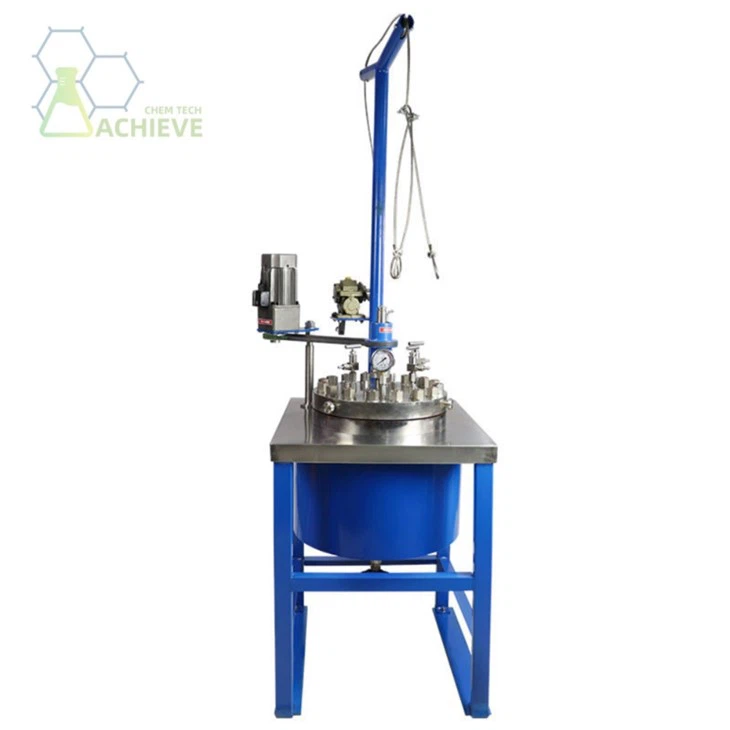


Autoclave Reactor Vessel
2.Volume: 0.1-50L
3.Suitable for alkylation, amination, bromination, carboxylation, chlorination, and catalytic reduction
4.Stainless steel framework
5.Setting Temperature up to 350°C
6.Voltage (V/Hz): 220V 50/60Hz
7.Manufacturer: ACHIEVE CHEM Xi’an Factory
8.16 years experiences on Chemical Equipment
9.CE and ISO certification
10.Professional shipping
Description
Technical Parameters
The autoclave reactor vessel is a critical piece of equipment used extensively in chemical processing, pharmaceuticals, and research laboratories. Designed to facilitate high-pressure and high-temperature reactions, this vessel enables scientists and engineers to conduct experiments and production processes that would otherwise be impossible under normal conditions.
Typically constructed from robust materials such as stainless steel, autoclave reactors are built to withstand extreme pressures and temperatures, often exceeding 200°C and several hundred bar. This capability allows for reactions involving supercritical fluids, hydrogenations, and polymerizations, which require precise control over reaction conditions.
Safety features are paramount in autoclave reactor design, incorporating pressure relief valves, reinforced seals, and advanced monitoring systems to ensure operator safety and prevent equipment failure. These vessels often come equipped with agitators to promote uniform mixing and heat transfer, enhancing reaction efficiency and consistency.
The versatility of autoclave reactors makes them indispensable in developing new compounds, optimizing reaction yields, and scaling up processes for industrial production. Their ability to operate under stringent conditions while maintaining safety and precision underscores their value in advancing scientific research and manufacturing across various industries.

Parameters Table



Key Features
 |
 |
 |
Pressure Resistance: The most distinguishing feature of an autoclave reactor is its ability to withstand significant internal pressures. The thick, heavy-duty walls and specialized materials (such as stainless steel, Hastelloy, or titanium alloys) ensure structural integrity even at high pressures, allowing for reactions that cannot be safely conducted at atmospheric pressure.
Temperature Control: Equipped with heating and cooling systems, autoclave reactors enable precise temperature control within a wide range. This is crucial for many reactions that require specific temperatures for optimal yield, selectivity, or reaction rates. The ability to ramp up and cool down temperatures smoothly and uniformly is vital for reproducible results.
Sealing Mechanism: The reactor's closure system, often featuring a bolted flange or a quick-opening closure, is designed to maintain a leak-tight seal under pressure. This ensures that the reaction environment is isolated from the external atmosphere, preventing contaminants from entering and reactants from escaping.
Safety Measures: Autoclave reactors incorporate various safety features to minimize risks associated with high pressure and temperature operations. These can include pressure relief valves, temperature sensors with alarms and automatic shut-off systems, burst disks, and emergency venting systems. Additionally, many reactors are designed with explosion-proof enclosures and are equipped with fire suppression systems.
Mixing Capabilities: Efficient mixing is essential for uniform heating and reaction kinetics. Autoclave reactors are often equipped with agitation systems, such as impellers, stirrers, or gas spargers, to ensure proper mixing of reactants. Some reactors also utilize rotating vessels or special baffles to enhance mixing.
Versatility: These reactors can be customized to suit specific process requirements, including various sizes, shapes, and materials of construction. They can also be equipped with additional features like sampling ports, feed and discharge lines, and in-situ monitoring equipment for pH, temperature, or pressure.
Automation and Control: Modern autoclave reactors often incorporate advanced automation and control systems, allowing for precise control of reaction parameters and remote monitoring. This enhances process safety, reproducibility, and productivity.
Easy Cleaning and Maintenance: Design considerations often include access ports and drainage systems to facilitate cleaning and maintenance operations. The use of smooth surfaces and corrosion-resistant materials further simplifies cleaning procedures and minimizes downtime.
Applications
- The autoclave reactor vessel finds its primary application in hydrothermal synthesis, a technique that leverages high pressure and temperature conditions to facilitate chemical reactions in an aqueous environment. This unique process is indispensable in the synthesis of a diverse array of materials, including nanomaterials, catalysts, zeolites, and numerous crystalline compounds.
- In the realm of nanotechnology, autoclave reactors are employed to precisely control the growth and morphology of nanoparticles, enabling the production of materials with tailored properties for applications such as electronics, energy storage, and biomedicine. The high-pressure, high-temperature conditions favor the formation of crystalline structures with well-defined shapes and sizes, crucial for achieving optimal performance in these advanced technologies.
- Catalysts, which accelerate chemical reactions without being consumed, are another important class of materials synthesized using autoclave reactors. The controlled environment provided by the reactor vessel allows for the precise adjustment of reaction conditions, leading to the formation of catalysts with enhanced activity and selectivity.
- Zeolites, known for their remarkable adsorption and ion exchange properties, are also commonly synthesized through hydrothermal processes in autoclave reactors. The unique pore structures of zeolites make them ideal for applications in separation technologies, catalysis, and environmental remediation.
- Additionally, it plays a pivotal role in the synthesis of various crystalline compounds, such as minerals and pharmaceuticals. The high-pressure, high-temperature conditions facilitate the crystallization process, leading to the formation of materials with well-ordered structures and desired properties.
- The high pressure and temperature environment within the autoclave promotes the dissolution of reactants, enhances mass transfer, and facilitates the formation of desired products through crystallization or precipitation.
- Autoclave reactors are also employed in material processing, where they can be used to modify the properties of materials through hydrothermal treatment. For instance, ceramics, metals, and composites can undergo structural changes or surface modifications under these extreme conditions.
- In the case of ceramics, autoclave reactors can be used to densify the material, improving its mechanical strength and wear resistance. The high-pressure, high-temperature environment facilitates the sintering process, which involves the consolidation of ceramic particles into a dense, monolithic structure. This structural change enhances the performance of ceramics in applications such as cutting tools, abrasives, and structural components.
- Metals can also undergo beneficial transformations under autoclave conditions. For instance, autoclave reactors can be used to anneal metals, a process that eliminates internal stresses and improves the material's ductility and toughness. Additionally, autoclave treatment can be employed to create oxide layers on metal surfaces, enhancing corrosion resistance and wear properties.
- Composite materials, which consist of a combination of two or more distinct phases, can also benefit from autoclave processing. The high-pressure, high-temperature environment can promote the infiltration of one phase into another, leading to improved adhesion and mechanical properties. Furthermore, autoclave treatment can be used to cure composite materials, such as polymers reinforced with fibers or particles, ensuring that they achieve their desired mechanical and thermal properties.
- During catalyst activation, the high-temperature environment within the autoclave can be used to remove impurities, restructure the catalyst surface, and promote the formation of active sites. This activation process is crucial for maximizing the catalyst's performance and ensuring that it operates efficiently under reaction conditions.
- Once activated, the catalyst can be evaluated within the autoclave reactor under conditions that closely mimic those of the intended industrial application. By exposing the catalyst to the appropriate reactants and reaction conditions, researchers can assess its activity, selectivity, and stability. This information is essential for optimizing the catalyst's design and formulation, as well as for predicting its performance in a commercial setting.
- While less common, autoclave reactors can also be utilized in biological and biochemical reactions, such as the hydrothermal liquefaction of biomass for the production of biofuels and biochemicals.
- In hydrothermal liquefaction, biomass is subjected to high pressure and temperature conditions within an autoclave reactor. These conditions promote the breakdown of complex organic material into simpler, liquid-phase products. The resulting bio-oil can be used as a fuel or as a precursor for the production of various biochemicals, such as platform chemicals and bioplastics.
- The use of autoclave reactors for hydrothermal liquefaction offers several benefits. Firstly, the high-pressure, high-temperature environment within the reactor enhances the breakdown of biomass and increases the yield of liquid products. Secondly, autoclave reactors provide a controlled environment that minimizes side reactions and ensures the production of high-quality bio-oil.
- In addition to these benefits, autoclave reactors are also well-suited for the treatment of various types of biomass, including agricultural residues, municipal solid waste, and algae. This versatility makes autoclave reactors an attractive option for the production of biofuels and biochemicals from a wide range of feedstocks.
- Autoclave reactors have indeed found applications in environmental engineering, particularly in the degradation of toxic or hazardous waste materials under hydrothermal conditions. This process, known as hydrothermal treatment, can effectively convert harmful compounds into less toxic or more manageable forms, making it an attractive option for waste management.
- During hydrothermal treatment, waste materials are subjected to high pressure and temperature conditions within an autoclave reactor. These conditions promote the breakdown of complex organic compounds and the conversion of harmful substances into more benign products. The resulting treated waste can then be disposed of more safely or recycled for other uses.
- The use of autoclave reactors for hydrothermal treatment offers several advantages. Firstly, the high-pressure, high-temperature environment within the reactor enhances the degradation of waste materials and increases the efficiency of the process. Secondly, autoclave reactors provide a controlled environment that minimizes the release of harmful emissions and ensures the safe disposal of treated waste.
- In addition to these benefits, autoclave reactors are also well-suited for the treatment of various types of hazardous waste, including industrial waste, medical waste, and radioactive waste. This versatility makes autoclave reactors an important tool in the field of environmental engineering, enabling the safe and effective management of hazardous waste materials.
Design Features
The autoclave reactor vessel is a high-pressure, temperature-controlled device crucial in various industrial processes, particularly in the chemical, pharmaceutical, and food processing industries. It combines the functions of a pressure vessel and a heated reactor, allowing for the execution of reactions under controlled conditions of elevated temperature and pressure.
Constructed from corrosion-resistant materials such as stainless steel or hastelloy, the vessel ensures durability and safety during operation. Its robust design can withstand pressures ranging from several bars to hundreds of bars and temperatures up to several hundred degrees Celsius, depending on the specific application.
Inside the vessel, a stirring mechanism, often powered by a magnetic drive or a mechanical seal, ensures efficient mixing of reactants. This promotes uniform heating and enhances the reaction kinetics, leading to higher yields and purer products.
The autoclave reactor vessel is also equipped with advanced control systems for precise monitoring and regulation of temperature, pressure, and other critical parameters. These systems often incorporate sensors, valves, and automated control algorithms to maintain optimal reaction conditions and enhance process safety.
Furthermore, its design allows for easy cleaning and maintenance, ensuring consistent performance and product quality over time. Its versatility makes it suitable for a wide range of reactions, including polymerization, hydrolysis, crystallization, and sterilization processes.
Hot Tags: autoclave reactor vessel, China autoclave reactor vessel manufacturers, suppliers, factory, 500ml Short Path Distillation Kit, Rotovap Distillation, PPL Lined Hydrothermal Autoclave, Crystallization Reactor, Rotary Evaporators, Hydrothermal Autoclave Reactor
Previous
Pilot Glass ReactorSend Inquiry


