



Graduated Erlenmeyer Flask
1) Narrow-mouth Bottle: 50ml~10000ml;
2) Big B Bottle: 50ml~3000ml;
3) Horn Mouth: 50ml~5000ml;
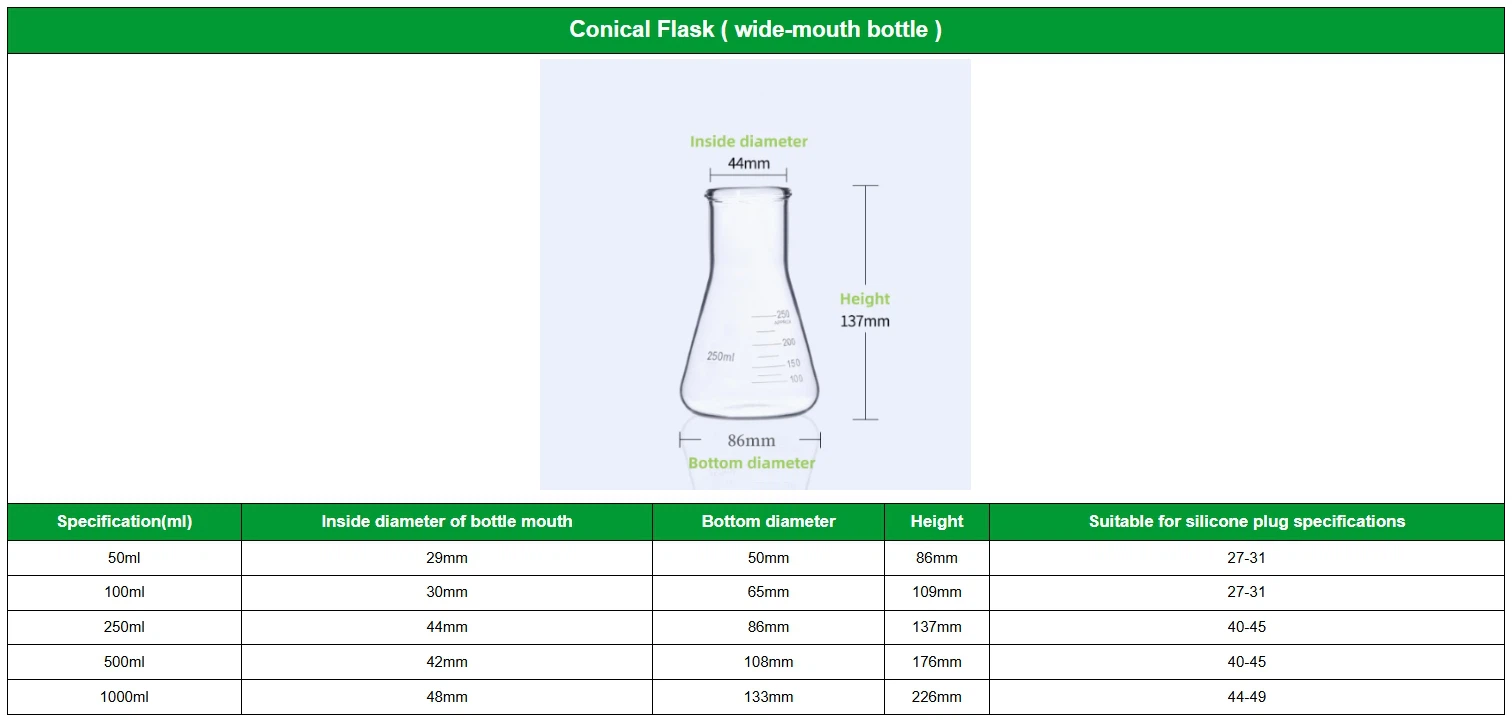
4) Wide-mouth Bottle: 50ml/100ml/250ml/500ml/1000ml;
5) Conical Flask With Cover: 50ml~1000ml;
6) Screw Conical Flask:
a. Black Lid (General Sets): 50ml~1000ml
b. Orange Lid (Thickening Type): 250ml~5000ml;
2. Single and Multi-mouth Round Bottom Flask:
1) Single Mouth Round Bottom Flask: 50ml~10000ml;
2) Inclined Three-mouth Flask: 100ml~10000ml;
3) Inclined Four-mouth Flask: 250ml~20000ml;
4) Straight Three-mouth Flask: 100ml~10000ml;
5) Straight Four-mouth Flask: 250ml~10000ml.
***Price List for whole above, inquire us to get
Description
Technical Parameters
Graduated Erlenmeyer Flask is a common and important glassware in the laboratory. It plays an important role in multiple fields such as chemical experiments, biological experiments, drug research and development, and teaching demonstrations. Its precise scale marking, heat and corrosion resistance, as well as the advantages of easy cleaning and storage make it a powerful assistant in the laboratory. In the future, with the advancement of technology and the continuous changes in laboratory demands, graduated conical flasks will continue to develop and improve, providing researchers with more convenient, efficient and accurate experimental tools.
The used graduated conical flasks should be cleaned in time to avoid the influence of residues on the next experiment. When cleaning, you can use detergent and water for a preliminary rinse, and then rinse thoroughly with distilled water or deionized water. For residues that are difficult to clean, appropriate solvents or cleaning agents can be used for soaking and cleaning.
History and Evolution

The origins of the Erlenmeyer flask can be traced back to the late 19th century, when German chemist Emil Erlenmeyer first introduced the design to the scientific community. Prior to this, scientists relied on various types of glassware, such as beakers and flasks with straight sides, for their experiments. However, these traditional containers often posed challenges in terms of mixing efficiency and the prevention of splashing during reactions.
Erlenmeyer's innovative design addressed these issues by incorporating a conical shape that narrowed towards the base. This feature not only facilitated better mixing by directing the stirring motion towards the center of the flask but also minimized the risk of spills by directing any splashes back into the container. Additionally, the graduated markings along the side of the flask allowed for precise measurements of liquid volumes, further enhancing its utility in scientific research.
Over time, the erlenmeyer flask underwent several modifications to better suit the needs of different experiments. The introduction of the graduated version, for instance, made it even more versatile by enabling scientists to accurately measure and dispense specific volumes of liquids. Today, the Erlenmeyer flask is available in a variety of sizes, ranging from small, handheld versions to large, industrial-scale models, catering to the diverse requirements of scientific research.
Parameter list


Construction and Materials
The erlenmeyer flask is typically constructed from borosilicate glass, a type of glass known for its exceptional resistance to thermal shock and chemical corrosion. This material choice is crucial in ensuring the flask's durability and safety during use, as it can withstand extreme temperature changes without cracking or shattering.
The flask's conical shape is carefully crafted to optimize mixing efficiency and minimize splashing. The narrow base, in particular, helps to concentrate the stirring motion, ensuring that all contents are thoroughly mixed. The graduated markings, usually etched or printed onto the side of the flask, are calibrated to provide accurate measurements of liquid volumes. These markings are typically in milliliters (mL) or liters (L), depending on the size of the flask, and are designed to be easy to read, even in dimly lit laboratory environments.
Applications in Scientific Research
The graduated Erlenmeyer flask finds applications in a myriad of scientific disciplines, where it serves as a vital tool for conducting experiments and facilitating research.
● Chemistry: In chemistry, the erlenmeyer flask is commonly used for preparing and mixing chemical solutions. Its conical shape and graduated markings make it ideal for accurately measuring and dispensing specific volumes of reactants, solvents, and other chemicals. Additionally, the flask's design promotes efficient mixing, ensuring that reactions proceed smoothly and uniformly.
● Biology: In biological research, the erlenmeyer flask is frequently employed for culturing cells, bacteria, and other microorganisms. Its wide mouth allows for easy access and manipulation of the contents, while its conical shape minimizes the risk of contamination during handling. Furthermore, the flask's graduated markings enable scientists to precisely control the volume of media or nutrients used in their experiments.
● Biochemistry and Molecular Biology: In these fields, the erlenmeyer flask is often used for a variety of reactions, including protein purification, enzyme assays, and DNA/RNA extractions. Its versatility and precision make it an invaluable tool for researchers working at the molecular level.
● Physics and Materials Science: While less common in these disciplines, the erlenmeyer flask can still find use in experiments involving liquid-based reactions or measurements. For instance, it may be employed in studies of fluid dynamics or the properties of various liquids under different conditions.

Advantages and Limitations
The erlenmeyer flask offers several advantages that make it a preferred choice for scientific research:
● Precision: The graduated markings allow for accurate measurements of liquid volumes, ensuring that experiments are reproducible and reliable.
● Efficiency: The conical shape promotes efficient mixing, ensuring that all contents are thoroughly combined during reactions.
● Versatility: The flask's design and functionality make it suitable for a wide range of experiments in various scientific disciplines.
● Durability: Constructed from borosilicate glass, the flask is resistant to thermal shock and chemical corrosion, ensuring its longevity and safety during use.
However, like any laboratory tool, the erlenmeyer flask also has its limitations:
● Fragility: Despite its durability, the flask is still made of glass and can break if dropped or subjected to excessive force.
● Limited Volume Range: The flask's size and capacity may limit its use in experiments requiring larger volumes of liquids.
● Potential for Contamination: The wide mouth of the flask can make it more susceptible to contamination during handling, particularly in sterile or sensitive experiments.
Significance and Impact
|
|
The erlenmeyer flask's significance in scientific research lies in its ability to facilitate precise measurements, efficient mixing, and safe handling of substances. Its conical shape and graduated markings have revolutionized the way scientists conduct experiments, enabling them to achieve greater accuracy and reproducibility in their results.
This, in turn, has led to significant advancements in various scientific disciplines, from the development of new drugs and treatments to the understanding of fundamental biological and chemical processes.
Moreover, the erlenmeyer flask's versatility and durability have made it a staple in educational settings, where it is used to teach students the fundamentals of laboratory techniques and safety protocols.
By providing a hands-on experience with this iconic laboratory tool, educators can instill in students a sense of curiosity and respect for the scientific method, fostering a new generation of scientists and researchers. |

Key points of training for experimentalists
Conical bottles are commonly used in chemical experiments, and their standardized use is very important for the accuracy of experimental results and the safety of experimentalists. Therefore, it is necessary to conduct comprehensive and systematic training for the experimenter who uses conical bottles for experiments. The training points are described in the following aspects.
Theoretical knowledge training
The structure and characteristics of conical bottles
The shape, material, capacity and other basic information of the conical bottle are introduced in detail, so that the experimentals can understand the design characteristics of its wider bottom and narrower top, and the advantages of this structure in experiments such as chemical reaction, solution preparation and titration.
Applicable experimental scope
The application of conical bottles in different types of experiments is explained, such as as a reaction vessel in acid-base titration experiments, and for accurate measurement and mixing of solutions when preparing solutions, so that experimenters can know its specific use in various experiments.
Operation skill training
Train the experimenter how to hold the conical bottle correctly, avoid direct contact with the mouth and inner wall of the bottle with fingers, and prevent contamination of reagents. At the same time, teach them to place the conical bottle smoothly on the test bench to ensure that it will not tip over during the experiment.
Demonstrates the correct way to add liquid to the conical bottle, including the operation points when using tools such as droppers and pipettes, and how to gently shake the conical bottle to mix the liquid well and avoid splashing.
If the experiment involves heating the liquid in the conical bottle, it is necessary to train the heating method in detail, such as the flame adjustment when heating with the alcohol lamp, the selection of the heating position, and how to prevent the liquid from boiling violently during the heating process.
Safety precautions training

Reagent safety
It is emphasized that when using conical bottles for experiments, it is necessary to understand the nature of the reagents used, such as corrosiveness, toxicity, flammability, etc., and take corresponding protective measures, such as wearing protective glasses, gloves, etc.

Prevent breakage
Remind the experimenter to carefully handle the conical bottle during operation to avoid collision resulting in breakage, resulting in reagent leakage and personnel injury. If it breaks, it should be handled promptly and correctly.

Emergency handling
Training of the experimental personnel to master the emergency treatment methods of common accidents, such as the treatment measures of reagent splashing on the skin or eyes, and the fire extinguishing methods in case of fire.

Actual operation test
After completing the training of theoretical knowledge and operational skills, the experimental personnel were arranged to conduct practical operation assessment to check whether they had mastered the correct use of conical bottles and safety precautions. For those who are not qualified in the assessment, targeted counseling and re-assessment should be carried out to ensure that each experimenter can conduct experiments with conical bottles in a standardized and safe manner.
conclusion
The erlenmeyer flask, with its iconic conical shape and graduated markings, has become an indispensable tool in scientific research. Its precision, efficiency, versatility, and durability make it a preferred choice for experiments in chemistry, biology, biochemistry, molecular biology, and even some areas of physics and materials science.
As scientific research continues to evolve and expand, the erlenmeyer flask will likely remain a staple in laboratories worldwide, facilitating the discovery of new knowledge and the advancement of human understanding. Its legacy as a symbol of ingenuity and precision in scientific instrumentation will endure for generations to come.
Hot Tags: graduated erlenmeyer flask, China graduated erlenmeyer flask manufacturers, suppliers, factory, Hydrothermal Synthesis Reactor, Zp9 Rotary Tablet Press, Autoclave For Hydrothermal Synthesis, 16 Station Tablet Compression Machine, Teflon Lined Stainless Steel Autoclave, Chemical Equipment
Previous
Heating Erlenmeyer FlaskSend Inquiry


