



Glove Box For Chemistry Lab
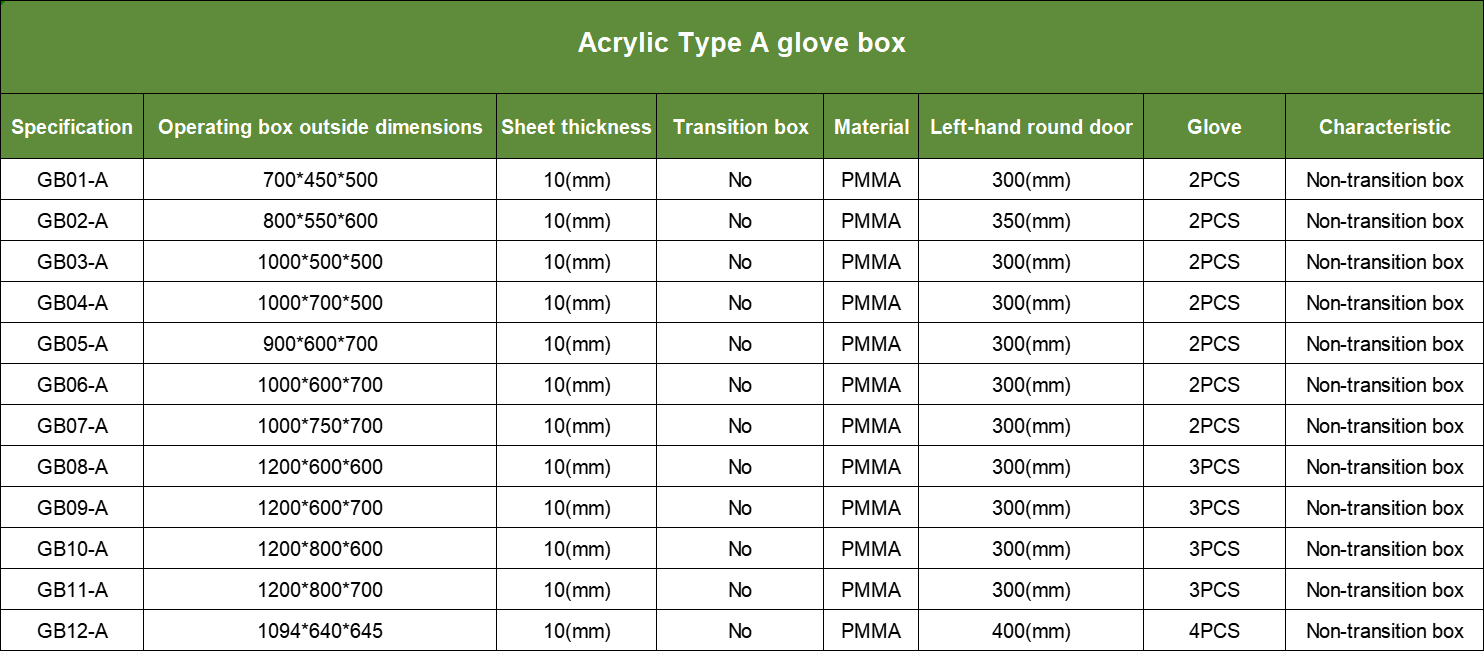
1)Acrylic Type A glove box: No sample transfer window, must be take it out from the door.
2)Acrylic Type B glove box:There is a sample transfer window, which can protect the gas environment inside the box from being damaged by the outside world.
3)Acrylic Type B glove box:The air in the box can be extracted through the vacuum pump, and then through the high purity dry inert gas into the box, and reach the lower water oxygen content in the box
2.Customization:
1)Single, double, multiple people and other different station boxes.
2)Different shapes, different structures, different applications, different thickness customization options.
3)Doors of different sizes can be opened on any side of the box to facilitate the entry and exit of equipment and accessories.
4)For other optional configurations, contact sales personnel.
***Price List for whole above, inquire us to get
Description
Technical Parameters
Glove box for chemistry lab is a widely used equipment in chemical experiments, it can be divided into a variety of types according to the material and use of different, such as acrylic glove box, stainless steel glove box, plexiglass glove box, etc., the correct use and maintenance of the glove box can ensure the safety and accuracy of the experiment, provide reliable experimental protection for researchers. There are significant differences between the glove box and the ordinary glove box in the use environment, functional requirements, design features, price, etc. Users should make comprehensive consideration according to the specific use scenario and requirements.
In the complex environment of modern laboratories, there is such a equipment, which seems ordinary but contains huge energy, like a silent guardian to protect the smooth conduct of all kinds of experiments, it is the glove box for chemistry lab. It plays an indispensable role in many laboratory fields, and its importance is reflected in many aspects such as creating a special environment for experiments, ensuring the safety of experiments, and helping the accuracy of experimental operations.
Parameter
|
|



Personal Protection
Eye and face protection
Goggles or chemical goggles
Choose goggles with anti-fog and anti-scratch features to ensure clear vision. Goggles should fit the face without gaps to stop chemicals from splashing or gas entering the eyes. When performing particularly dangerous experiments, consider using goggles with side protection to fully protect the eyes and face.
Eye washers
Wall-mounted or portable eye washers should be set up in areas of the laboratory where chemicals are easily splashed. Check the running status of the eyewash regularly to ensure that it is ready to use. When chemicals spill into your eyes, rinse them quickly and thoroughly with an eyewash and seek medical attention immediately.
Hand protection


Selection of gloves: Depending on the nature of the experiment and the chemicals used, select the appropriate type of gloves, such as acid-alkali, cut-resistant or heat-resistant gloves. Make sure the gloves are the right size, neither too tight nor too loose, to ensure the flexibility and protection of the gloves.
Polyethylene disposable gloves: used to deal with corrosive solid drugs and dilute acids (such as dilute nitric acid), but the gloves cannot be used to deal with organic solvents, because many solvents can penetrate polyethylene and create holes in the suture.
Medical latex gloves: made of latex, which can be reused after treatment. Since the gloves are short, care should be taken to protect the arms. The gloves are not suitable for handling hydrocarbon solvents (such as hexane, toluene) and chlorine-containing solvents (such as chloroform), as these solvents can cause swelling damage to the gloves.
Rubber gloves: thicker than medical latex gloves, more suitable for long-term exposure to chemical reagents.
Canvas gloves and cotton gloves: generally used to handle high temperature objects.
Yarn gloves: generally used for the operation of contact machinery.
Use and replacement of gloves:
Before the experiment, the integrity of the gloves should be checked, and if there is damage or aging, it should be replaced in time.
Avoid wearing the same pair of gloves for a long time to avoid slipping or reducing the protective effect of sweaty hands.
When handling different types of chemicals, new gloves should be replaced to prevent cross-contamination.
Other parts of the body protection
Lab coat and apron: Choose a lab coat that is breathable, comfortable, and covers your entire body to avoid exposing your skin. When performing experiments that may produce large amounts of sashes, a protective apron should be worn to ensure that the front of the body is protected.
Protective shoes and socks: Choose anti-slip, anti-chemical penetration protective shoes to ensure foot safety. Wear thick cotton or synthetic socks to absorb sweat and provide extra protection.
Respiratory protection
Gas mask or respirator: Select the appropriate gas mask or respirator according to the nature of the harmful gases or vapors generated during the experiment. Make sure the mask or respirator fits the face well and there is no air leakage.
Replace the filter element regularly: according to the frequency of use and the laboratory environment, regularly replace the filter element of the gas mask or respirator to ensure its filtration effect.
Personal hygiene and habits
Wash hands frequently
Hands should be thoroughly cleaned before and after the experiment and after exposure to chemicals to prevent damage to the skin from chemical residues.
Avoid eating and smoking
In the laboratory work area, eating and smoking are strictly prohibited to prevent chemical contamination of food or inhalation of harmful substances.
Keep the lab clean
Clean the lab regularly to ensure that the work area is clean and organized to reduce the risk of chemical spills and slips.
Organic luminescence industry

Overview of the organic luminescence industry
The organic luminescence industry mainly involves the development and production of organic electronic devices such as organic light-emitting diodes (OLED) and field effect transistors (OFET). These devices have the advantages of high luminous efficiency, low energy consumption, bendability, etc., and have wide application prospects in display technology, lighting technology and other fields.
Application in organic luminescence industry
Synthesis of organic luminescent materials
In the synthesis process of organic luminescent materials, many reactions are sensitive to air and water, which can easily lead to material performance degradation or even failure. The glove box can provide a water-free, oxygen-free environment to ensure the smooth progress of the reaction and improve the purity and stability of the material.
Preparation of organic light-emitting devices
In the preparation of organic light-emitting devices, such as OLED, it is necessary to strictly control the oxygen and moisture content in the environment. The inert gas circulation filtration system in the glove box can effectively remove oxygen and moisture from the air, providing a clean, oxygen-free environment for the preparation of the device, thereby improving the performance and stability of the device.
Performance testing and characterization
The glove box also plays an important role in the performance testing and characterization of organic light-emitting devices. For example, when measuring performance indicators such as luminous efficiency and life of devices, it is necessary to ensure the consistency and stability of the test environment. The glove box provides a constant oxygen free or low oxygen environment to ensure the accuracy and reliability of test results.
Tensile strength test

Test purpose
The tensile strength test is designed to measure the maximum stress value of the glove box material when subjected to tensile forces to assess its ability to withstand tensile deformation and fracture. This is essential to ensure that the glove box maintains its structural integrity and stability during use.
The test principle
In the tensile test, the specimen is gradually extended until it breaks under the action of tensile force. The tensile strength of the material can be determined by measuring the maximum tensile stress of the specimen before fracture. Tensile strength is usually expressed as the maximum tensile force on a unit area of the material, measured in MPa (mpa).

Test method
Sample preparation:
Prepare samples according to test standards (e.g. ISO, ASTM, etc.). The sample shall be cut from the glove box material to ensure that its size, shape and preparation process meet the standard requirements.
The shape of the sample is usually rectangular or round, depending on the test standard and the characteristics of the glove box material.
Test equipment:
Select a suitable tensile testing machine for testing. The tensile testing machine should be able to accurately measure the tensile force and the elongation of the specimen.
Ensure that the testing machine is calibrated and in good working order.
Test steps:
Install the sample correctly on the fixture of the testing machine to ensure that the sample is stable and aligned in the fixture.
Start the testing machine and apply tensile force to the sample at a constant speed.
The load and displacement data of the specimen during the tensile process were recorded.
The fracture of the sample was observed and the maximum tensile stress was recorded.
Data processing:
The tensile strength of the material is calculated according to the test data. The tensile strength is calculated as follows: σt=p/(b×d), where σt is the tensile strength (MPa), p is the maximum load (N), b is the specimen width (mm), and d is the specimen thickness (mm).
Stress-strain curves are drawn to further analyze the mechanical properties of the material.
Test considerations
Sample preparation
The preparation of the sample should meet the requirements of the standard to ensure the accuracy and comparability of the test results.
Avoid introducing defects or damage during sample preparation to avoid affecting test results.
Test environment
The test should be carried out under constant temperature, humidity and light conditions to avoid the influence of environmental factors on the test results.
Ensure that the test environment is clean and tidy to avoid contamination of the sample and test equipment interference.
Equipment calibration
The testing machine is calibrated prior to testing to ensure measurement accuracy and accuracy.
Check and maintain the testing machine regularly to ensure its long-term stable operation.
Data recording and analysis
Record test data in detail, including load, displacement, fracture stress, etc.
Statistical analysis of the test data was performed to evaluate the tensile properties and stability of the glove box material.
Test significance
Evaluate material strength
The tensile strength test can evaluate the strength and durability of the glove box material and provide a basis for the design and improvement of the product.
Ensure product quality
Tensile strength testing is an important part of quality control, helping to ensure that glove box products meet relevant standards and requirements.
Prevent security risks
Through testing, the weak links and potential safety hazards in the stretching process of glove box materials can be found, so that timely measures can be taken to improve and prevent
Methods to avoid microbial contamination
Item screening and pretreatment
Strictly screen items entering the glove box
Only items that have been cleaned and pre-treated as necessary are allowed into the glove box. For example, laboratory equipment should be thoroughly cleaned and dried outside to remove impurities such as dust and oil that may be carried on the surface, as well as potential microorganisms.
Check package integrity
For some raw materials or special reagents that need to be brought into the glove box, if they are packaged, check that the package is intact to prevent the damage of the package from causing external contaminants (including microorganisms) to enter the glove box.
Personnel operation standards
Develop good operating habits
Before conducting experiments or operations, operators should ensure that their hands are clean, and it is best to wear special sterile gloves to avoid bringing outside bacteria, sweat and other pollutants into the glove box due to hand contact.
Comply with the operation process
Develop a detailed operation process and operate in strict accordance with the process. Between the different steps, care should be taken to clean or replace used tools to reduce the chance of transmission of microorganisms..
Environmental control and maintenance

Check the seals regularly
The seals of the glove box (such as seals, glove interfaces, etc.) are the key to preventing the entry of outside gases and microorganisms. The seal should be checked regularly for wear, aging or damage. Once the problem is found, replace the seal in time to ensure the tightness of the glove box.

Install pressure monitoring device
Real-time monitoring of pressure changes in the glove box. If there is an abnormal fluctuation in pressure, it may mean that there is a problem with the seal or there is a gas leak, and it is necessary to investigate the cause and deal with it in time to prevent the intrusion of external microorganisms.

Optimize gas circulation
Ensure that the gas circulation in the glove box is efficient and stable, so that the gas can be fully passed through the purification device, reducing the breeding and spread of microorganisms.
Emergency treatment and plan
Formulate pollution emergency treatment plan: Once the gas or items in the glove box are found to be contaminated by microorganisms, the experimental operation should be stopped immediately, and the pollution emergency treatment plan should be activated, such as starting the emergency purification mode of the gas purification system, or isolating and treating the contaminated items.
Conduct regular pollution emergency simulation exercises: improve the response ability and handling ability of operators in the face of pollution incidents to ensure that they can deal with pollution in an orderly manner when it actually occurs.
Other precautions
Choose high-quality, well-sealed containers
Containers used to store liquid or solid samples should be well sealed to prevent microbial intrusion and contamination.
Clean the inside regularly
Use gentle, non-polluting cleaning reagents and tools, such as anti-static cleaning cloth, to clean the inside of the glove box regularly to reduce the breeding of microorganisms.
Hot Tags: glove box for chemistry lab, China glove box for chemistry lab manufacturers, suppliers, factory, High Pressure Reactor Vessel, Short Path Molecular Distillation, Hydrothermal Synthesis Autoclave Reactor, Short Path Vacuum Distillation, Double Glass Reactor, Chemical Equipment
Previous
Vacuum Atmospheres Glove BoxNext
Vacuum Glove BoxSend Inquiry


