



2l Separatory Funnel
2.Big mouth Funnel:90mm/170mm/210mm/260mm
3.Wide-mouthed funnel: 150mm/200mm/250mm/300mm
***Price List for whole above, inquire us to get
Description
Technical Parameters
In the realm of chemistry, the separatory funnel stands as a cornerstone of liquid-liquid extraction processes. Among the various sizes available, the 2L separatory funnel is particularly versatile, finding widespread application in both academic and industrial settings. This article delves into the intricacies of the 2-liter separatory funnel, exploring its design, function, uses, and the critical role it plays in ensuring the success of chemical separations.
Design and Features
The 2-liter separatory funnel is distinguished by its capacity, which is suitable for handling larger volumes of liquid compared to smaller models. This size is particularly advantageous in scenarios where larger quantities of material need to be processed, such as in industrial-scale synthesis or when working with compounds that are available in limited quantities and thus need to be utilized efficiently.
|
Design Elements: ◆ Capacity: The 2-liter capacity allows for the processing of significant volumes of reactants and solvents, making it ideal for applications that require bulk handling. ◆ Stopcock: Typically made of glass or Teflon, the stopcock is a critical feature that controls the flow of liquid from the funnel. It must be tight-fitting to prevent leaks and durable enough to withstand repeated use and exposure to various chemicals. ◆ Ground Joint: The connection between the funnel body and the stopcock is usually a ground joint, which ensures a secure and leak-proof fit. ◆ Markings: The funnel often features volumetric markings, allowing for precise measurement and monitoring of the liquid levels during the extraction process. ◆ Neck Size: The neck of the funnel is designed to be narrow enough to facilitate the formation of a sharp interface between the two liquid phases but wide enough to allow for easy addition of reagents and mixing. ◆ PTFE Tape or Grease: To further ensure leak-proof operation, the joint may be sealed with PTFE (polytetrafluoroethylene) tape or a suitable grease, which is resistant to most chemicals. |
|

Parameter
|
Triangular Funnel |

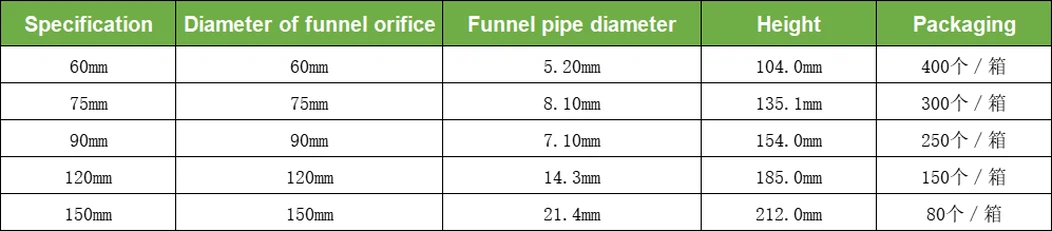

Big mouth Funnel


Wide-mouthed funnel

Operating Procedures
|
|
◆ Assembly and Preparation: 1) Ensure that the funnel is clean and dry before use. 2) Assemble the funnel with the stopcock, ensuring that the joint is tight and leak-proof. 3) If using PTFE tape or grease, apply it to the joint in a thin, even layer. ◆ Loading the Funnel: Pour the first liquid (typically the aqueous phase) into the funnel, filling it to the desired level. Carefully add the second liquid (typically the organic solvent) through the neck, using a funnel or pipette to avoid splashing. ◆ Mixing: Secure the funnel and invert it several times to mix the two liquids thoroughly. Ensure that the stopcock is closed during this process to prevent accidental dispensing. ◆ Separation: Allow the funnel to stand for a few minutes to allow the two liquid phases to separate. The interface between the phases should be clear and distinct. ◆ Dispensing: Open the stopcock and carefully dispense the desired layer into a clean container. Use a separator or a graduated cylinder to collect the liquid, ensuring that no contamination occurs. |

Cases
The following are some specific experimental cases involving the use of a separator funnel, which show the application and operation details of the separator funnel in different experiments:
► Case 1: Extraction experiment of iodine in saturated aqueous solution
Objective: The saturated aqueous solution of iodine was extracted by carbon tetrachloride to observe the color change of the liquid before and after extraction, and to explore the reason of separation of the upper and lower layers.
Experimental steps:
Prepare 10ml of iodine in saturated water and 4ml of carbon tetrachloride.
The saturated aqueous solution of iodine is poured into the separating funnel, and the carbon tetrachloride is slowly added.
Gently shake the separator funnel so that the two liquids are fully mixed.
After standing layering, observe the color change of the upper and lower liquid.
Open the lower valve of the separator funnel and release and collect the lower liquid (carbon tetrachloride solution containing iodine).
Close the valve, open the upper mouth, and pour out the upper liquid (water phase).
The results showed that the lower liquid was purplish red and was carbon tetrachloride solution containing iodine. The upper liquid is colorless and aqueous.
Note:
When adding the extractant, ensure that the total volume of the liquid does not exceed 3/4 of the capacity of the separator funnel.
When layering, be patient and do not rush.
When releasing liquid, the flow rate should be controlled to avoid liquid splashing.
► Case 2: Detection of pesticide residues in Food (liquid-liquid extraction)
Objective: To extract and purify pesticide residues from food samples by liquid-liquid extraction method for subsequent gas chromatographic analysis.
Experimental procedure (taking vegetable sample as an example) :
Weigh about 20g vegetable samples, add 80ml methanol, and shake for 30min.
The extraction vessel and filter were filtered by a Brinell funnel lined with rapid filter paper, and the extraction vessel and filter were washed fractional with 50mL methanol.
Transfer all filtrate into the separating funnel and add 100mL 5% sodium chloride solution.
Add 50mL petroleum ether into the separator funnel, shake for 1min, and then stand for stratification.
The lower layer (methanol + sodium chloride solution) was put into the second separation funnel, and petroleum ether was added repeatedly for extraction until the extraction was complete.
The petroleum ether layer was collected and dried with anhydrous sodium sulfate for concentration and volume determination.
The treated samples were analyzed by gas chromatography to detect pesticide residues.
Experimental results: The chromatographic peaks of different pesticides could be observed by gas chromatogram, and quantitative analysis was carried out according to the peak area or peak height.
Note:
During the extraction process, it is necessary to ensure the sealing of the liquid separation funnel to prevent liquid leakage.
When adding sodium chloride solution, pay attention to its concentration and volume to affect the extraction effect.
Sample loss and contamination should be avoided during the drying and concentration steps.
► Case 3: Extraction of products after organic synthesis reaction
Objective: To extract the target product from the mixed liquid after organic synthesis reaction, and then purify and analyze it.
Experimental steps:
Pour the reaction mixture into the separating funnel.
According to the polarity and solubility of the product, the appropriate extraction solvent (such as ethyl acetate, dichloromethane, etc.) is selected.
The extraction solvent is slowly added to the separator funnel, and the two liquids are fully mixed by gently shaking.
After the static layering, the extraction layer containing the product is released and collected.
Repeat the extraction steps until the extraction is complete.
The collected extract is dried, concentrated and purified.
The purified products were analyzed and identified.
Results: Through extraction and purification, relatively pure target products can be obtained, which provides strong support for subsequent analysis and identification.
Note:
When selecting the extraction solvent, the polarity and solubility of the product should be fully considered.
In the extraction process, attention should be paid to controlling the shaking strength and time to avoid product loss.
In the drying and concentration steps, the appropriate temperature and time should be selected to avoid product decomposition or deterioration.
► Case 4: Extraction and determination of petroleum substances in water
Experimental purpose:
Petroleum substances are extracted from oil contaminated water samples and quantitatively determined to assess the extent of water pollution.
Experimental principle:
Using the difference of solubility of petroleum substances in water and organic solvents, petroleum substances are extracted from water samples by liquid-liquid extraction method, and then determined by appropriate analytical methods (such as ultraviolet spectrophotometry, fluorescence spectrophotometry, etc.).
Experimental steps:
Water sample collection: Use clean glass bottles to collect oil contaminated water samples and ensure that the water samples are free from external contamination during the collection process.
Pretreatment: The collected water sample is filtered through filter paper to remove suspended solids and impurities in the water.
Extraction:
Pour the pre-treated water sample into a 2L separator funnel.
Add an appropriate amount of organic solvent (such as carbon tetrachloride or n-hexane) to ensure that the volume of organic solvent does not exceed 3/4 of the capacity of the separator funnel.
Gently shake the separator funnel, make the water sample and organic solvent fully mixed, stand stratification.
Repeat the extraction steps 2-3 times until the extraction is complete.
Collection and drying:
The layer of organic solvent containing petroleum substances is released from the separation funnel and collected into a clean container.
The collected organic solvent is dried with anhydrous sodium sulfate to remove water from it.
Determination:
The organic solvent after drying was concentrated to obtain the concentrated liquid of petroleum substances.
Using appropriate analytical methods (such as ultraviolet spectrophotometry, fluorescence spectrophotometry, etc.) to determine the concentration of petroleum substances.
Experimental results:
By measuring, the content of oil substances in water samples can be obtained, so as to assess the degree of water pollution.
Note:
During the extraction process, it is necessary to ensure that the seal of the liquid separation funnel is good to prevent the volatilization of organic solvents and the entry of external air.
When collecting organic solvents, pay attention to control the flow rate to avoid liquid spatter and loss.
In the drying and concentration steps, the appropriate temperature and time should be selected to avoid the decomposition or deterioration of petroleum substances.
In the process of measurement, the operation procedures of the analytical method should be strictly followed to ensure the accuracy and reliability of the measurement results.
Experimental significance:
In this experiment, petroleum substances were extracted from oil-contaminated water samples by liquid-liquid extraction method and quantitatively determined. The method has the advantages of simple operation, high sensitivity and good accuracy, and can be used to assess the degree of oil pollution in water bodies, and provide strong support for environmental protection and water quality monitoring. At the same time, the experiment also provides valuable reference for researchers in related fields.
Hot Tags: 2l separatory funnel, China 2l separatory funnel manufacturers, suppliers, factory, Rotovap Machine, Laboratory Rotary Evaporator, 20l Rotovap, Single Punch Tablet Press, 50l Rotary Evaporator, Double Layer Glass Reactor
Previous
Cylindrical Separatory FunnelSend Inquiry


