


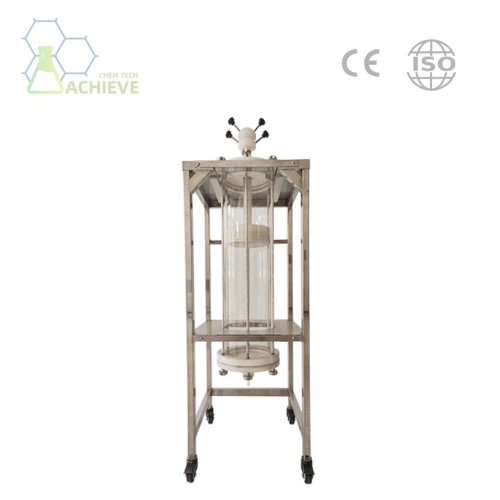

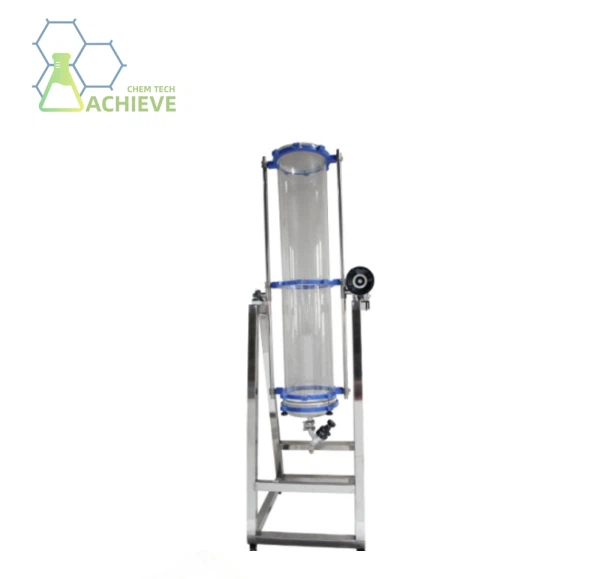
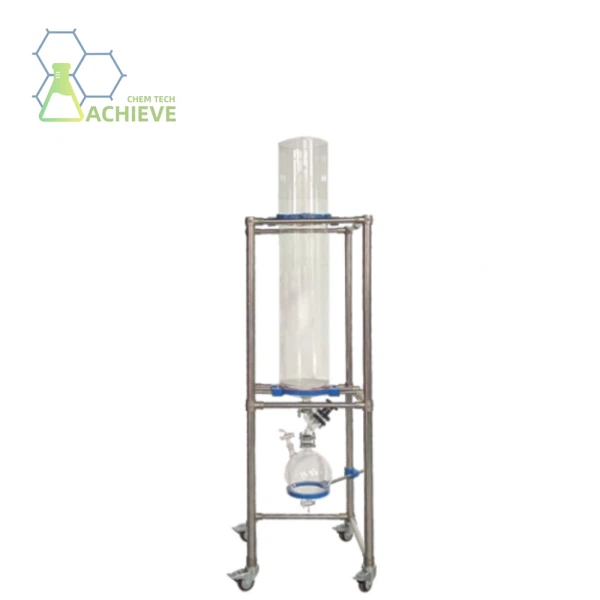
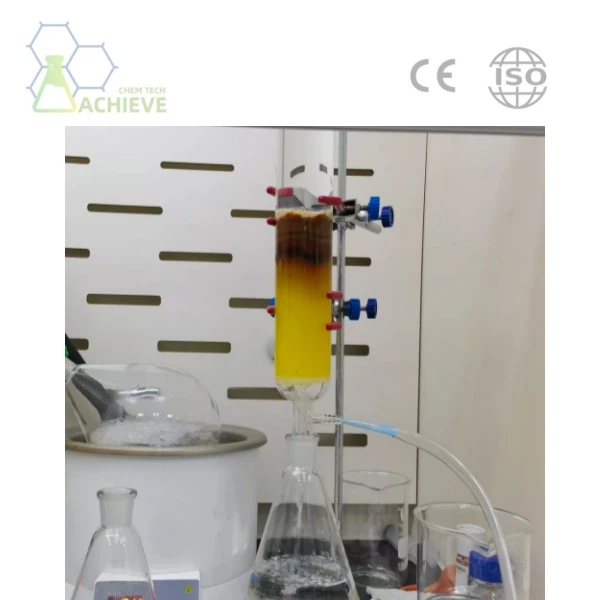
20mm Chromatography Column
2.Chromatographic Column (Rotation Type)
3.Chromatographic Column (Manual)
***Price List for whole above, inquire us to get
Description
Technical Parameters
A 20mm chromatography column is a vital tool in analytical and preparative chromatography, offering unique advantages for the separation, purification, and identification of various compounds. This column features an internal diameter of 20 millimeters, which sets it apart from other column sizes in terms of its capacity, resolution, and throughput.
It is often used in preparative chromatography, where the goal is to isolate and purify larger quantities of target compounds. Its increased capacity enables the processing of larger sample volumes, making it suitable for applications in pharmaceutical research, environmental analysis, and food science, among others.
Moreover, the larger diameter can contribute to reduced backpressure, allowing for the use of higher flow rates without compromising column performance. This can significantly shorten analysis time and increase productivity in laboratories.
Despite its advantages, the use of a 20mm chromatography column may require more solvent and can result in broader peaks compared to narrower columns, which offer higher resolution. However, for many preparative and semi-preparative applications, the balance of capacity, efficiency, and throughput offered by a 20mm column makes it an indispensable tool in the chromatography arsenal.
Parameters


Applications
A 20mm chromatography column is a versatile tool widely used in analytical and preparative chromatography across various industries, including pharmaceuticals, biotechnology, environmental science, and food testing. Its 20mm internal diameter provides an optimal balance between sample capacity and resolution, making it suitable for both qualitative and quantitative analyses.
In analytical applications, this column size is ideal for purifying and isolating compounds in moderate quantities, offering higher throughput compared to narrower columns while maintaining efficient separations. It is commonly employed in liquid chromatography (LC) techniques, such as HPLC and UHPLC, for tasks like drug metabolite analysis, peptide separation, and natural product purification.
For preparative purposes, the 20mm column enables the scalable production of purified substances, bridging the gap between analytical-scale separations and large-volume industrial processes. Its robust design accommodates higher flow rates and sample loads without compromising separation efficiency, which is crucial for processes like pharmaceutical active ingredient isolation or environmental contaminant extraction.
Additionally, this column size is compatible with a range of stationary phases, allowing customization for specific applications, from reversed-phase to ion-exchange chromatography, thus enhancing its adaptability in research and industrial settings.
Pharmaceutical Analysis
The increased diameter of the column allows for the use of larger internal diameters (IDs) for the tubing and packing material. This means that more sample can be loaded onto the column without causing excessive pressure drop or backpressure issues. The ability to process larger sample volumes is crucial for several reasons:

Improved Sensitivity
With more sample material present in the column, the signal intensity for the analytes of interest is typically higher. This improves the sensitivity of the assay, making it easier to detect and quantify trace impurities or minor components.

Enhanced Resolution
The larger column diameter can accommodate a greater number of theoretical plates, which is a measure of the column's separation efficiency. Higher resolution translates to better separation between analytes, making it easier to distinguish between closely related compounds or isomers.

Reduced Analysis Time
Although the absolute flow rate through the column might not change significantly, the larger sample volume can be eluted over a similar time frame, effectively diluting the sample concentration but maintaining a detectable signal. This can lead to shorter analysis times, as the elution profile of the sample is spread out over a wider range of volumes without losing sensitivity.
In the pharmaceutical industry, purity assessments are critical for ensuring the safety and efficacy of drugs. Impurities in pharmaceutical compounds can affect their therapeutic properties, stability, and even lead to adverse reactions in patients. Therefore, the ability to accurately assess and quantify impurities is paramount.
Its capacity to handle larger sample volumes makes it ideal for these assessments because:
Comprehensive Impurity Profiling
With more sample material available for analysis, a more comprehensive impurity profile can be generated. This includes the detection of low-level impurities that might be missed with smaller sample volumes.
Robust and Reproducible Results
The larger column diameter provides a more stable and reproducible chromatographic environment, reducing variability and improving the reliability of the results.
Scalability
The use of a larger column diameter can facilitate the transition from research and development to manufacturing scales, ensuring that the purity assessment method remains valid and consistent throughout the drug development process.
In summary, the large diameter of a chromatography column is a key feature that enhances its suitability for purity assessments of pharmaceutical compounds. By allowing for the processing of larger sample volumes, it improves sensitivity, resolution, and analysis time, ultimately leading to more accurate and reliable results.
Natural Product Extraction
Natural extracts often contain a complex mixture of compounds, many of which may be present in low concentrations. The larger diameter of a 20mm column allows for the loading of significantly larger amounts of sample material compared to smaller diameter columns. This is particularly advantageous for:
Enhanced Recovery
By loading more sample, a greater proportion of the target compounds can be retained by the column, leading to improved recovery rates. This is crucial when working with valuable or scarce natural extracts.
Detection of Minor Components
The increased sample volume increases the likelihood of detecting minor components that might otherwise be missed due to their low abundance. This is important for comprehensive characterization of natural extracts.
Reduced Preparation Time
Larger sample loads can often be processed in fewer chromatography runs, reducing the overall preparation time and improving laboratory efficiency.
The high separation efficiency of a 20mm column is essential for isolating and purifying components from natural extracts, as these extracts typically contain a wide range of chemically diverse compounds. High separation efficiency is achieved through:
Improved Resolution
The ability to separate closely related compounds or isomers is critical for purifying individual components from natural extracts. High-resolution chromatography ensures that target compounds can be isolated with a high degree of purity.
Selectivity
The choice of stationary phase and mobile phase conditions can be optimized to selectively retain and elute specific compounds of interest, further enhancing the purification process.
Scalability
The large diameter of the column facilitates scaling up the purification process, allowing for the isolation of larger quantities of pure compounds for further analysis, testing, or use in downstream applications.
The combination of these features makes the 20mm column particularly well-suited for applications in natural product isolation and purification.
Phytochemical Analysis
Isolating and purifying bioactive compounds from plants for use in pharmaceutical, nutraceutical, or cosmetic products.


Food and Beverage Industry
Extracting and purifying flavor and aroma compounds from natural ingredients for use in food and beverage formulations.
Environmental Science
Separating and identifying compounds in environmental samples, such as soil, water, or air, for ecological studies and pollution monitoring.

In summary, the ability of a chromatography column to handle large sample loads and achieve high separation efficiency makes it an ideal choice for isolating and purifying components from natural extracts. These features facilitate comprehensive characterization, improved recovery rates, and efficient laboratory workflows, ultimately contributing to more successful and productive natural product isolation projects.
Development Trends
The 20mm chromatography column, a cornerstone in analytical and preparative chromatography, has undergone significant advancements in automation and intelligence. This diameter column, known for its high separation efficiency and capacity, is now integrated with state-of-the-art technologies that streamline workflows and enhance precision.
Automation in the chromatography columns is achieved through the incorporation of liquid chromatography (LC) systems equipped with robotic arms, auto-samplers, and intelligent software. These systems automatically load samples, inject them onto the column, and collect fractions, minimizing human intervention and reducing the risk of contamination. Advanced pumps ensure precise solvent delivery, maintaining consistent flow rates crucial for reproducible results.
Intelligence stems from the integration of smart sensors and data analytics. Sensors monitor critical parameters such as pressure, temperature, and flow rate in real-time, adjusting conditions dynamically to maintain optimal column performance. Data analytics software processes the vast amounts of chromatographic data generated, identifying trends, and flagging potential issues before they impact results. Machine learning algorithms further optimize separation methods, predicting the best conditions for specific analytes based on historical data.
Moreover, remote monitoring and control capabilities allow operators to oversee multiple chromatography runs from anywhere, enhancing productivity and flexibility. User-friendly interfaces and mobile apps provide real-time access to experimental data and system status, facilitating quick decision-making and troubleshooting.
In summary, the evolution of 20mm chromatography columns towards automation and intelligence not only boosts throughput and accuracy but also transforms chromatography from a manual, labor-intensive task into a streamlined, data-driven process. These advancements are pivotal in meeting the demands of modern analytical laboratories striving for efficiency, reliability, and innovation.
Hot Tags: 20mm chromatography column, China 20mm chromatography column manufacturers, suppliers, factory, Double Jacketed Glass Reactor, 5l Glass Reactor, Short Path Distillation, Hydrothermal Reactor, 20 Liter Rotary Evaporator, Double Layer Glass Reactor
Previous
Box FurnaceSend Inquiry


