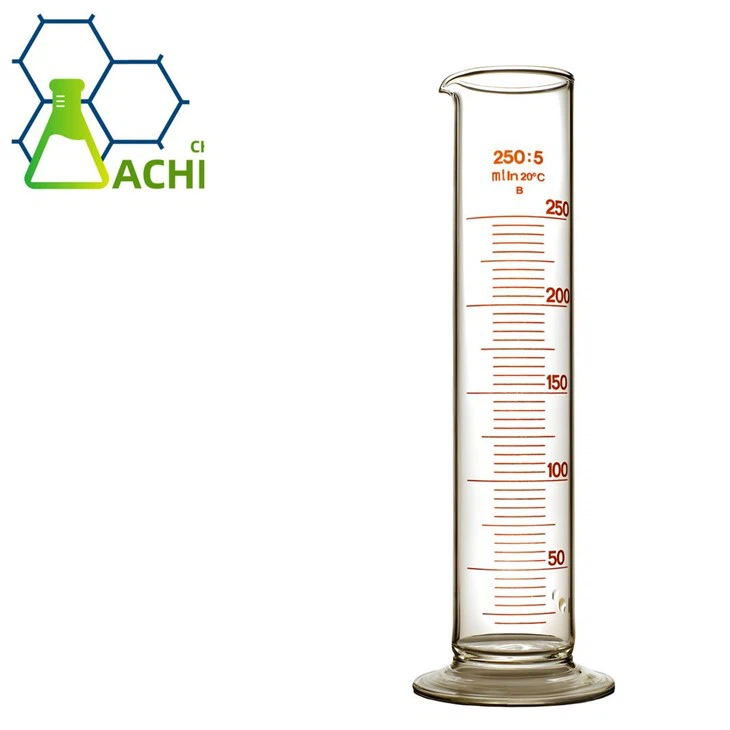


150 ML Measuring Cylinder
Capacity(ml):5/10/25/50/100/250/500/1000/2000/5000
2.Stoppered measuring cylinder
Capacity(ml):5/10/25/50/100/250/500/1000/2000
***Price List for whole above, inquire us to get
Description
Technical Parameters
As a basic measuring instrument in the laboratory, the 150ml measuring cylinder remains irreplaceable in the following scenarios:
Rapid and rough measurement: In operations such as solution preparation and sample dilution where precision requirements are not high, its operational efficiency is more than three times higher than that of pipettes.
Large-volume solution mixing: The 150mL volume design can accommodate a magnetic stirring bar (with a diameter of 10mm) and multiple sample loading tubes, which is significantly superior to graduated cylinders of 50mL or less.
Teaching and training: As a fundamental tool for beginners to understand the concept of volume and experimental norms, its intuitiveness and fault tolerance are superior to those of precision pipetting equipment.
In the future, with the development of materials science and intelligent manufacturing, 150-milliliter graduated cylinders will achieve breakthroughs in precision, durability and intelligence, but their core position in basic experiments will not be shaken.
Products Description
|
|


Case Sharing
In life science laboratories, large-sized original reagents need to be repackaged into small-sized samples. The traditional manual pipette portioning operation is cumbersome, inefficient and prone to errors, making it difficult to meet the requirements of batch portioning. After using a 150-milliliter graduated cylinder, 150 milliliters of reagent can be measured at one time and poured into multiple containers. For instance, when dividing 150 milliliters of the culture medium into five 250 milliliters shake flasks, each flask was divided into 30 milliliters. By controlling the pouring Angle, the residual amount was kept ≤0.3 milliliters. The volume deviation of each flask was ±0.2 milliliters, and the relative error (CV) was 0.67%, fully meeting the precision requirements of the microbial fermentation experiment. This method reduces the portioning time from 8 minutes to 2 minutes, increases the efficiency by 4 times, and is easy to operate. It is suitable for medium-scale experiments.
In biological experiments, 10 milliliters of buffer solution needs to be aliquot for the 96-well plate storage tank. The traditional single-channel pipette requires operation well by well and takes 120 minutes. Use a 150-milliliter graduated cylinder for rough aliasing, measuring 15 to 20 milliliters of liquid each time, and complete the pre-aliasing of the storage tank in 8 portions. Then, use an 8-channel pipette to add samples to a 96-well plate. This solution reduces the total operation time to 15 minutes and increases the efficiency by 8 times. During the rough dispensing process, the accuracy of the 150-milliliter graduated cylinder (CV≤1%) can meet the pre-dispensing requirements of multi-channel pipettes, ensuring the consistency of experimental results.
In the chemistry teaching experiment, students need to measure and aliquot liquids of different volumes. For example, in the acid-base neutralization titration experiment, students need to measure 150 milliliters of the standard solution. When using a 150-milliliter graduated cylinder, by placing the cylinder on a level table and keeping your line of sight level with the lowest point of the concave liquid surface, you can accurately read the volume. The scale resolution (1 milliliter) and capacity design (150 milliliters) of the graduated cylinder are suitable for students to operate, which can not only meet the experimental accuracy requirements but also cultivate their standardized operation skills. In addition, the cost of graduated cylinders is relatively low, making them suitable for large-scale teaching.
In the quality inspection process of chemical enterprises, 150 milliliters of samples need to be divided into multiple testing bottles. The traditional repackaging method is prone to cause volume deviations, which affects the test results. After using a 150-milliliter graduated cylinder, through single measurement and sub-packaging, it can be ensured that the volume deviation of each test bottle is ≤±0.4 milliliters, and the relative error (CV) is ≤0.4%. For instance, when distributing 150 milliliters of solvent into 5 test bottles, with each bottle containing 30 milliliters, the accuracy of the measuring cylinder fully met the requirements of the ISO standard. This method simplifies the operation process, reduces human errors and improves the efficiency of quality inspection.
In cooking, a 150ml measuring cylinder can be used to precisely measure liquid seasonings or ingredients. For example, when cooking millet porridge, 150 milliliters of rice and an appropriate amount of water need to be measured. Through the clear scale of the measuring cylinder, users can intuitively grasp the amount of ingredients used and avoid taste deviations caused by inaccurate amounts. In addition, the high-temperature resistant glass material of the measuring cylinder is suitable for kitchen environments and is easy to clean. For users with slightly deteriorated memory, the intuitive scale of the graduated cylinder can help reduce gueswork and confusion during cooking and enhance the cooking experience.
Core applications and operational norms in microbial culture medium aliasing
Applicability of 150-milliliter Graduated Cylinders in Culture Medium Filling
The range matches the repackaging requirements
Typical portioning volume:
Plate preparation: Each petri dish requires 15-20 milliliters of culture medium. A 150-milliliter graduated cylinder can measure the volume of 7-10 dishes at one time, avoiding the risk of contamination caused by repeated measurement.
Slant preparation: Each test tube requires 5-8 milliliters of culture medium, which can be divided into 20-30 tubes and is suitable for batch preparation.
Liquid cultures: When portioning into conical flasks, 50-100 milliliters are commonly used, and a graduated cylinder can quickly complete the measurement.
Precision requirements:
Microbial culture medium subfilling has a relatively high tolerance for volume error (usually ≤5%), and the absolute error of a 150ml measuring cylinder (±1.5 milliliters) can meet the requirements. For example:
When dividing 100 milliliters of the culture medium, the relative error is 1.5%, and the influence on colony count or growth curve can be ignored.
Comparison with other measuring tools
Pipette vs. Measuring cylinder:
Pipette: It has high precision (for example, the error of a 10-milliliter pipette is ±0.02 milliliters), but the volume measured each time is small. To aliquot 100 milliliters, the operation needs to be repeated 10 times, increasing the risk of contamination.
Graduated cylinder: It has a wide single-measurement range, high operational efficiency, and is suitable for scenarios where the volume of the sub-filling is ≥50 milliliters.
Beaker vs. Measuring cylinder
Beaker: The scale is blurry, with an error of up to ±5%. It is only suitable for rough filling (such as estimated volume).
Graduated cylinder: Precise scale, suitable for packaging tasks that require quantitative control.
Standard Operating Procedures for Culture Medium Aliasing


1. Preparations before repackaging
Medium treatment:
Cooling after sterilization: After high-pressure sterilization of the culture medium, it needs to be cooled to 45-50℃ (the outer wall of the hand-held conical flask should not be hot to the touch) to prevent the culture dish or test tube from cracking due to high temperature.
Mixing: Gently shake the conical flask to ensure the uniform distribution of the culture medium components and avoid inconsistent concentrations in the aliquot due to sedimentation.
Pre-treatment of measuring cylinder:
Cleaning and drying: Rinse the measuring cylinder with deionized water, let it air dry naturally or blow it dry with nitrogen to avoid diluting the culture medium with residual moisture.
Pre-rinsing (optional) : For high-precision experiments (such as drug sensitivity tests), measure a small amount of the culture medium with a graduated cylinder to rinse the inner wall to reduce adsorption errors.
2. Specifications for repackaging operations
Handheld and tilting postures:
Incorrect posture: Holding the middle of the graduated cylinder with one hand and tilting it (which can easily cause the graduated cylinder to tilt and the liquid level to fluctuate).
Correct posture:
Hold the upper part of the measuring cylinder with your left hand (at least 5 centimeters above the liquid surface) and keep it vertical.
Hold the conical flask with your right hand (align the mouth of the flask with the mouth of the graduated cylinder), and slowly pour the culture medium until it approaches the target scale.
Liquid level control and fine-tuning
Initial portioning: Pour 2-3 milliliters below the target mark to avoid overfilling.
Fine-tuning: Use a dropper to add the culture medium drop by drop until the liquid level is tangent to the scale line.
When portioning 100 milliliters of culture medium, first pour it down to 98 milliliters, and then use a dropper to replenish it to 100 milliliters.
Repackaging target selection:
Plate culture medium: The liquid level should cover two-thirds of the bottom of the culture dish (about 15-20 milliliters) to avoid the accumulation of condensation due to excessive thickness.
Inclined medium: The test tube is tilted at an Angle of 15-20°, allowing the medium to flow along the tube wall to the lower 1/3 of the tube opening (approximately 5-8 milliliters).
3. Handling after repackaging
Seal in time:
Plate: Cover the petri dish lid to prevent the culture medium from being exposed for too long (it is recommended to be ≤30 seconds).
Test tube: Seal with a silicone stopper or a screw cap to prevent water evaporation.
Marking and storage
Mark the name of the culture medium, the date of aliasing and the volume with a waterproof marker pen, and store it upside down in a 4℃ refrigerator (for solid culture medium) or at room temperature (for liquid culture medium).
Sources of Repackaging Errors and Control Methods
Systematic Error and Correction
Graduated cylinder scale error
Calibration method: Use an analytical balance to weigh the mass of water in the graduated cylinder (1 milliliter of water ≈1 gram), and calculate the actual volume. If 102 grams are measured when 100 milliliters of water are taken, the correction value of -2 milliliters should be recorded.
Medium density error
Temperature influence: The density of the culture medium varies with temperature (for example, the density at 45℃ is approximately 0.2% lower than that at 25℃), which may lead to volume deviations during aliquoting.
Correction plan: For high-precision demand experiments, the aliquot volume needs to be adjusted according to the temperature-density relationship table.
Random Error and Avoidance
Residual liquid surface
Residual volume determination: Use a 150-milliliter graduated cylinder, repeatedly measure 100 milliliters with the culture medium and pour it out. Collect the residual liquid and weigh it. The residual volume is approximately 0.4-0.6 milliliters.
Correction plan: When repackaging 100 milliliters, the actual volume poured out is 99.5 milliliters. The total demand needs to be calculated in advance.
Operational contamination
Pollution risk points:
The residual moisture on the inner wall of the measuring cylinder dilutes the culture medium.
When pouring, the culture medium splashes onto the outer wall of the measuring cylinder.
Control measures:
Wipe the outer wall of the measuring cylinder with an alcohol cotton ball.
Operate within a laminar flow hood to avoid microbial contamination in the air.
Strategies for Optimizing Teaching and Experiments
Repackaging skills training
Basic training:
Task 1: Use a 150-milliliter graduated cylinder to divide 100 milliliters of water into petri dishes, ensuring that the liquid levels are consistent (with an error of no more than 2 milliliters).
Task 2: Simulate the portioning of the culture medium. Use food coloring water instead of the culture medium and observe the uniformity of the portioning.
Advanced training
Task: Design the "Aliquot Accuracy Challenge" - aliquot 50 ml, 100 ml and 130 ml culture media using a 150 ml graduated cylinder, calculate the relative errors and rank them.
Optimization of experimental design
Comparative experiment
Objective: To verify the differences between the packaging with graduated cylinders and the packaging with pipettes.
Plan:
Divide 100 milliliters of the culture medium into 10 petri dishes using a 150ml measuring cylinder.
Divide 100 milliliters of the culture medium into 10 petri dishes using a 10-milliliter pipette.
Observe the growth conditions of the colonies (such as diameter and density), and evaluate the influence of the aliquoting accuracy on the experimental results.
Interdisciplinary application
Food microbiological testing: Aliquot the culture medium into test tubes to detect the total number of bacteria in milk.
Environmental microbiological research: Aliquot the culture medium into plates for collecting microorganisms from soil or water bodies.
Common Problems and Solutions
Question 1: The portioning volumes are inconsistent
Reasons: The measuring cylinder is not vertical, the liquid level fluctuates, and it has not been fine-tuned.
Solution: Use a laser level to assist in vertical reading. Let the graduated cylinder stand for 30 seconds before portioning.
Question 2: The culture medium solidifies unevenly
Reason: The packaging speed was too slow, resulting in local cooling.
Solution: Before portioning, place the culture medium in a 45℃ water bath for heat preservation, and control the portioning time within 2 minutes.
Question 3: There are bubbles on the surface of the plate
Reason: The pouring speed was too fast or the temperature of the culture medium was too high.
Solution: Pour slowly along the wall of the petri dish. After portioning, gently shake the petri dish to release the air bubbles.
Summary
Selection of graduated cylinder
It is preferentially used for portioning culture media with a volume of ≥50 milliliters to avoid insufficient accuracy when portioning small volumes.
Operating Specifications
Vertical reading: Ensure that the measuring cylinder is perpendicular to the line of sight to avoid looking down or up errors.
Fine-tuning technique: Use a dropper to add the culture medium drop by drop to improve the accuracy of portioning.
Error control
Systematic error: Reduced through calibration and temperature correction.
Random error: Controlled through standardized operation and residual correction.
Teaching and Experiment Optimization
Strengthen the concept of precision through comparative experiments and enhance students' comprehensive abilities by integrating interdisciplinary applications.
The ultimate goal is to enable students to master the core skills of culture medium filling, understand the sources of errors and correction methods, and be able to apply the graduated cylinder filling technology to the design and operation of microbiological experiments, laying a foundation for subsequent research.
Hot Tags: 150 ml measuring cylinder, China 150 ml measuring cylinder manufacturers, suppliers, factory, Double Jacketed Glass Reactor, High Pressure Batch Reactor, High Pressure Hydrogenation Reactor, 10 Liter Short Path Distillation, High Pressure Stainless Steel Reactor, Stainless Steel Reactor
Previous
Chemistry Measuring CylinderSend Inquiry