


Science Measuring Cylinder
Capacity(ml):5/10/25/50/100/250/500/1000/2000/5000
2.Stoppered measuring cylinder
Capacity(ml):5/10/25/50/100/250/500/1000/2000
***Price List for whole above, inquire us to get
Description
Technical Parameters
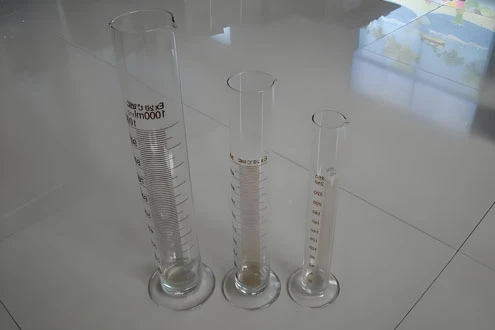
The science measuring cylinder, as an indispensable tool for measuring liquid volume in the laboratory, is exquisitely designed and has clear functions. It is usually made of transparent glass, a material that is not only strong and durable but also has good chemical stability and can resist the erosion of most chemical reagents. The shape of the graduated cylinder is a tall and narrow cylindrical. This design is not only convenient for handheld operation but also can effectively reduce the error caused by the surface tension of the liquid.
The bottom of the graduated cylinder is designed with wide feet to ensure stability and prevent it from toppling over when placed. The upper part is equipped with a tipping nozzle. This design enables smoother pouring of the liquid, reducing the residue and splashing of the liquid. The outer wall of the graduated cylinder is engraved with fine volume scales, which are usually measured in milliliters (mL) and gradually increase from the bottom, facilitating the experimenter to accurately read the volume of the liquid.
Specifications
|
|


Reading skills and error analysis
Reading skills: The core method to ensure precise measurement
1. Liquid level identification skills
Concave liquid surface and convex liquid surface
Transparent liquids (such as water, alcohol) : The liquid surface is concave. When reading, the lowest point of the concave liquid surface is taken as the standard (as shown in Figure 1).
Opaque liquids (such as mercury) : The liquid surface is convex. When reading, the highest point of the convex liquid surface is taken as the standard.
Turbid liquids (such as milk) : Master the best observation Angle through multiple practices, or use the contrast method (such as comparing with liquids of known volume).
Case illustration:
If 50 mL of water is measured, the line of sight should be level with the lowest point of the concave liquid surface. If it is misread as the midpoint of the liquid surface, it may lead to an error of ±0.5 mL (depending on the specification of the measuring cylinder).
2. Operate with line of sight level
Standard posture:
The graduated cylinder is placed on a horizontal table, with the eye, the scale line and the lowest point of the concave liquid surface in a straight line.
Training with a laser pen: Aim the laser beam at the scale line and the lowest point of the liquid surface, ensuring that the light aligns.
Comparison of error cases
| Error type |
Actual volume |
Reading result | Error |
| Look up (from below) | 80ml |
78ml |
-2ml |
| Looking down (from above) | 80ml |
82ml |
+2ml |
3. Estimation reading rules
Graduation value and estimation
Small-sized graduated cylinders (such as 10 mL) : The graduation value is 0.2 mL, no estimation is required (the reading is an integer or a multiple of 0.5, such as 7.0 mL, 7.5 mL).
Large-sized graduated cylinders (such as 100 mL) : The graduation value is 1 mL, and it should be estimated to 0.1 mL (if the liquid level is between 80 and 81 mL, it should be estimated to 80.5 mL).
Example:
If a 100 mL graduated cylinder is used to measure a liquid and the liquid level is close to 80 mL but less than 81 mL, it can be estimated as 80.3 mL or 80.7 mL (depending on the specific position of the liquid level).
4. Special circumstances handling
Volatile liquids (such as ethanol) :
Operate quickly and cover to reduce evaporation loss.
Take the reading immediately after measuring 50 mL of ethanol to avoid volume reduction due to evaporation.
High-viscosity liquids (such as glycerol) :
The measuring cylinder can be preheated with warm water to reduce the viscosity before measurement.
Preheating the measuring cylinder to 30℃ before measuring glycerol can reduce the residue on the wall.
 |
 |
 |
Error analysis: Key Strategies for identifying and controlling errors
1. Error types and sources
Systematic error
Measuring cylinder manufacturing error: inaccurate scale or deformation of the measuring cylinder.
Temperature influence: The volume of a liquid varies with temperature (for example, water has the greatest density and the smallest volume at 4℃).
Control method: Regularly calibrate the graduated cylinder and control the experimental temperature (such as in a standard environment of 20℃).
Random error
Reading deviation: Uneven line of sight or liquid level fluctuation.
Liquid residue: Wall adhesion or residue on the inner wall leads to a smaller volume measurement.
Control method: Standardize the reading posture and take the average of multiple measurements.
Human error
Improper operation: Excessive pouring speed causes fluctuations in the liquid level.
Control method: Pour the liquid slowly and switch to a dropper when approaching the target scale.
2. Error Calculation and Examples
Absolute error and relative error:
Absolute error: The difference between the measured value and the true value (for example, if the true value is 80 mL and the measured value is 78 mL, the absolute error is -2 mL).
Relative error: The ratio of absolute error to the true value (e.g. -2 mL / 80 mL = -2.5%).
Example:
When measuring 80 mL of water with a 100 mL graduated cylinder, if the reading is 78 mL due to looking up, the absolute error is -2 mL and the relative error is -2.5%.
3. Error control strategy
Select the appropriate graduated cylinder:
Avoid multiple measurements. (If 150 mL of liquid needs to be measured, a 250 mL graduated cylinder should be chosen instead of using a 100 mL graduated cylinder twice.)
Standardize the operating procedures:
Clean the graduated cylinder, pour slowly, let the liquid surface stand still, and keep your line of sight level.
Environmental control
Avoid fluctuations in the liquid level caused by air flow or vibration.
Data correction:
Correct the graduated cylinder with known systematic errors (such as calibrating the scale by the weighing method).
4. Common Error cases
Case 1: Wall residue
Phenomenon: After measuring 50 mL of concentrated sulfuric acid, there was residue on the inner wall, resulting in insufficient actual output.
Error: May be reduced by 0.5 to 1 mL (depending on the viscosity of the liquid).
Solution: Rinse the measuring cylinder 2 to 3 times with a small amount of solvent and transfer the remaining liquid along with it.
Case 2: Temperature Influence
Phenomenon: When measuring hot water (80℃) with a graduated cylinder at room temperature (25℃), the volume reading is larger due to thermal expansion.
Error: The volume of water expands by approximately 2.1% at 80℃ compared to that at 20℃. If 100 mL is measured, the actual volume might be 102.1 mL.
Solution: Use a graduated cylinder that matches the liquid temperature or calibrate the temperature of the graduated cylinder.
Summary and Suggestions
Core principle
Accurate liquid level identification, level line of sight, reasonable estimation and reading, and standardized operation.
01
Skill Enhancement
Master the skills of identifying concave liquid surfaces and keeping the line of sight level through repeated practice, and use a laser pointer to assist in training.
02
Error control
Select the appropriate graduated cylinder, standardize the operation process, control the experimental environment, and correct the known errors.
03
Safety awareness
When handling corrosive or toxic liquids, it is necessary to operate in a fume hood and wear protective equipment.
04
The reading skills and error analysis of science measuring cylinders are the basis for the accuracy of experimental data. Through systematic training and standardized operation, errors can be significantly reduced, providing reliable support for scientific research.
Evaluation methods for quantitative training
To scientifically evaluate the effect of science measuring cylinder quantitative training, it is necessary to establish a systematic evaluation system, covering three major dimensions: skill mastery, error control ability, and operation standardization. The training results should be verified through quantitative indicators, comparative experiments, and long-term tracking. The following is the specific assessment plan:
Evaluation Dimensions and Indicator Design
Core indicators:
Reading accuracy rate: The deviation range between the actual reading and the standard value (for example, an error of ≤±0.05 mL is considered excellent).
Proficiency in operation: The time required to complete standard operations (such as measuring 10 mL of liquid) (e.g., ≤30 seconds is considered qualified).
Test method:
Randomly select 10 individual accumulation points (such as 2 mL, 5 mL, 8 mL, etc.), record the readings of the experimenter and the operation time, and calculate the average error and time consumption.
Core indicators:
Residual liquid error correction rate: The deviation between the actual volume and the target volume after correction by the rinsing method or the residual liquid formula.
Temperature error correction rate: After correction based on the temperature compensation table, whether the volume error is within the allowable range (such as ±0.02 mL).
Test method:
Design a comparative experiment:
Group 1: The residual liquid and temperature error were not corrected;
Group 2: Correct the residual liquid and temperature errors;
Compare the average errors of the two groups of experiments.
Core indicators:
The implementation rate of the "Three Levels" principle: The proportion of times when the measuring cylinder is placed flat, the line of sight is level, and the liquid surface is calm.
Point alignment accuracy: The accuracy of alignment between the lowest point of a concave liquid surface or the highest point of a convex liquid surface.
Test method:
Through video playback or on-site observation, record whether the experimenter's operation complies with the norms and calculate the compliance rate.
Evaluation tools and processes
1. Evaluation tool
Electronic graduated cylinder: Real-time display of readings and record of errors, automatically generating data reports.
Intelligent reading software: It captures the liquid surface image through the camera, automatically identifies the cutting point and calculates the error.
Scoring sheet:
|
Evaluation dimension |
Indicator |
Scoring Criteria (Example) |
|
Reading accuracy rate |
Average error (mL) |
≤0.05 mL (5 points), 0.05-0.1 mL (3 points) |
|
Residual liquid correction rate |
Corrected error (%) |
≤5% (5 points), 5-10% (3 points) |
|
The implementation rate of the "Three Equal" principle |
Proportion of times reaching the standard (%) |
≥90% (5 points), 80-90% (3 points) |
2. Evaluation process
Phase 1: Pre-training test, record the initial level of the experimenter.
Phase 2: Quantitative training (such as step-by-step injection method, laser-assisted calibration).
Phase 3: Post-training testing to compare the changes in indicators before and after training.
Phase 4: Long-term tracking (such as a retest after one month) to verify the skill retention status.
Analysis and improvement of evaluation results
1. Data comparison
Example:
|
Experimenter |
Mean error before training (mL) |
Average error after training (mL) |
Improvement rate (%) |
| A |
0.12 |
0.04 | 66.7 |
| B | 0.09 | 0.02 | 77.8 |
2. Problem diagnosis
If the correction rate of the residual liquid is still low, it may be necessary to strengthen the training of the rinsing method.
If the temperature error correction rate is insufficient, it is necessary to increase the practice of using the temperature compensation meter.
3. Improvement plan
For weak points: Conduct specialized refresher training for experimenters with large errors (such as residual liquid correction and intensification training).
Optimization tool: Upgrade to an electronic graduated cylinder or an intelligent reading system to reduce human error.
Summary and Recommendation

Core of the evaluation system
Focus on quantitative indicators (such as error, time consumption, and compliance rate), and avoid subjective evaluations.
Combine comparative experiments with long-term tracking to ensure the reliability of the assessment results.

Recommended tools
Basic assessment: Scoring sheet + electronic graduated cylinder (low cost, suitable for routine laboratory assessment).
High-precision assessment: Intelligent reading system + constant temperature water bath (suitable for research-level experiments).
Improvement objective
Through quantitative training, the reading error of the graduated cylinder is controlled within ±0.05 mL (within the accuracy range of grade A graduated cylinder).
The compliance rate of operational standardization has been raised to over 90%.
Through the above evaluation system, the effect of science measuring cylinder quantification training can be scientifically and objectively measured, and data support can be provided for subsequent improvements.
Hot Tags: science measuring cylinder, China science measuring cylinder manufacturers, suppliers, factory, Glass Lab Reactor, Glass Reactor Laboratory, PPL Lined Hydrothermal Autoclave, 50l Rotovap, Hydrothermal Reactor Autoclave, Short Path Distillation
Previous
Graduated Cylinder With ValveSend Inquiry


