



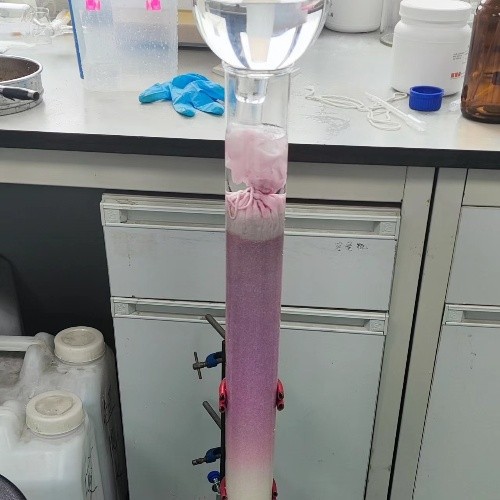


Plastic Chromatography Column
2.Chromatographic Column (Rotation Type)
3.Chromatographic Column (Manual)
***Price List for whole above, inquire us to get
Description
Technical Parameters
Plastic chromatography column is a common tool in the field of chemical analysis, is the core component of liquid chromatography, its working principle is mainly based on the distribution of components in the sample between the fixed phase and the mobile phase balance. When the sample solution passes through the chromatographic column, the residence time of different components in the column is different due to the different interaction force with the stationary phase, so as to achieve the separation of components. As a new chromatographic separation technology, plastic column has been widely used in many fields. However, it is necessary to pay attention to its limitations such as pressure resistance and temperature sensitivity when selecting and using, and make reasonable selection and maintenance according to the sample type and operating conditions.
Parameter


Different from glass chromatography columns
There are significant differences between plastic and glass columns in several aspects, and the following is a detailed analysis of these differences:
Material and characteristics
Plastic column:
Material: Mostly polymer materials, such as polyamide, polypropylene, polyurethane and so on.
Characteristics: It has excellent physical and chemical properties and mechanical properties, so that the plastic column has high selectivity, separation and good mechanical strength. In the preparation process, the plastic chromatographic column is coated with a special macromolecular film, which enhances the selectivity and stability of the column.
Glass column:
Material: Glass is used as material.
Features: Excellent high temperature resistance, acid and alkali resistance and stability. Its smooth surface is not easy to be affected by oxidation, corrosion, etc., which makes it widely used in various liquid chromatography.
Corrosion resistance
Plastic column:
Poor corrosion resistance, generally only suitable for neutral or weakly acidic solution analysis.
It is not corrosion resistant to strong acid, strong alkali and organic solvent, and is easy to be corroded and deformed.
Glass column:
Good corrosion resistance, can adapt to a variety of different analytical conditions.
It can be used for analysis under high temperature and high pressure conditions, and has a wider application range.
Selectivity
Plastic column:
It has high selectivity.
For example, the polyamide column is suitable for the separation of acid and alkaline substances, and the polyamide column containing siloxane can be used for weakly polar compounds.
Glass column:
The selectivity is relatively low.
It is commonly used in the separation of neutral substances or polar compounds.
Cost and durability
Plastic column:
The production cost is low, so the price is relatively cheap.
Poor durability, easy to be corroded by chemical agents, affecting the accuracy and stability of the analysis results.
Glass column:
The manufacturing cost is high and the price is relatively expensive.
It has good durability and long service life, but needs careful operation to avoid breakage.
Application Scenarios
Plastic column:
It is suitable for low-cost, high-volume analysis scenarios.
It has been widely used in drug analysis, environmental monitoring, food detection and other fields.
Glass column:
It has been widely used in organic synthesis, environmental monitoring and other fields.
Due to its high corrosion resistance and stability, it can provide accurate analysis results.
To sum up, there are significant differences between plastic and glass columns in terms of material, corrosion resistance, selectivity, cost and durability, and application scenarios. Therefore, when performing chromatographic analysis, it is necessary to select a column that matches the characteristics of the sample according to the specific analytical needs.
Advantage
Strong chemical resistance
Plastic materials usually have good resistance to a variety of chemicals and are not easily corroded by acids, alkalis or organic solvents. This allows the plastic column to maintain stable performance in complex and demanding chemical environments.
01
Lightweight and portability
Plastic chromatography column is usually lighter than glass or metal columns, making them easier to carry and transport. This is an important advantage for users who need to move frequently or perform analytics work in different locations.
02
Cost effectiveness
The production cost of plastic materials is relatively low, so the price of plastic columns is usually more economical than those of traditional materials such as glass or stainless steel. This reduces the operating costs of the laboratory, making high-quality chromatography affordable for more users.
03
Diverse options
By changing the composition or structure of the plastic, columns with different selectivity and separation properties can be prepared. This allows plastic columns to be adapted for many different types of samples and analytical needs.
04
Easy to process and customize
Plastic materials are easy to process into a variety of shapes and sizes, making it easy to customize columns to meet specific analytical needs. This flexibility provides users with more choices and possibilities.
05
Environmental friendliness
Many plastic materials are recyclable and have relatively little impact on the environment during production and use. This makes plastic columns more popular in laboratories pursuing green chemistry and sustainability.
06
Reduce rupture risk
Compared to glass columns, plastic columns are less likely to break during transportation and use, reducing the risk of laboratory accidents. This is of great significance to ensure the safety of laboratory personnel and reduce equipment damage.
07
Improve analysis efficiency
Plastic columns usually have a faster separation speed and higher separation efficiency, which makes the analysis process more rapid and accurate. This is especially important for use cases where analysis results need to be obtained quickly.
08
In summary, plastic chromatographic columns play an increasingly important role in the field of analytical chemistry due to their strong chemical resistance, lightweight and portability, cost effectiveness, diversified selectivity, ease of processing and customization, environmental friendliness, reduction of rupture risk and improvement of analytical efficiency.
Personnel safety protection
When using plastic chromatography column for experiments, personnel safety protection is crucial, which is not only related to the physical health of the experimental personnel, but also the basis for ensuring the smooth conduct of the experiment and the accuracy of the results. The following is a detailed set of personal safety guidelines designed to help experimentalists protect themselves when working with plastic columns.
Understand the experimental material and risk

Familiar with experimental substances
Before starting the experiment, it is important to familiarize yourself with key information such as the nature, toxicity, flammability and explosiveness of the mobile phase, sample and other chemical substances used.
Consult the relevant safety data Sheet (SDS) to understand the hazard level of the substance, first aid measures, protection methods, etc.
Assess the risk
Assess potential risks, such as chemical burns, inhalation of toxic gases, fire or explosion, depending on the nature of the experimental substance.
Develop appropriate risk prevention and control measures, such as the use of explosion-proof equipment, fume hoods, personal protective equipment, etc.

Use of personal protective equipment
Lab coat
Wear a clean, suitable lab coat to prevent chemicals from splashing on the skin or contaminating clothing.
The lab coat should be cleaned regularly and kept clean.
Gloves
Select suitable gloves according to the nature of the experimental material, such as latex gloves, nitrile gloves, etc.
Gloves should be checked regularly and replaced immediately if damaged.
Goggles
Wear proper goggles to prevent chemicals from splashing into your eyes.
Goggles should be kept clean and free of scratches.
Respiratory protection
If the experiment involves toxic gases or volatile substances, wear appropriate respiratory protective equipment, such as a gas mask or respirator.
Ensure that respiratory protective equipment is regularly tested and maintained to maintain its effectiveness.
Laboratory environment control
Use of fume hoods
When operating plastic chromatography column, it should be done in the fume hood as much as possible to reduce exposure to harmful substances.
Ensure that the ventilation system of the fume hood is working properly without blockage or leakage.
Laboratory cleaning
Keep the laboratory clean, avoid debris accumulation, and ensure that emergency evacuation routes are clear.
Regularly clean laboratory equipment and floors to reduce chemical residues.
Safety operation procedures

Follow the operating procedures
Conduct experiments in strict accordance with laboratory safety operating procedures to avoid accidents caused by illegal operations.
Before operation, read and understand the experimental procedures and precautions carefully.

Use explosion-proof equipment
When using flammable and explosive substances, explosion-proof appliances and equipment, such as explosion-proof lights and explosion-proof switches, should be used.
Ensure that the electrical equipment in the laboratory is well grounded to avoid explosion caused by electrostatic sparks.

Emergency response measures
Be familiar with the emergency evacuation route and the use of fire extinguishing equipment in the laboratory.
Set up a first aid kit in the laboratory, and regularly check whether the first aid items are complete and effective.
Training and supervision
Conduct regular safety training for experimental personnel to improve their safety awareness and emergency handling ability.
The training covers chemical safety, the use of personal protective equipment, and the operation of laboratory equipment.
Laboratory management shall regularly monitor and check the operation of laboratory personnel to ensure that they comply with safety procedures.
Promptly correct and punish violations of safety procedures to make an example of others.
In summary, when using plastic chromatography column, the experimentor should understand the experimental substances and risks, the use of personal protective equipment, laboratory environmental control, safe operating procedures, training and supervision and other aspects of safety protection. By strictly adhering to these safety guidelines, experimentalists can minimize risks during experiments and ensure their own safety and the accuracy of experimental results.
Development trend
With the advancement of materials science, the packing materials for plastic chromatographic columns will continue to be innovated. New materials such as nanomaterials and composite materials may be applied in the preparation of chromatographic columns to enhance their separation efficiency and stability. Meanwhile, the further reduction and homogenization of the particle size of the packing material is also an important direction for future development, which is conducive to improving the resolution and separation speed of the chromatographic column. In addition, plastic materials with high heat resistance and high strength will be more widely used in plastic chromatographic columns to meet the market demand for higher-quality products.
The preparation process of plastic chromatographic columns will be continuously optimized to enhance the filling density and uniformity of the packing material, reduce dead volume and vortex diffusion, and thereby improve the separation performance of the chromatographic column. The application of automation and intelligent technologies in the preparation of chromatographic columns will also gradually increase to enhance production efficiency and product quality. For instance, by introducing advanced manufacturing processes such as precision injection molding and laser cutting, the production efficiency and quality of plastic chromatographic columns will be significantly enhanced.
Biopharmaceuticals are one of the important application fields of plastic chromatographic columns. With the continuous increase in global investment in biological research and development and the continuous expansion of the biopharmaceutical market, the demand for plastic chromatographic columns will continue to grow. In particular, the rapid development of downstream biopharmaceutical markets such as antibodies, vaccines, and recombinant proteins will drive the rapid growth of the biopharmaceutical plastic chromatographic column market. In addition, the demand for plastic chromatographic columns in the fields of food safety and environmental monitoring is also constantly increasing. As people pay more and more attention to food safety and environmental protection, relevant detection technologies and standards will also be continuously improved, thereby promoting the development of the plastic chromatographic column market. The field of scientific research and teaching is also an important application area for plastic chromatographic columns. With the continuous deepening of scientific research activities and the improvement of teaching levels, the demand for plastic chromatographic columns will also continue to grow.
The implementation of environmental protection policies has prompted enterprises to pay more attention to the sustainability and recycling capacity of their products, promoting the application of biodegradable materials in the field of plastic chromatographic columns. In the future, the plastic chromatographic column industry will pay more attention to green production and sustainable development. By adopting environmentally friendly materials and optimizing production processes, the impact on the environment will be reduced.
Hot Tags: plastic chromatography column, China plastic chromatography column manufacturers, suppliers, factory, Rotary Distillation, Hydrothermal Reactor, Short Path Distillation System, Rotovap Distillation, Stainless Steel Chemical Reactor, Rotating Evaporator
Previous
Short Column ChromatographySend Inquiry


