



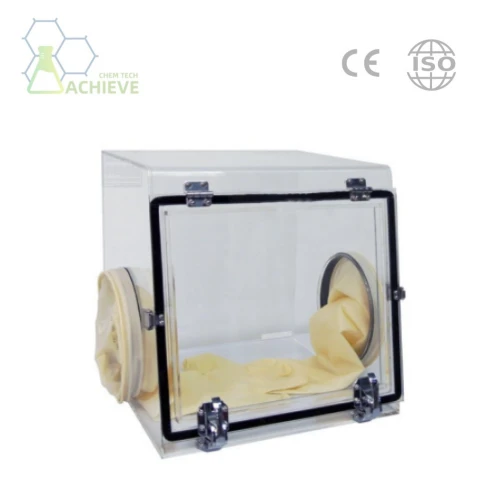

Laboratory Glove Box
1)Acrylic Type A glove box: No sample transfer window, must be take it out from the door.
2)Acrylic Type B glove box:There is a sample transfer window, which can protect the gas environment inside the box from being damaged by the outside world.
3)Acrylic Type C glove box:The air in the box can be extracted through the vacuum pump, and then through the high purity dry inert gas into the box, and reach the lower water oxygen content in the box.
2.Customization:
1)Single, double, multiple people and other different station boxes.
2)Different shapes, different structures, different applications, different thickness customization options.
3)Doors of different sizes can be opened on any side of the box to facilitate the entry and exit of equipment and accessories.
4)For other optional configurations, contact sales personnel.
***Price List for whole above, inquire us to get
Description
Technical Parameters
A laboratory glove box is a specialized enclosure designed to allow operators to manipulate materials within a controlled atmosphere while protecting both the operator and the materials from external contaminants. The operator's hands and forearms are placed in gloves attached to the box's exterior, enabling them to work inside with relative freedom while observing through a clear window.
The primary purpose of a glove box is protection or isolation, achieved through a physical barrier. Depending on the type, this barrier may serve to isolate sensitive materials from environmental contamination or to shield the operator from hazardous substances being manipulated inside.
Parameter
|
|
|||||||
| Acrylic Type A glove box | |||||||
| Specification | Operating box outside dimensions | Sheet thickness | Transition box | Material | Left-hand round door | Glove | Characteristic |
| GB01-A | 700*450*500 | 10(mm) | No | PMMA | 300(mm) | 2PCS | Non-transition box |
| GB02-A | 800*550*600 | 10(mm) | No | PMMA | 350(mm) | 2PCS | Non-transition box |
| GB03-A | 1000*500*500 | 10(mm) | No | PMMA | 300(mm) | 2PCS | Non-transition box |
| GB04-A | 1000*700*500 | 10(mm) | No | PMMA | 300(mm) | 2PCS | Non-transition box |
| GB05-A | 900*600*700 | 10(mm) | No | PMMA | 300(mm) | 2PCS | Non-transition box |
| GB06-A | 1000*600*700 | 10(mm) | No | PMMA | 300(mm) | 2PCS | Non-transition box |
| GB07-A | 1000*750*700 | 10(mm) | No | PMMA | 300(mm) | 2PCS | Non-transition box |
| GB08-A | 1200*600*600 | 10(mm) | No | PMMA | 300(mm) | 3PCS | Non-transition box |
| GB09-A | 1200*600*700 | 10(mm) | No | PMMA | 300(mm) | 3PCS | Non-transition box |
| GB10-A | 1200*800*600 | 10(mm) | No | PMMA | 300(mm) | 3PCS | Non-transition box |
| GB11-A | 1200*800*700 | 10(mm) | No | PMMA | 300(mm) | 3PCS | Non-transition box |
| GB12-A | 1094*640*645 | 10(mm) | No | PMMA | 400(mm) | 4PCS | Non-transition box |


| Acrylic Type B glove box | |||||||
| Specification | Operating box outside dimensions | Sheet thickness | Transition box | Material | Left-hand round door | Glove | Transition box size |
| GB01-B | 700*450*500 | 10(mm) | Yes | PMMA | 300(mm) | 2PCS | 240*240*240 |
| GB02-B | 800*550*600 | 10(mm) | Yes | PMMA | 350(mm) | 2PCS | 240*240*240 |
| GB03-B | 1000*500*500 | 10(mm) | Yes | PMMA | 300(mm) | 2PCS | 240*240*240 |
| GB04-B | 1000*700*500 | 10(mm) | Yes | PMMA | 300(mm) | 2PCS | 240*240*240 |
| GB05-B | 900*600*700 | 10(mm) | Yes | PMMA | 300(mm) | 2PCS | 240*240*240 |
| GB06-B | 1000*600*700 | 10(mm) | Yes | PMMA | 300(mm) | 2PCS | 240*240*240 |
| GB07-B | 1000*750*700 | 10(mm) | Yes | PMMA | 300(mm) | 2PCS | 240*240*240 |
| GB08-B | 1200*600*600 | 10(mm) | Yes | PMMA | 300(mm) | 3PCS | 240*240*240 |
| GB09-B | 1200*600*700 | 10(mm) | Yes | PMMA | 300(mm) | 3PCS | 240*240*240 |
| GB10-B | 1200*800*600 | 10(mm) | Yes | PMMA | 300(mm) | 3PCS | 240*240*240 |
| GB11-B | 1200*800*700 | 10(mm) | Yes | PMMA | 300(mm) | 3PCS | 240*240*240 |
| GB12-B | 1094*640*645 | 10(mm) | Yes | PMMA | 400(mm) | 4PCS | 240*240*240 |

| Acrylic Type C glove box | |||||||
| Specification | Operating box outside dimensions | Sheet thickness | Transition box | Material | Material | Glove | Transition box size |
| GB01-C | 700*450*500 | 20(mm) | Yes | PMMA | 300(mm) | 2PCS | 240*240*240 |
| GB02-C | 800*550*600 | 25(mm) | Yes | PMMA | 350(mm) | 2PCS | 240*240*240 |
| GB03-C | 1000*500*500 | 25(mm) | Yes | PMMA | 300(mm) | 2PCS | 240*240*240 |
| GB04-C | 1000*700*500 | 30(mm) | Yes | PMMA | 300(mm) | 2PCS | 240*240*240 |
| GB05-C | 900*600*700 | 30(mm) | Yes | PMMA | 300(mm) | 2PCS | 240*240*240 |
| GB06-C | 1000*600*700 | 30(mm) | Yes | PMMA | 300(mm) | 2PCS | 240*240*240 |
| GB07-C | 1000*750*700 | 30(mm) | Yes | PMMA | 300(mm) | 2PCS | 240*240*240 |
| GB08-C | 1200*600*600 | 30(mm) | Yes | PMMA | 300(mm) | 3PCS | 240*240*240 |
| GB09-C | 1200*600*700 | 30(mm) | Yes | PMMA | 300(mm) | 3PCS | 240*240*240 |
| GB10-C | 1200*800*600 | 30(mm) | Yes | PMMA | 300(mm) | 3PCS | 240*240*240 |
| GB11-C | 1200*800*700 | 30(mm) | Yes | PMMA | 300(mm) | 3PCS | 240*240*240 |
| GB12-C | 1094*640*645 | 30(mm) | Yes | PMMA | 400(mm) | 4PCS | 240*240*240 |
Types of Laboratory Glove Boxes
◆ Acrylic Type A glove box
Type A glove box can do simple isolation experiment, inert gas replacement experiment, dust proof test, ultraviolet test, drying experiment, etc., through the glove to operate the experimental samples inside the box. No sample transfer window, must be take it out from the door.
◆ Acrylic Type B glove box
The B-type glove box can do simple isolation experiment, inert gas replacement experiment, dust proof experiment, ultraviolet experiment, drying experiment, etc., and operate the experimental samples inside the box through gloves. There is a sample transfer window, which can protect the gas environment inside the box from being damaged by the outside world.
◆ Acrylic Type C glove box
Type C can vacuum glove box, on the basis of type A and type B still need to control the water oxygen content during the experiment, the air in the box can be extracted through the vacuum pump, and then into the high purity dry inert gas into the box, in order to achieve the lower water oxygen content in the box. The thickness of this type of acrylic sheet is 20mm-30mm and there is a transfer box.
Design and Construction
The design of a laboratory glove box is meticulously engineered to ensure both functionality and safety. Key components include:
|
◆ Glove Ports: These are the entry points for the operator's hands, allowing them to manipulate materials inside the box. The gloves are typically made of durable, impermeable materials to prevent contamination.
◆ Viewing Windows: Clear, transparent windows made of materials like acrylic or glass allow the operator to observe the interior without compromising the controlled atmosphere.
◆ Gas Inlet and Outlet Ports: These ports facilitate the introduction and removal of gases, enabling the maintenance of a specific atmosphere inside the box. |
|
|
|
◆ Sealing Mechanisms: Tight-fitting seals around the glove ports and viewing windows prevent leaks, ensuring the integrity of the controlled environment.
◆ Pressure Control Systems: Advanced models include pressure control systems to maintain a constant internal pressure, preventing the ingress of contaminants. |


Applications in Scientific Research
Laboratory glove boxes play a pivotal role in various scientific disciplines, enabling research that would otherwise be impossible or impractical. Some key applications include:
◆ Materials Science:
In materials science, glove boxes are used to study the properties and behavior of materials in controlled environments. This includes research on the effects of oxygen, moisture, and other contaminants on materials' performance.
◆ Pharmaceutical Research:
Pharmaceutical researchers rely on glove boxes to handle sensitive drugs and chemicals under controlled conditions. This ensures the purity and stability of the compounds, enabling the development of effective medications.
◆ Biological Research:
In biological research, sterile conditions are crucial to prevent contamination and ensure accurate results. Glove boxes with HEPA filters provide the necessary cleanliness, enabling experiments on cells, tissues, and microorganisms.
◆ Nanotechnology:
Nanotechnology research often involves handling tiny particles that are highly reactive and sensitive to their environment. Glove boxes offer a controlled atmosphere to prevent contamination and ensure the accuracy of experiments.
◆ Electronics Manufacturing:
In the electronics industry, glove boxes are used to assemble and test sensitive components in a clean, dust-free environment. This prevents contamination and ensures the reliability of electronic devices.
◆ Radioactive Material Handling:
Handling radioactive materials requires extreme caution to protect both the operator and the environment. Glove boxes provide a safe, controlled environment for these operations, minimizing the risk of exposure.
Benefits of Using Laboratory Glove Boxes
The use of laboratory glove boxes offers numerous benefits, including:
|
◆ Contamination Control: By isolating materials from the external environment, glove boxes prevent contamination, ensuring the purity and integrity of samples.
◆ Operator Safety: Glove boxes protect operators from exposure to hazardous materials, reducing the risk of injuries and illnesses.
◆ Accuracy and Reliability: Controlled environments enable more accurate and reliable experimental results, enhancing the quality of scientific research.
◆ Flexibility and Adaptability: Different types of glove boxes cater to a wide range of research needs, offering flexibility and adaptability for various applications.
◆ Cost-Effective: While glove boxes may have a significant upfront cost, their ability to prevent contamination and ensure operator safety can lead to significant savings in the long run by reducing waste and rework. |
|

Conclusion
Laboratory glove boxes are indispensable tools in scientific research, enabling researchers to conduct experiments in controlled environments that would otherwise be impossible or impractical. Their ability to prevent contamination, protect operators, and ensure the accuracy and reliability of experimental results makes them invaluable assets in various scientific disciplines.
While they present some challenges and limitations, the benefits of using glove boxes far outweigh these concerns. As technology continues to advance, we can expect to see further improvements in glove box design and functionality, enhancing their capabilities and making them even more valuable to the scientific community.
Laboratory glove boxes are a critical component of modern scientific research, enabling researchers to push the boundaries of knowledge and discovery. Their importance cannot be overstated, and their continued development and improvement will undoubtedly play a pivotal role in the future of scientific exploration.
Hot Tags: laboratory glove box, China laboratory glove box manufacturers, suppliers, factory, Rotovap Distillation, Hydrothermal Reactor, Hydrothermal Autoclave Reactor, 20l Rotary Evaporator, Teflon Lined Autoclave, 10l Glass Reactor
Previous
Stainless Steel Glove BoxSend Inquiry


